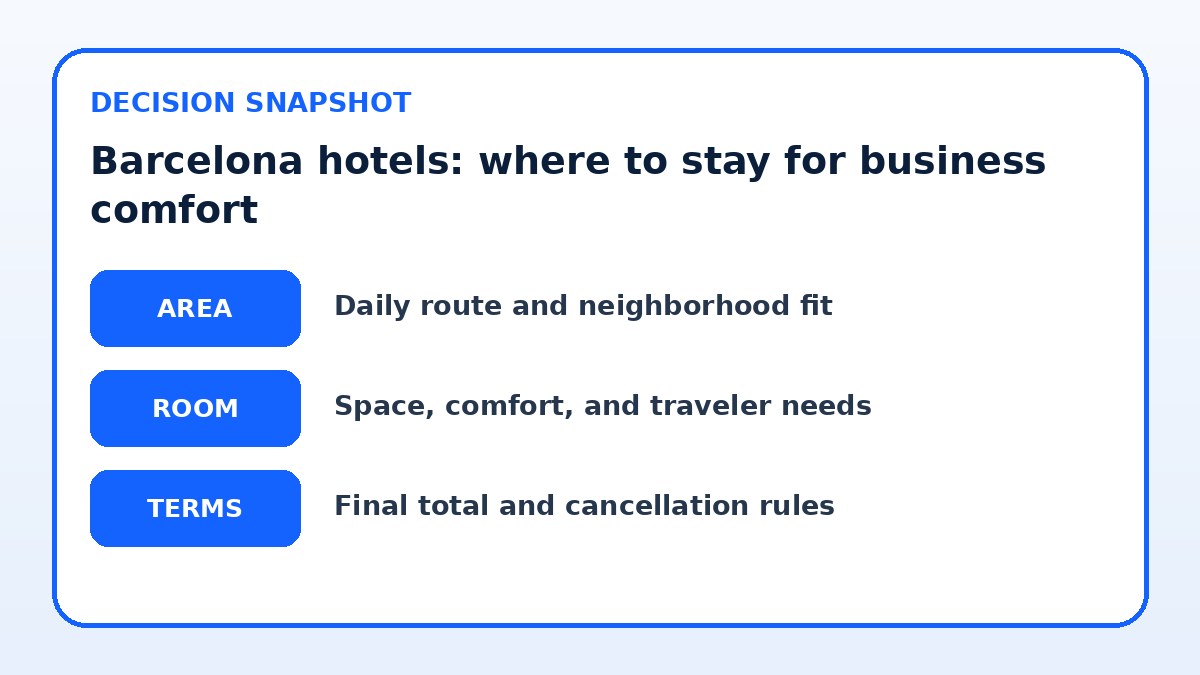
Pick the neighborhood first, then refine room specs. For a short business trip to Barcelona, the biggest time sink is daily routing: transfers, local traffic, and late-night logistics. If your schedule includes morning meetings, evening client dinners, or a conference center, choosing a neighborhood that minimizes transit friction will save both time and stress. But location alone won’t fix a noisy street-facing room, weak work surfaces, or poor lighting for video calls. This guide helps you choose an area that fits your typical day, then decide which room features matter most so your stay supports productivity. Read on to narrow to a shortlist of areas before you pull up live hotel inventory, and to know exactly what to verify on any booking page.

Check live stays in the areas that fit
Use your dates and party size to compare current rooms after you narrow the neighborhood fit.
Neighborhood fit: match area to your itinerary
Decide where to stay by mapping three to five addresses you’ll visit most: offices, clients, conference venues, and key transport nodes. In Barcelona, common business hubs include the Fira trade fair area, the Diagonal corporate corridor, and districts around Passeig de Gràcia for headquarters and law firms. If your meetings cluster in one area, prioritize walkable distance or a single direct metro line to cut transfers. If your schedule is spread across the city, pick a central node with good cross-city connections rather than a peripheral spot near a single venue.
Also weigh evenings and weekends into the fit. If you'll be meeting clients for dinner in Eixample or entertaining at beachfront restaurants, staying nearby reduces taxi time and complexity. For early starts or late-night flights, consider proximity to the airport train or major taxi routes. Finally, note any local events that may affect transit routes during your dates — confirm on venue or local authority pages rather than assuming typical patterns.
Choose an area-selection strategy
| Area approach | Best for | Tradeoff to check |
|---|---|---|
| Stay next to your main meeting hub | Minimal commute for clustered meetings | Limited access to other city areas and fewer dining options nearby after hours |
| Choose a central transport node (city center) | Balanced access to multiple districts | Possible higher street noise and premium room rates in central areas |
| Stay near the conference or trade fair venue | Convenience during multi-day events | Crowding, event-related surcharges, and less character for client dinners |
| Pick a quieter residential neighborhood | Nighttime rest and less noise | Longer transfers to meetings and fewer late-night transport options |
Daily-route friction: time saved by small choices
Estimate the door-to-door time between typical points: hotel to meeting, meeting to lunch, and hotel to evening venue. In many European cities, a 10–15 minute difference per trip compounds across multiple meetings, turning a manageable day into a rushed one. Look for hotels near metro lines with few transfers to your main destinations and near convenient taxi stands for late returns. If you’ll rely on ride-hailing, confirm that pickup locations are practical for the hotel and not on a narrow pedestrian street where cars struggle to stop.
Consider the time of day you travel. Barcelona’s peak tram and metro hours can affect reliability; if you need to travel during rush hour, a short walk to a mainline station may be worth more than a quieter, peripheral street. For business travelers carrying luggage or samples, prioritize ground-floor access, elevators, and short hotel-to-station walks. Before booking, check the hotel’s directions and ask the property about typical taxi wait times and recommended routes for evening travel.
Now compare like with like
Keep the same dates, guests, room needs, and cancellation preferences while you compare the final choices.
Room and party needs: what to demand for productivity
Once you have a neighborhood, decide the room features that let you work. A clear priorities list helps: a dedicated desk with accessible power outlets, adjustable lighting for video calls, reliable high-speed internet (ask whether wired Ethernet is available), and soundproofing to block street and hallway noise. If you require privacy for calls, request a room on a higher floor away from elevators and service areas. If traveling with a colleague, consider a two-room suite or adjoining rooms so both of you can work without interruption.
Beyond work furniture, check bed comfort and blackout options because good rest supports performance. If you need to store samples, confirm available secure storage or a mini-fridge for medications. For longer stays, an in-room kettle or coffee maker and laundry options matter. When you contact the hotel to confirm, ask specifics about Wi‑Fi speed guarantees, whether the desk has a lamp and multiple plugs, and which floors are quieter — keep notes to compare across shortlisted properties.

Hotel booking check before payment
- Map all meeting and event addresses, then choose three neighborhoods that minimize total daily transfer time.
- Contact shortlisted hotels to confirm Wi‑Fi type (wired or wireless), expected speeds, and availability of a dedicated desk.
- Ask each property which room categories are on quieter floors and request one specifically at booking.
- Verify cancellation, invoice, and corporate billing policies on the hotel’s official booking page before payment.
- Confirm practical last-mile logistics: nearest metro line, taxi stand location, and recommended pickup spots for ride-hailing.
- Note check-in and check-out windows and request early check-in or late check-out in writing if you need them.
Final booking terms: verify before you commit
Treat the booking page as the final factsheet. Verify cancellation and change terms, whether corporate invoicing is supported, and what ID or credit card policies apply at check-in. Confirm whether breakfast is included if mornings matter, and whether early check-in or late check-out is offered — properties vary and these services can be essential for flights that arrive early or meetings that finish late. If you need VAT invoices or company billing, ask how those are handled and what documentation the hotel requires.
Double-check operational details that affect your plan: the hotel’s stated Wi‑Fi type (paid vs. complimentary, wired vs. wireless), shuttle or airport transfer options, and any guest restrictions that could affect late-night guests or visitors. If you plan to compare live inventory, Trip.com can be used once to compare current availability and terms, but always confirm the policy details, room size, floor, and noise exposure on the hotel’s own booking or corporate booking page before final payment.
Hotel Guide questions travelers ask
Which Barcelona neighborhood is best if I have meetings across the city?
If your meetings are spread across Barcelona, choose a central neighborhood with strong transport links. Areas around Passeig de Gràcia or Eixample offer multiple metro lines and tram connections that reduce transfers. A central base lowers average travel time to disparate locations and simplifies evening logistics. Before booking, confirm the hotel’s walking distance to the nearest metro station and whether the route includes many stairs or a long walk; these details can make a short trip significantly more convenient when you’re moving between several appointments in one day.
How can I ensure my hotel room will be quiet enough for video calls?
Ask the hotel which floors are quieter and request a room away from elevators, service corridors, and street-facing facades. Specify you need a quiet room for calls and ask whether windows are double-glazed or if the property offers rooms with soundproofing. Request confirmation in writing and, if possible, ask for a room number type or floor. On arrival, test sound levels during a short call; if noise interferes, ask the front desk to move you or provide a quieter alternative before accepting the room for your stay.
What room features should I prioritize for a two-night business trip?
For a short business stay prioritise a comfortable bed, blackout curtains, and a reliable workspace with multiple power outlets and good lighting. Complement that with dependable Wi‑Fi (ask whether wired Ethernet is available), an accessible power adaptor if needed, and an on-site option for quick meals if time is tight. If you expect late meetings, check the hotel’s food service hours and nearby evening dining options. Confirm these specifics on the hotel’s booking page or by contacting the property so you don’t rely on marketing descriptions alone.
Final decision note
Balance location and room comfort by starting with your daily map: where you must be and when. Choose a neighborhood that reduces repeat transfers, then use a short checklist to evaluate rooms for work: quiet placement, a practical desk, multiple outlets, and reliable internet. Confirm cancellation and billing terms on the hotel’s official page, and ask for quiet-room placement and any early check-in needs in writing. With a focused shortlist of areas and clear room priorities, you’ll be ready to open live inventory and compare specific properties quickly and confidently.
Continue planning
Check current options and final conditions
Use the provider page to confirm live availability, the final total, cancellation terms, and every condition that matters to your trip.
This evergreen planning guide was created with AI-assisted drafting and a structured quality review. It does not display live prices, schedules, availability, visa guidance, or provider rankings. Verify current details before booking. Some links are affiliate links; we may earn a commission at no additional cost to you.