
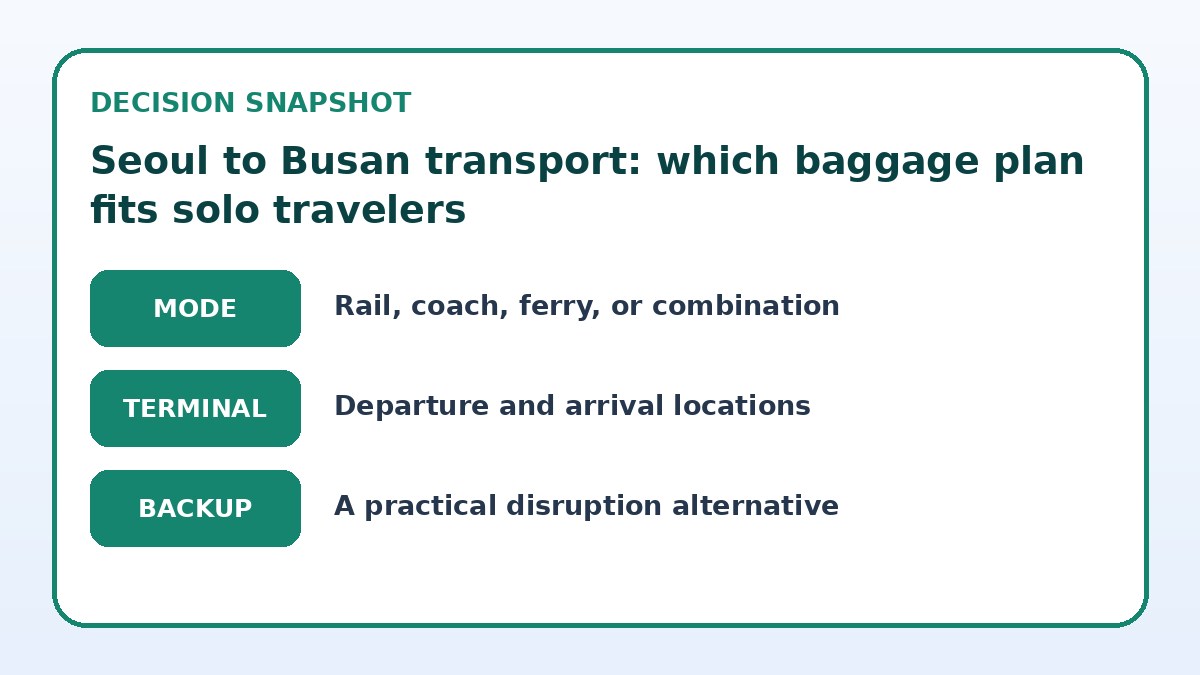
If you’re a solo traveler planning Seoul to Busan transport with luggage, start by deciding how much you’ll carry and how you want to move it. The simplest practical answer: choose the fastest direct train option for ease of transfers if you have manageable luggage, or split the journey—use rail for yourself and a luggage-forward service or station lockers for bulky bags. That puts you in control of time, cost, and physical effort. The rest of this article helps you weigh tradeoffs—comfort vs. speed, cost vs. convenience, and risks with door-to-door luggage services—so you can pick an approach that fits your mobility, schedule, and tolerance for extra planning.
Which transport options suit solo travelers with luggage
Trains are the most common and often most comfortable choice for Seoul to Busan transport for solo travelers. They reduce the amount of road handling, let you sit with your bag or stow it nearby, and typically run between major stations in both cities. For gently packed travelers a direct train avoids extra transfers: you board once, keep sight of your luggage, and get off at your destination. If your luggage is small and you prefer simplicity, prioritize routes that minimize platform changes and avoid busy interchanges.
If your bags are heavy, bulky, or numerous, look beyond a single-vehicle mindset. Combining a train for yourself with a luggage-forward service, station luggage storage, or a short taxi leg can cut the physical burden and reduce transfer stress. Each approach adds steps: booking a separate luggage delivery requires lead time and a pick-up/drop-off plan, while station lockers work well for short visits but aren’t suitable for all items. Think about what you’ll do on arrival—walking to a guesthouse up stairs, handling last-mile transport, and whether you need access to valuables during transit.
Packing and equipment choices that make transit easier
Choose luggage that matches the mode you plan to use. A wheeled suitcase with durable wheels and a telescoping handle is ideal for station-to-station travel; a backpack with a hip belt is better for uneven streets and stairs. If you expect to lift your bag onto overhead racks, practice lifting technique and keep heavy items low and centered. Use packing cubes to separate essentials—documents, a change of clothes, chargers—so you can access them without unzipping the whole bag during brief transfers.
Bring a small daypack for valuables and items you’ll need on the train—water, snacks, phone charger, and any medication. If you’ll be carrying the bag on public transport to and from stations, add a lightweight rain cover and sturdy straps. For fragile or oddly shaped items, consider protective sleeves or a soft bag that compresses into overhead space. Always label luggage clearly with a destination address and your contact details, and keep a copy of reservation or delivery receipts with you when using third-party luggage services.
| Approach | Best for | Tradeoff to check |
|---|---|---|
| Direct train with your luggage | Travelers who can lift and prefer a single boarding and arrival | May require lifting bags on stairs or into overhead racks during busy periods |
| Train for yourself + luggage delivery service | Travelers with heavy or multiple bags who want hands-free movement | Adds coordination and dependency on pickup/drop-off windows |
| Station lockers for short stops | Day trips or short layovers where you only need to stow items temporarily | Size limits and unsuitability for valuables or long-term storage |
| Taxi or ride-hail door-to-door | Those prioritizing minimal handling and direct transfer to accommodation | Higher cost and potential for traffic delays compared with rail |
Comparing convenience: direct ride, split transport, or luggage services
A direct rail ride places you and your luggage on the same vehicle; convenience is high if you can store bags near your seat and prefer minimizing coordination. However, if platforms are crowded or stations involve stairs and long corridors, lifting and carrying might reduce comfort. Evaluate the stations at both ends: how many transfers, distance from platform to exit, and last-mile options to your accommodation. That assessment helps decide whether a door-to-door approach is worth the extra cost or effort.
Sending luggage ahead or using a pickup-and-deliver service reduces the physical load and can let you travel light on the train, but it introduces scheduling dependency and an extra handoff. Station lockers are a middle ground for short waits—quick and often inexpensive, but they have size and access limits and aren’t good for valuables. When comparing these approaches, check lead times, secure handling assurances, and pickup/drop-off locations. Always verify service terms and any restrictions by reading the provider’s booking details before committing.
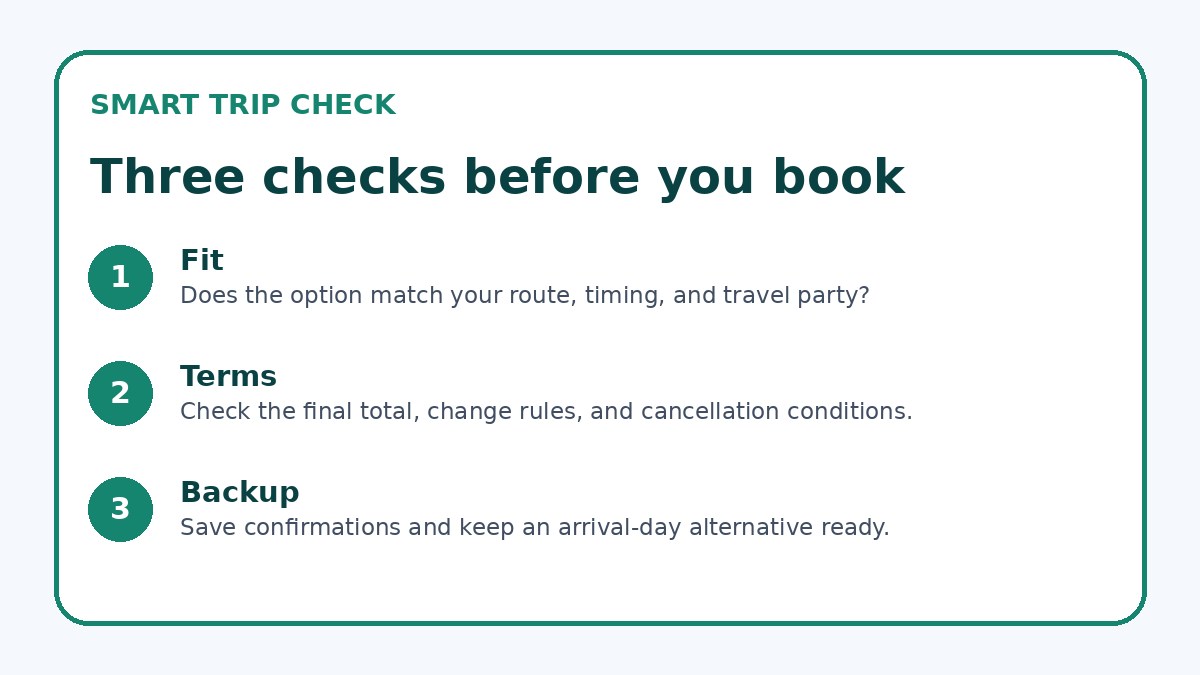
Before you book
- Weigh total door-to-door time, including walking and transfers, before choosing train or mixed options.
- Confirm luggage size and weight policies on the transport or delivery provider’s official booking page.
- Pack a daybag with travel documents, valuables, and essentials you’ll need during transit.
- Label each bag with your name, contact number, and destination address inside and out.
- Identify elevator and locker locations at your origin and destination stations using station maps.
- Keep digital and paper copies of train and luggage service reservations readily accessible.
Practical steps to minimize stress on travel day
Start the day with a clear plan: confirm your train reservation, know which platform or terminal you need, and factor generous time for security checks, ticket gates, and walking between stations and pick-up points. If you’re using a luggage service, re-check the pickup window and have identification ready. Keep digital and physical copies of booking references. Wearing comfortable shoes and keeping a small emergency kit—snacks, a power bank, and a folding tote—makes busy stations easier to handle.
At the station, position yourself near the carriage doors that align with your platform’s luggage areas if possible, and ask staff for assistance when unsure about accessing overhead racks or luggage bays. If you’re alone and need help carrying a bag up stairs, station staff can often assist or direct you to elevators; verify elevator locations while planning. Finally, keep a simple backup plan: know the phone number or web address of the luggage service or station office, and allow extra time so a missed connection doesn’t derail the whole trip.
Frequently asked questions
Can I keep my luggage with me on trains between Seoul and Busan?
Yes, most trains allow passengers to keep luggage with them, stored in overhead racks or near seats. For solo travelers, that’s often the simplest option because you maintain control of your bags and can access valuables quickly. However, trains and platforms vary in space and layout—during peak times or on crowded services, finding convenient storage may be harder. If you plan to be on a busy departure or arrive at a busy time, consider an alternative like a luggage-forward service or station lockers and verify allowed dimensions with the operator before you travel.
When should I consider sending luggage ahead instead of bringing it on the train?
Send luggage ahead if your bags are very heavy, oddly shaped, or would slow you down when navigating stations, stairs, or last-mile transfers. Luggage delivery services reduce physical strain and allow you to move quickly and unencumbered. They require scheduling and reliable pickup/drop-off points, so they’re best when you have fixed arrival and accommodation details. Always check the delivery service’s handling guarantees, pickup windows, and instructions for fragile items on the provider’s booking page before you commit.
Are station lockers a reliable option for solo travelers with baggage?
Station lockers are a useful, low-effort solution for short-term storage and for solo travelers who want to explore briefly without bulky bags. They work best for medium-sized items and short stays; large suitcases or valuables may not fit or be wise to leave. Lockers may be limited in number, have size restrictions, and vary in accessibility hours, so check availability and rules beforehand. If you need guaranteed long-term storage or door-to-door convenience, look into dedicated luggage services and confirm terms on their booking pages.
Final planning note
Deciding how to handle luggage on Seoul to Busan transport comes down to balancing physical load, timing, and simplicity. If you can lift and wheel your bags comfortably, a direct train typically minimizes coordination and keeps you in control. If heavy or awkward luggage is a concern, combining rail travel with a luggage-forward service or using station lockers can reduce strain but requires extra planning. Before booking, verify luggage dimensions, pick-up and drop-off details, and any access restrictions on the official booking pages of the transport or delivery providers. For a quick comparison of current services and availability, you may check Trip.com as one place to view options, but always confirm specifics with the provider you choose.
Continue planning
Check current options and final conditions
Use the provider page to confirm live availability, the final total, cancellation terms, and every condition that matters to your trip.
This evergreen planning guide was created with AI-assisted drafting and a structured quality review. It does not display live prices, schedules, availability, visa guidance, or provider rankings. Verify current details before booking. Some links are affiliate links; we may earn a commission at no additional cost to you.