If your flight lands late in Seoul, practical choices in the first hour after arrival will shape the rest of your trip. The most important decision is how you’ll get from the airport to your hotel: pre-book a private transfer to avoid stress, take a public bus or train if schedules match your arrival, or use an authorized taxi for straightforward door-to-door service. Consider where you want to sleep (near the airport, in central Seoul, or a quieter neighborhood) and how jet lag, luggage, and immigration lines will affect timing. This guide focuses on first-time visitors planning a late-night arrival and walks you through quick decisions, tradeoffs, and what details to verify on booking pages so you can choose the transfer that fits your comfort level and budget.
Pick where to sleep first — airport area or central Seoul
Choosing whether to stay near the airport or head into central Seoul should be the first question you answer. A night near the airport reduces late-night travel stress, shortens time to bed, and can be useful if you have an early domestic connection. Conversely, staying in central neighborhoods like Myeongdong, Hongdae, or Itaewon places you closer to sightseeing and morning transport options, but could mean a longer transfer after a long flight.
For first-time visitors, priorities like sleep, luggage handling, and how confident you feel navigating foreign transit at night should weigh heavily. If you are jet-lagged, carrying lots of luggage, or worried about transfer logistics, an airport-area hotel or a pre-arranged transfer can simplify the night. If you want to maximize daytime exploration and don’t mind one late-night transfer, central Seoul gives you more immediate access to the city’s core.
Compare transfer methods and what to confirm on booking pages
Main transfer choices are private pre-booked transfers or hotel shuttles, public train or bus services, and licensed taxis. When comparing options on a booking page, verify pickup location (terminal and exit), how the driver will contact you, luggage allowances, how cancellations or flight delays are handled, and whether the price is final including tolls and taxes. If a provider mentions meeting points or flight monitoring, check the fine print so you understand whether delayed flights are covered or require extra fees.
Public transport often requires reading schedules closely — some night services may not run or have reduced frequency. For taxis, confirm accepted payment types (cash, card, mobile) and whether the service uses metered fares. Wherever possible, keep screenshots or confirmation emails with contact numbers and instructions for the driver or meeting point; if details look unclear, message the provider before booking to avoid surprises on arrival.
| Approach | Best for | Tradeoff to check |
|---|---|---|
| Pre-booked private transfer | Travelers prioritizing convenience and minimal navigation after arrival | Higher cost and need to verify pickup details and flight delay policies |
| Airport or hotel shuttle | Those staying at hotels that offer direct pickup and drop-off | May run on fixed schedules and require advance coordination with the hotel |
| Licensed taxi | Travelers needing door-to-door service without prior booking | Potential language barriers and variable payment options late at night |
| Public train or bus | Budget-conscious visitors who arrive while services are operating | Limited night schedules and extra transfers with luggage can be tiring |
Safety, convenience and cost tradeoffs for late-night arrivals
Safety and convenience typically increase with pre-arranged services, while cost tends to be higher. A reserved private transfer or a hotel-arranged pick-up reduces waiting time and the chance of miscommunication, which can be important after long flights. Licensed taxis offer door-to-door service with little waiting; they’re convenient but can be uncomfortable if you’re unsure about payment or the best route. Public buses and trains are usually cheaper but may require transfers and walking with luggage — factors to consider late at night.
Also consider the limits of late-night travel: stations may be closed, shuttle schedules reduced, and fewer staff on duty to assist. Balance your willingness to navigate unfamiliar systems at night against the comfort of a more expensive, direct option. If you choose a lower-cost public option, have a contingency plan like a taxi app or the hotel’s contact number handy in case services are unavailable when you land.
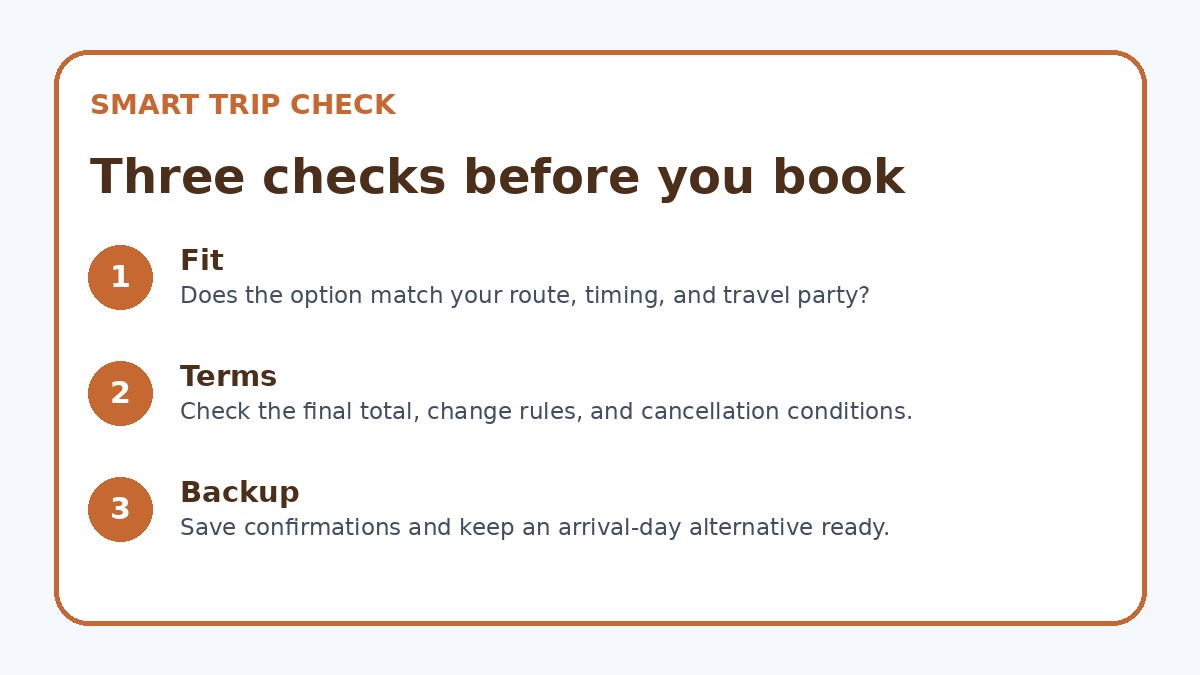
Before you book
- Confirm the exact pickup point and terminal on the provider’s final booking page and save the confirmation to your phone.
- Check whether your chosen transfer tracks flight numbers and how it handles delays; contact the provider before booking if policies are unclear.
- Download local maps or a translation app and save your hotel name and address written in Korean to show drivers.
- Have small local currency and at least one payment method accepted by taxis or transfer providers.
- Plan a backup route (taxi app, hotel shuttle number, or airport lounge) in case your first transfer option is unavailable.
- Share your arrival details with someone at your hotel and keep emergency contact numbers in both digital and paper form.
Practical arrival checklist and tips for a smooth transfer
Before you travel, prepare essential items: a printed or saved confirmation with the exact pick-up point, local currency for small expenses, a SIM or roaming plan for contacting your driver, and a clear written address and Korean name for your hotel to show drivers. Photograph or screenshot transit maps and local signage for terminals. If your flight could be delayed, confirm the provider’s policies on flight-tracking and late pickups so you won’t be charged or left waiting unexpectedly.
On arrival, move through immigration and baggage claim calmly, then head to your confirmed meeting point. If using a taxi, choose an official taxi rank to avoid touts and show the driver the hotel name written in Korean. If you’ve booked a hotel pickup, call the hotel desk using the number on your confirmation if you don’t see your driver. Keep essential contact details (hotel, transfer provider, and embassy) in multiple places: phone, email, and a quick paper note.
Frequently asked questions
Is it better to stay near the airport or go into Seoul after a late-night arrival?
If you value quick rest and minimal transit the same night, staying near the airport reduces travel stress and the chance of delays. If you want to start exploring early the next morning and aren’t worried about one late-night transfer, staying in central Seoul gives better access to attractions and morning transport. Decide based on your energy level, luggage, and whether you have early plans the next day; if uncertain, consider a nearby airport hotel for your first night and move inward the following morning.
How can I ensure a taxi driver understands my destination and preferred route?
Save your hotel address in Korean and present it to the driver to avoid language issues. If you have a preferred route or need a receipt, ask clearly before the trip begins. Use a mapping app to show the driver the exact location or have the hotel’s phone number available so the driver can call if directions are unclear. Carry small change in local currency for payment and verify whether the taxi accepts cards or mobile payments before relying on them.
What should I verify on a transfer booking page to avoid surprises on arrival?
Look for exact pickup location details (terminal and meeting point), how the provider monitors flight arrivals and handles delays, contact information for the driver or company, cancellation and refund policies, and any stated luggage limits or extra fees. If any of these items are missing or ambiguous, message the provider and request clarification before confirming. Keep screenshots of confirmations and any correspondence so you can show proof of booking if needed at the airport.
Final planning note
Planning your Seoul airport transfer before arrival removes unnecessary stress from a long trip. Start by deciding whether you need the convenience of a pre-booked transfer or the savings of public transport, then verify pickup details, delay policies, and payment options on the provider’s final booking page. Pack essentials like the hotel address in Korean, local payment options, and a backup plan such as a hotel shuttle or taxi app. With these checks and a clear decision about where to sleep on your first night, you’ll turn a late arrival into a smooth start to your Seoul visit.
Continue planning
Check current options and final conditions
Use the provider page to confirm live availability, the final total, cancellation terms, and every condition that matters to your trip.
This evergreen planning guide was created with AI-assisted drafting and a structured quality review. It does not display live prices, schedules, availability, visa guidance, or provider rankings. Verify current details before booking. Some links are affiliate links; we may earn a commission at no additional cost to you.