For most families deciding how to travel from Seoul to Gyeongju, the central practical choice is whether to prioritize schedule flexibility or door-to-door convenience. If your dates are fixed around events, school schedules, or a short stay in Gyeongju, pick the option with fewer transfers and more predictable departure times. If you have wiggle room and want lower stress when a child is tired or plans change, value flexible tickets and wider departure windows. Use the rest of this guide to map those priorities to concrete checks: how to compare direct versus connecting flights (or combined air+land routings), what to verify on the airline’s booking page, and how to plan family-friendly transfers and baggage. A careful comparison of total travel time, transfer complexity, and the refundable/change rules will make the trip smoother for everyone.
Direct versus connecting options: what families should weigh
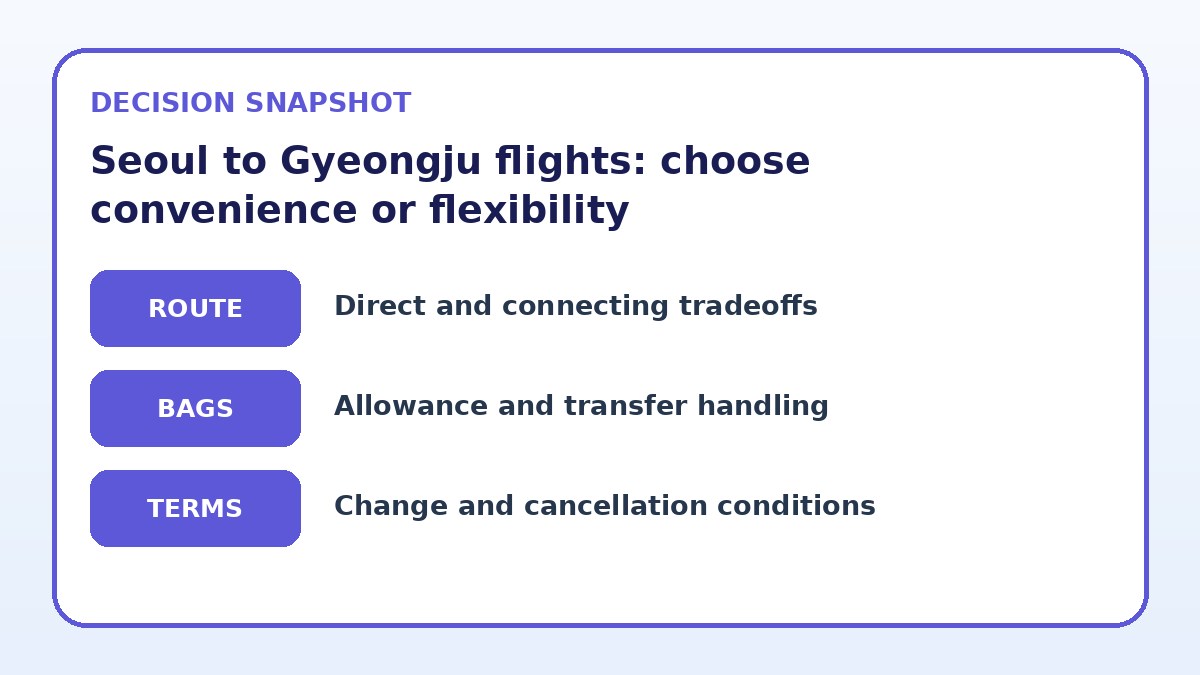
When you look at Seoul to Gyeongju travel options, treat 'direct' and 'connecting' as concepts that affect the whole trip, not just airborne minutes. Direct options cut the number of handoffs—fewer baggage re-checks, fewer terminal changes, and less time managing children between connections. That convenience can matter more than a small time savings on paper. But direct services may depart at limited times and could be more expensive or less frequent than itineraries with a stop. Evaluate how many times you and the children will need to move between gates, handle passports and security, and wait in transit areas during any proposed journey.
Connecting options often offer greater schedule flexibility because more departure windows and carrier combinations exist. If your family needs a mid-day departure or you want more choice to align with local plans, a connection may be preferable. However, connections introduce uncertainty: missed connection risks, extra walking, and possible long layovers that can be unpleasant with restless kids. For connecting itineraries, build realistic minimum connection times into your planning and choose layovers that allow easy access to childcare-friendly facilities like family restrooms and quiet seating.
Ticket rules and changeability: reduce stress before you travel
Fare conditions matter for families because plans can change suddenly. Before booking, read the airline’s or booking agent’s full fare rules on the final purchase page—specifically change fees, refund eligibility, and whether name or date changes are allowed. A ticket labeled 'refundable' or 'flexible' can avoid last-minute scramble, but those options often carry different fare structures. Verify baggage allowances and how child or infant fares are applied, since fees or restrictions can affect whether you need additional bags for strollers or child seats.
Also check how add-ons are handled: seat selection, priority boarding, and pre-boarding for families may be sold separately. If a carrier charges for seat assignment, reserving a row or adjacent seats in advance can be worth the extra cost to keep kids together. Confirm on the booking page whether the carrier allows online check-in window times that suit your morning routine, and whether you can add special assistance requests like infant bassinets or wheelchair support if needed.
| Approach | Best for | Tradeoff to check |
|---|---|---|
| Prioritize convenience (fewer transfers, fixed times) | Families with young children, tight schedules, or single-day plans | Fewer departure choices and possibly higher fares or limited flexibility to change dates |
| Prioritize flexibility (more schedule options, refundable fares) | Families with variable dates or recovery time if plans change | May involve longer total travel time or more transfers and heavier planning |
| Choose mixed approach (direct outward, flexible return) | Families wanting a smooth arrival with ability to adapt departure plans | Requires separate fare comparisons and careful verification of change rules |
| Focus on ground convenience (better transfers over shorter flights) | Families who dislike multiple airport movements or long walks with gear | Might accept slightly longer in-air time to gain simpler airport routing |

Airport transfers and ground logistics: the hidden part of convenience
Convenience is about more than the flight itself—think door-to-door. From Seoul, there are different airports and ground options to reach Gyeongju. When assessing a flight, calculate total travel time including the drive to the departure airport, required arrival-before-departure buffer for domestic travel with kids, and the transfer from arrival airport to your Gyeongju accommodation. A shorter airborne time that requires a long, complicated transfer at either end can be less convenient than a slightly longer flight with a simple, short transfer.
Consider how you’ll move luggage and children between transport modes. Simplify transfers by choosing flights that land at the airport with clearer, faster ground connections to Gyeongju, or by booking meet-and-greet or private transfer services if budget and comfort are priorities. Look up the walking distances between gates and transfer desks on the airline website or airport maps, and, when possible, book flights that arrive during daylight to ease navigation and reduce stress for the family.
Before you book
- Confirm which Seoul airport your itinerary uses and estimate door-to-door travel time to your lodging in Gyeongju.
- Verify fare change and refund rules on the airline’s official booking page before completing payment.
- Reserve seats together and check if you can pre-board or request family seating at purchase.
- Check baggage rules for strollers, car seats, and checked bags; note any size or fee differences.
- Plan minimum connection times and avoid itineraries with tight layovers when traveling with children.
- Save booking confirmations and screenshots of fare rules, cancellation policies, and any special assistance requests.
Practical booking steps and what to verify before you hit purchase
Make your final choice with a checklist: confirm total door-to-door travel time, baggage rules for strollers and car seats, the exact change/refund policy on the carrier’s final booking page, seat availability for families, and whether transfers require terminal changes. If you use an online agent to compare options, always click through to the carrier’s page to verify the fare conditions and any ancillary fees that might be missing from the search results. Trip.com can be a convenient place to compare options, but verify rules on the airline’s official booking page before committing.
Before payment, also check whether the itinerary includes any overnight layovers or unusually tight connections; swap to a different time if the proposed plan leaves too little buffer for child-related delays. Confirm special assistance options and note the check-in window so you can plan arrival at the airport. Finally, save screenshots of the fare rules and the booking confirmation—those can be helpful if you need to request a change or explain a discrepancy at the counter.
Frequently asked questions
Are direct flights from Seoul to Gyeongju always the most convenient for families?
Not always. Direct flights reduce handoffs and simplify transfers, which is often more convenient with kids, but they can be limited in schedule and more expensive. Convenience also depends on airport location and ground transport: a direct flight that lands at an airport with poor onward connections could be less practical than a connecting option that drops you closer to Gyeongju with an easier transfer. Always compare door-to-door travel time and the total number of transfers, not just airborne time.
What should I check about fares to make sure I can change plans if a child gets sick?
Before booking, read the full fare conditions on the airline’s booking page—look for explicit language on change fees, whether changes are permitted for name or date, and refund eligibility. Some fares allow free changes or credit toward future travel, while others only permit changes for a specified fee. Also check how refunds are processed, whether any service fees apply, and whether travel insurance or the airline’s waiver policies cover illness-related changes.
How can I make airport transfers with kids less stressful during this route?
Reduce stress by building buffer time into your itinerary and choosing flights that minimize terminal changes and long walks. Pack essentials—snacks, a change of clothes, medications, and activities—in a carry-on that’s easy to reach. If possible, pre-book seat assignments together and arrange priority or family boarding. Look up airport maps ahead of time to know restroom locations and family rooms, and consider booking a private transfer or taxi for the final leg to Gyeongju to avoid complicated public transit with luggage and children.
Final planning note
Balancing schedule flexibility and convenience for Seoul to Gyeongju flights comes down to knowing what will cause the most stress for your family: tight timing or long, complex transfers. If you need predictable arrival times and minimal handling, prioritize fewer transfers and convenient connections even if that means less date flexibility. If your travel dates can shift, favor tickets with flexible change terms and more departure options. Always verify fare rules, baggage allowances, and transfer logistics on the carrier’s final booking page before purchasing. With a clear priority and a short checklist, you’ll choose the option that keeps the trip smooth and lets you enjoy Gyeongju once you arrive.
Continue planning
Check current options and final conditions
Use the provider page to confirm live availability, the final total, cancellation terms, and every condition that matters to your trip.
This evergreen planning guide was created with AI-assisted drafting and a structured quality review. It does not display live prices, schedules, availability, visa guidance, or provider rankings. Verify current details before booking. Some links are affiliate links; we may earn a commission at no additional cost to you.