If you’re planning Dubai to Sydney flights with children, the practical choice is to prioritize a balance: a schedule that minimizes overnight scrambling while still allowing for enough flexibility to handle delays, naps and connections. Start by deciding whether convenience — fewer transfers and predictable airport times — or schedule flexibility — more time between stages, changeable fares and broader seat options — matters most for your family’s temperament and itinerary. Consider the ages of your children, whether you need a longer connection for stroller handling, and whether evening departures that let kids sleep on the plane are preferable. This article lays out the tradeoffs, shows how to compare direct and connecting options, and gives a checklist of concrete steps to use when you reach the booking page, including items to verify with the carrier or travel platform.
Decide what convenience means for your family
Convenience can mean different things: fewer connections, predictable departure times, shorter arena of airport hustles, or simpler luggage handling. For families with infants or toddlers, a direct flight or a single connection with a long layover might be worth extra cost because it reduces the number of times you need to corral children, manage stroller gate-checks, and re-board. Convenience also includes timing — departures that align with nap or bedtime help many kids sleep through large portions of the journey, making the overall travel day calmer for everyone.
Consider how much airport time you and your family can handle without becoming frazzled. If one parent is traveling solo with children, convenience that limits transfers and terminal changes can be decisive. Also think about ground logistics: which airport terminals are easier for transfers with young kids, whether an airline offers family lanes, and whether you value services like pre-boarding, bassinets, or priority luggage handling. These practical conveniences often reduce stress more than a slightly lower fare.
When schedule flexibility matters more
Schedule flexibility becomes important when plans are likely to change, when multiple families are coordinating, or when you want to build buffer time around important events in Sydney. Flexible tickets, open-fare families, or options with generous change policies let you rebook without punitive fees and can be a lifesaver if a child gets sick or if work schedules shift. Flexibility can also refer to flight times across several days — traveling a day earlier or later can avoid bad-weather connections or overcrowded travel days and might align better with accommodation availability.
To get meaningful flexibility, look beyond a fare’s headline price and check the carrier’s rules on changes, cancellations, and name changes on the booking page. Some fares allow free changes within a certain window; others permit credit rather than refund. Also consider travel insurance that covers family-specific disruptions. If you prefer to keep options open, compare fares that allow modest penalties for changes rather than ones that lock you into a single rigid itinerary.
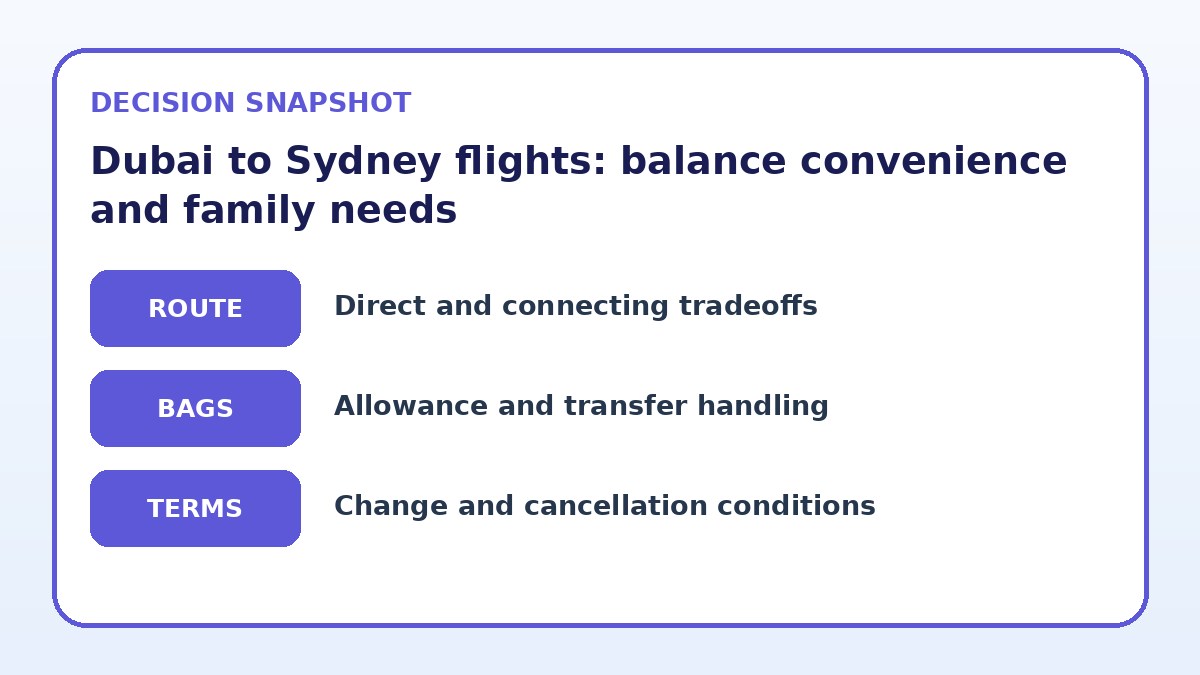
| Approach | Best for | Tradeoff to check |
|---|---|---|
| Choose direct/preferred-timing flights | Families prioritizing minimal airport transitions and predictable travel days | Often less flexible on changes and possibly higher fares for convenient time slots |
| Choose connecting flights with longer layovers | Families who need buffer time for transfers, naps, or stroller handling | Longer total travel time and more time spent in airports |
| Choose flexible fares with change-friendly rules | Families with uncertain schedules or risk of last-minute changes | Higher upfront cost but reduced penalty risk if plans change |
| Choose low-cost, strict-fare options and add services | Families prioritizing lower ticket prices and willing to pay for specific add-ons | You may lose convenience and face complex add-on management for seats and baggage |
Comparing direct and connecting itineraries
For the Dubai to Sydney route, you may see both direct and connecting itineraries depending on the carrier and schedule. A direct flight typically reduces the number of takeoffs and landings and can shorten total travel hassle, but might depart at an inconvenient hour or offer limited seat availability for families who want adjacent seats. Connecting itineraries introduce downtime that can be used for stretching legs, changing diapers in a comfortable lounge, or breaking the trip into more manageable segments — useful for families who prefer not to keep small children confined for long periods.
When comparing options, calculate the total door-to-door journey time including transit to and from airports, typical transfer times, and likely delays. Don’t assume a short connection is always better — tight minimum connection times increase the risk of missed transfers, especially with checked luggage and young children. Conversely, very long layovers add fatigue but can be turned into a restful stop if you plan a lounge access or a short local activity, depending on visa rules and airport facilities. Always verify connection times and terminal transfer details on the booking page before you commit.
Before you book
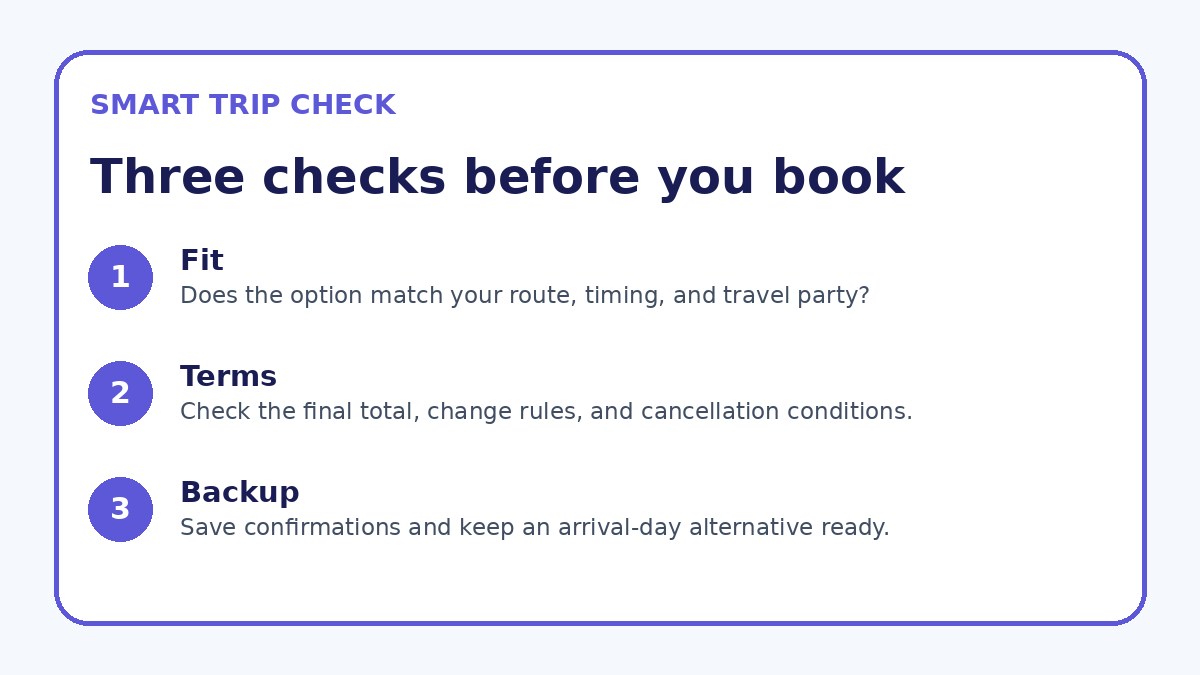
- Confirm total journey time and the number of connections including transfer terminals before you book.
- Verify seat maps and reserve adjacent seats or bassinets on the carrier’s booking page when possible.
- Check baggage allowances, stroller gate-check policies, and whether infant equipment is included or must be purchased.
- Compare fare-change and refund rules on the final booking page; note any fees and rebooking windows.
- Decide whether lounge access, priority boarding, or extra legroom seats are worth the added cost for your family.
- If you need flexibility, consider travel insurance that covers family-specific disruptions and confirm its terms.
Practical tradeoffs: seats, baggage, and timing
Seat selection and baggage allowances are practical levers you can use to tilt the scale toward convenience or flexibility. Bulkhead bassinets, extra legroom seats, or the ability to reserve adjacent seats for the whole family make a longer flight much more tolerable. If you choose a flexible fare with better change terms, check whether it also includes baggage and seat selection; sometimes a slightly higher fare bundles these conveniences, while the lowest-price option requires add-ons that raise the final cost and complexity.
Also weigh departure and arrival times against your family’s sleep patterns and plans in Sydney. An overnight flight that has children sleep most of the way may be convenient even if it’s less flexible. Alternatively, a daytime schedule with a long but comfortable connection might keep routines intact and make arrivals easier. Before booking, confirm seat assignments, child meal availability, stroller gate-check policies, and how many checked bags are included on the carrier’s final booking page or with your travel agent.
Frequently asked questions
Are direct flights always the most family-friendly option from Dubai to Sydney?
Not always. Direct flights reduce the number of times you need to manage strollers, reboard children, or worry about missed connections, which many families find easier. However, a direct flight that departs at a disruptive time for your child’s sleep schedule or offers limited adjacent seats could be less practical. Evaluate whether shorter overall travel time or better alignment with family routines matters more, and confirm seat availability and onboard family services on the carrier’s booking page.
How much connection time should we allow with young children?
Allow more time than the airline minimums: factor in stroller gate-check, immigration or security lines, diaper changes, and restroom breaks. For families, a comfortable connection often means at least 90–120 minutes for international transfers, though acceptable times vary by airport layout and whether you must change terminals. If you need to collect and recheck baggage, add extra buffer. Always verify the specific transfer process and minimum connection recommendations on the operating carriers’ information pages.
What should we verify on the carrier’s final booking page before paying?
On the booking page confirm seat assignments and the ability to reserve adjacent seats or request bassinets; check checked baggage allowances and stroller policies; read change, cancellation and refund terms; and review meal options for children. Also verify exact connection times, terminal transfer details, and whether priority boarding or lounge access is available for purchase. If using a third-party platform, cross-check these items with the carrier’s own site and consider checking Trip.com for current availability as an additional comparison tool.
Final planning note
Balancing schedule flexibility and convenience for Dubai to Sydney flights with children means making deliberate tradeoffs: fewer connections and favorable departure times reduce immediate stress, while flexible fares and longer layovers buy you breathing room if plans change. Start by assessing your family’s tolerance for airport time, the children’s sleep and feeding routines, and whether you need more predictable door-to-door timings or the ability to change plans. Use the checklist to verify seats, baggage, and fare rules on the booking page, and pick the approach that minimizes the particular stresses your family faces rather than chasing the lowest headline fare.
Continue planning
Check current options and final conditions
Use the provider page to confirm live availability, the final total, cancellation terms, and every condition that matters to your trip.
This evergreen planning guide was created with AI-assisted drafting and a structured quality review. It does not display live prices, schedules, availability, visa guidance, or provider rankings. Verify current details before booking. Some links are affiliate links; we may earn a commission at no additional cost to you.