
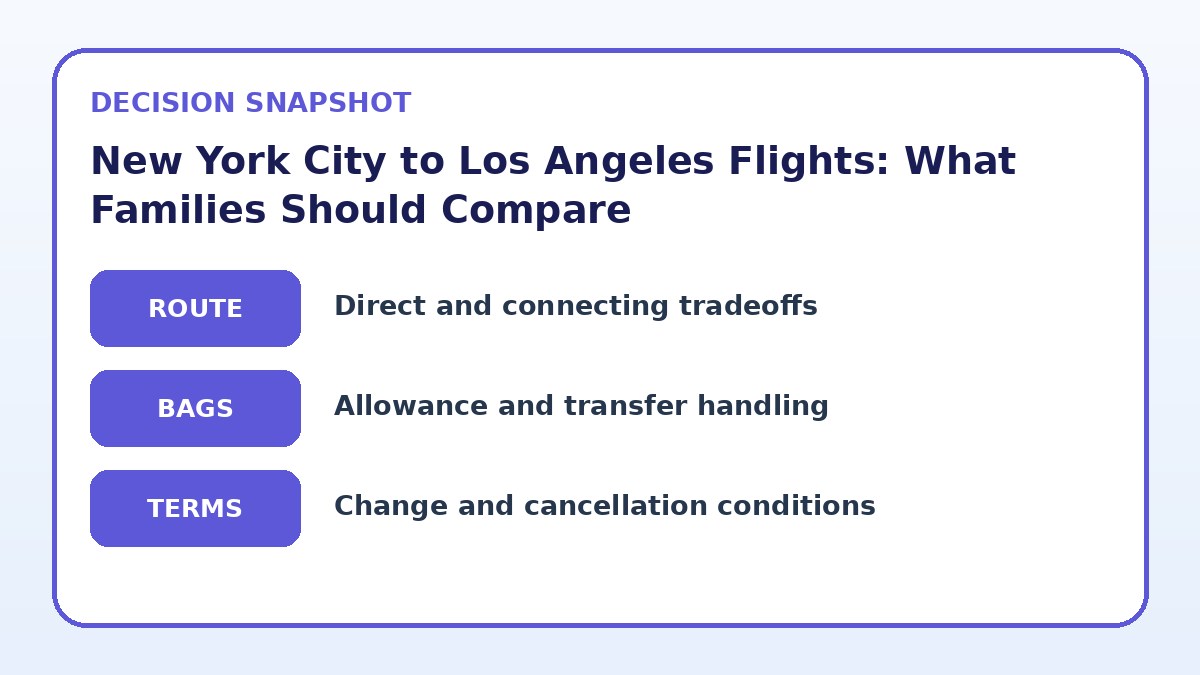
If you’re planning New York City to Los Angeles flights with children, start by deciding how much schedule flexibility you need versus how much convenience you’re willing to pay for. For most families, the practical choices narrow to two: a shorter, direct flight that reduces stress but costs more or a cheaper, connecting itinerary that adds transfer time, possible overnight waits, and more moving parts. Balance comes from prioritizing what matters on your trip day — sleep schedules, carry-on baggage needs, stroller handling and backup plans for delays. This article gives a clear decision framework: how to compare direct and connecting options, what schedule safeguards to buy, airport and ground-transport tradeoffs in both cities, and a checklist of exact things to verify on the carrier’s booking page before you click confirm.
Choose direct or connecting flights based on your family’s pain points
For many families, the single most important criterion is minimizing transitions. Direct flights reduce the number of times you need to board, deplane and shepherd luggage and kids through busy terminals. If your children do better with predictable routines or you have an evening event or appointment upon arrival, a nonstop can be worth the premium. Nonstop options also mean fewer places for a small delay to cascade into a missed connection — a comfort factor for parents who want fewer moving parts on travel day.
However, connecting flights can make sense when nonstop schedules are inconvenient or prohibitively expensive. Connections can open earlier or later departure windows that align better with sleep schedules, and they sometimes allow you to split a long day with a comfortable airport layover. The tradeoff is more planning: longer minimum connection times, potentially different airports for arrival or departure in the same metro area, and an increased need for contingency planning if a leg is delayed.
Timing and airport choices: pick what saves stress, not just minutes
Departure and arrival times matter more than small differences in flight time for families. A two-hour nonstop that departs late in the evening may be easier if it lets children sleep on the plane; conversely, an early-morning nonstop that requires a predawn commute to the airport can be rough. Compare how each option affects your family’s day — consider daycare schedules, morning routines, and whether you’ll need childcare at either end. Also think about which New York-area airport you’re using (JFK, LaGuardia, or Newark) and how predictable ground travel is from your home.
On the Los Angeles side, pick the arrival airport with convenience in mind: Los Angeles International and nearby options differ widely by traffic, ground transit and car-seat installation ease. Check whether an itinerary lands at an airport served by your preferred transport (rental car counters, shuttle services, or rideshare pickup areas). Remember that a flight saving 30 minutes in the air can cost an hour in car time in LA traffic if you land at a less convenient airport for your final destination.
| Approach | Best for | Tradeoff to check |
|---|---|---|
| Prioritize nonstop flights | Families with young children or strict arrival times | Higher fares and fewer departure time options |
| Choose the cheapest connecting itinerary | Budget-conscious families with flexible schedules | More transfers, longer door-to-door time, and higher disruption risk |
| Pick a mid-priced flexible fare | Families who want rebooking options without full refunds | Higher upfront cost but lower stress if plans change |
| Split approach: nonstop out, connecting return | Families balancing convenience on arrival and cost savings for less critical legs | More complex planning and mixed airport/service rules |
What to verify on the booking page before you commit
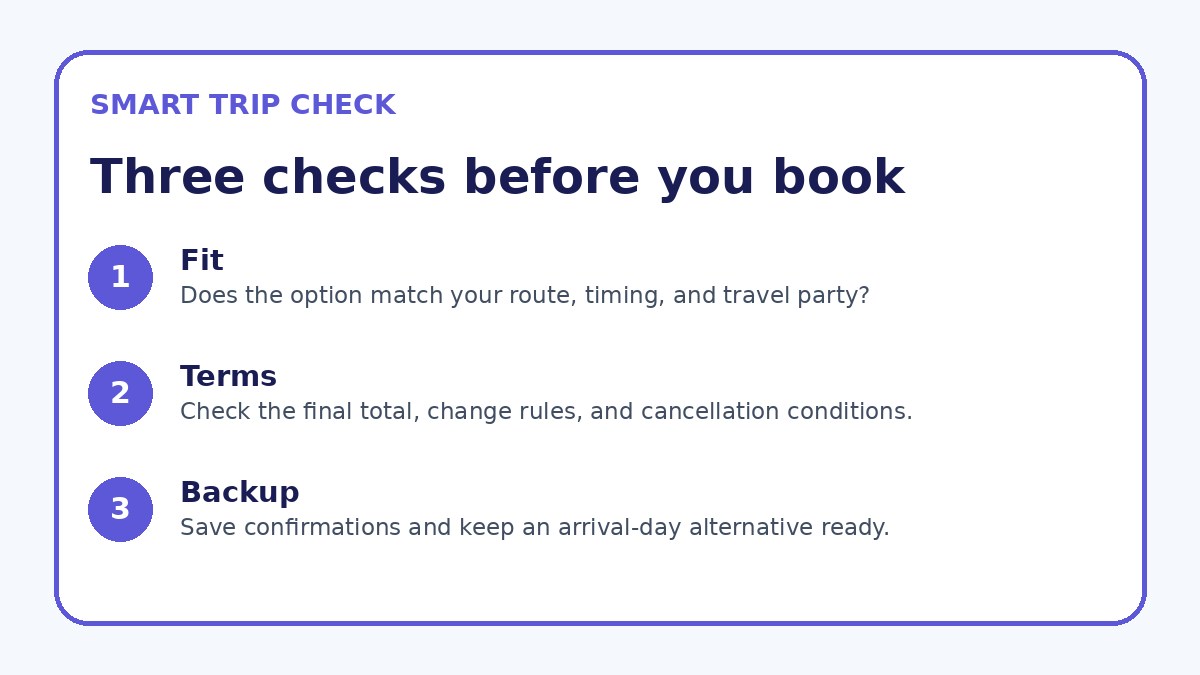
When you’re ready to buy, verify four things on the carrier or travel platform’s final booking page: exact airport codes and terminals for each leg, total connection times (not just layover labels), included carry-on and checked-bag allowances for each passenger type, and the specific fare’s change/cancellation rules. Family needs change quickly; knowing whether a fare allows a free name change, fee-waived rebooking, or refundable credits can save you hassle and money if plans shift. If the itinerary involves different airlines for each leg, confirm whether baggage is checked through or if you must collect and recheck it during connections.
Also check the seat assignment rules and whether a family or bulkhead row is selectable at booking. Some fares lock you out of free seat choices until check-in; that matters for families who need adjacent seats or extra space. If you plan to bring a stroller or car seat, look for the airline’s policy and any fees on the booking page. Finally, note the carrier’s stated minimum connection time and whether the platform shows protection options you might want — but always cross-check refund or change terms on the airline’s own site before finalizing.
Before you book
- Confirm exact airport codes and terminal information for every leg before booking to avoid last-minute transfers between different airports.
- Compare total door-to-door time including ground transit, security, recommended early arrival, and expected local traffic at both ends.
- Verify baggage allowances, stroller and car-seat policies on the airline’s final booking page and save screenshots of the policy text.
- Choose seats or pay for seat assignments in advance if you need adjacent seating; verify whether your fare permits immediate seat selection.
- Buy a flexible fare or travel protection if your plans may change, and confirm change/cancel terms directly on the airline’s site.
- Pack a carry-on with essential items (medications, snacks, distraction tools, and a change of clothes) to handle delays or lost luggage.
Contingency planning: reduce stress if things go wrong
Build buffer time into your itinerary and mentally map out Plan B options. For example, if you must be in Los Angeles for a morning appointment, choose a flight that arrives the previous evening or the earliest nonstop that still allows a reasonable commute. When taking a connection, pick a longer layover that still leaves a single travel day if possible. Have a childcare backup at both ends (a neighbor, hotel babysitter, or flexible caregiver) and keep essential items — medication, a change of clothes, nutritious snacks — in your carry-on so a delayed bag doesn’t derail the day.
Also prepare for airport-specific realities: security lines can spike unpredictably, and late-night airport services (like rental counter hours) vary. Save airline and airport customer-service numbers, download carrier apps for real-time updates and mobile rebooking, and consider buying a flexible fare or travel protection that specifically covers missed connections. If traveling with infants, ensure you have printed proof of age if needed for lap-infant policies, and know the stroller gate-check rules so you’re not surprised at boarding.
Frequently asked questions
Should families always take nonstop flights from New York City to Los Angeles?
Not always. Nonstops simplify the day and reduce the number of transitions, which is often worth the extra cost for families with young children or fixed schedules. However, if nonstop times don’t fit your family routine or are outside your budget, a well-chosen connection can be a reasonable alternative. Assess how much extra ground time, the risk of missed connections and baggage handling will affect your trip, and weigh that against savings or better departure times offered by connecting itineraries.
How far in advance should we arrive at the airport with kids for these cross-country flights?
Arrive earlier than usual when traveling with children to allow time for check-in, security and unexpected needs like stroller disassembly, diaper changes or last-minute feeding. For domestic cross-country flights, families often plan to arrive 90 to 120 minutes before departure, but consider busier travel periods, TSA wait times at your chosen NYC airport, and whether you need to drop off checked luggage. If you have TSA PreCheck or similar programs, you can reduce the buffer; otherwise, err on the side of more time to avoid stress.
What should we do if we need to change flights or miss a connection?
If a change becomes necessary, contact the airline as soon as possible via phone or the carrier’s app; apps often allow rebooking with fewer hold times. If you miss a connection due to a late incoming flight, airlines typically rebook you on the next available flight — but policies vary, so document delays and retain boarding passes. For complex itineraries with separate tickets, you may be responsible for rebooking, so consider buying protection that covers missed connections. Keep essential items with you, and know nearby airport hotels or family lounges as temporary refuges if a long delay occurs.
Final planning note
Balancing schedule flexibility and convenience on New York City to Los Angeles flights comes down to priorities. If minimizing transitions and preserving family routines on travel day are essential, choose a nonstop scheduled at a family-friendly time and accept the higher fare. If you can tolerate transfers for better times or lower cost, pick connections with sensible minimum layovers and strong contingency options. Always verify the fine print on fare rules, baggage and seat assignments on the airline’s booking page before committing, and pack a carry-on kit for disruptions. With a clear decision framework and a few verification steps, families can pick an itinerary that minimizes stress while meeting budget and timing needs.
Continue planning
Check current options and final conditions
Use the provider page to confirm live availability, the final total, cancellation terms, and every condition that matters to your trip.
This evergreen planning guide was created with AI-assisted drafting and a structured quality review. It does not display live prices, schedules, availability, visa guidance, or provider rankings. Verify current details before booking. Some links are affiliate links; we may earn a commission at no additional cost to you.