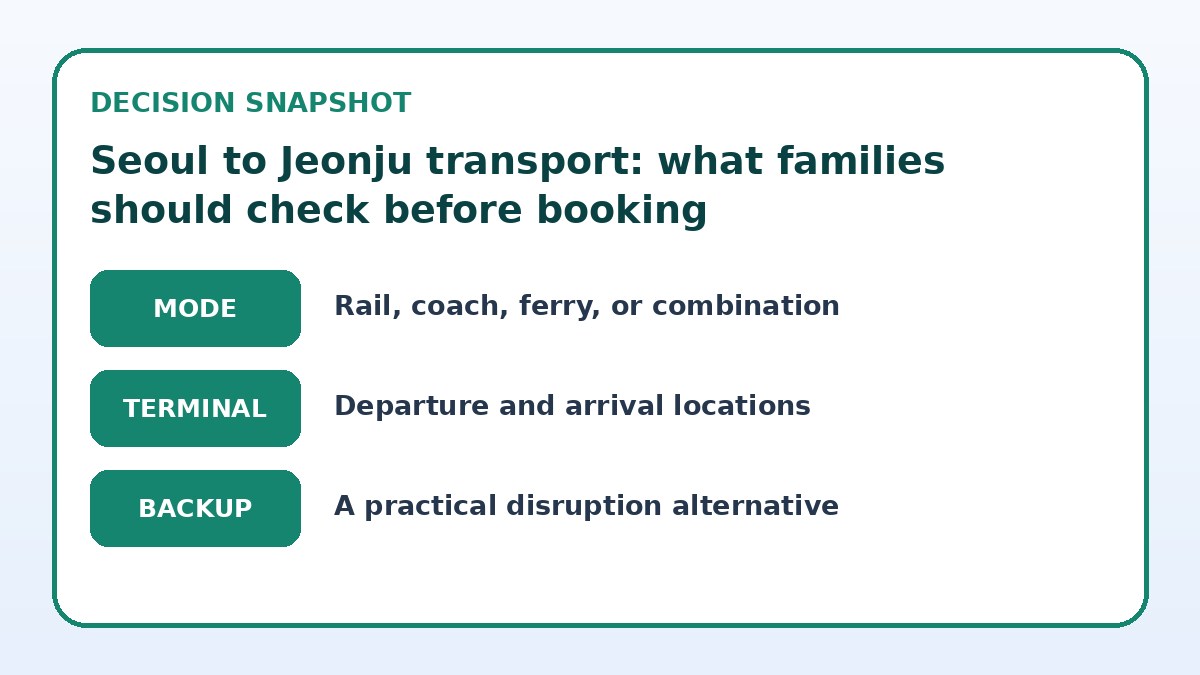
If you’re booking Seoul to Jeonju transport for a family, prioritize ticket flexibility: look for options that allow free or low-cost changes, child fare rules that match your children’s ages, and seats you can reserve together. Families face unpredictable needs—delays, stroller logistics, naps, and sudden itinerary changes—so a ticket that tolerates adjustments is often more valuable than a slightly lower fare. This article lays out the tradeoffs between refundable tickets, flexible-change reservations, and no-frill advance purchases, and explains how to compare direct and connecting services when both are offered. Read the straightforward guidance first, then use the decision criteria and checklists to pick the ticket type that reduces stress and protects your travel budget.
What “flexibility” means for families on Seoul–Jeonju trips
Flexibility covers several different things: the ability to change your departure time, to cancel for a refund, to move seat assignments, or to combine partially used tickets on another service. For a family, these features reduce the risk of paying for a service you can’t use if illness or a schedule conflict arises. Some tickets permit free changes up to a set time before departure; others allow exchanges with a small fee plus fare difference. Understand whether flexibility applies per passenger or per booking, because some platforms treat each passenger separately while others lock the whole reservation.
Also check practical flexibility: whether child fares are fully refundable or have separate rules, if infants or toddlers need a paid seat, and whether rail or bus providers accept stroller carriage or folding-pram storage without penalty. If you travel with multi-leg itineraries, verify whether connecting segments booked together will rebook automatically after a missed connection or whether you will have to repurchase separate tickets. These operational details directly influence how stress-free a family journey will be when plans change.
Comparing refundable, flexible-change, and non-refundable fares
Refundable fares typically let you cancel and receive a refund to the original payment method, sometimes after an administrative window or fee. Flexible-change fares usually prioritize the ability to alter travel times with little or no fee, though you may pay the difference if the new service costs more. Non-refundable fares are the most restrictive: they lock you into a specific departure and usually only permit changes for a fee or store value as credit. For families, flexible-change options often hit the best balance—easier to reschedule around illness or unexpected delays without committing to the higher cost of fully refundable tickets.
When weighing these options, calculate the likely scenarios: if you expect a high chance of cancellation, refundable fares might save money net of cancellation fees; if you expect date or time shifts rather than cancellation, flexible-change tickets are generally more practical. Also check whether a provider allows partial refunds or exchanges for some passengers on a booking, which helps when only one family member must change plans. Always read the exact wording on the booking page: phrases like ‘change allowed’ can hide specific deadlines or administrative fees that matter for families.
| Approach | Best for | Tradeoff to check |
|---|---|---|
| Refundable tickets | Families who might cancel travel completely and want the option to get money back. | Higher upfront cost and sometimes administrative refund windows or limits to consider. |
| Flexible-change tickets | Families likely to shift dates or times but not cancel; offers easy rescheduling. | May still require payment of difference for pricier replacements and rules vary by provider. |
| Non-refundable advanced buys | Families with a fixed plan seeking lowest upfront fares and who accept limited changes. | Least forgiving for illness or schedule disruption; changes usually cost more than initial savings. |
| Separate tickets for connecting legs | Families looking to mix providers or get cheaper segment fares with planned transfer margins. | Adds complexity: independent change/cancel rules and higher risk if an earlier leg is delayed. |
Seat assignments, group seating, and carriage needs
A family’s comfort depends heavily on seating rules. Some providers let you reserve seats when booking; others assign them at check-in. For families who want contiguous seats, prioritize ticket types that include seat reservations or let you pay a small fee to pick seats in advance. Verify whether that seat selection is changeable without penalty—if a child needs a different seat the day of travel, a rigid assignment can be a nuisance. Also confirm whether infant or child seats must be booked separately and whether carriers require children to occupy a paid seat above a certain age.
Consider carriage-level needs: luggage and stroller space, accessible boarding for elderly family members, and availability of restrooms or changing areas on board. When comparing options, read the provider’s boarding rules and carriage descriptions on the booking page so you know whether strollers are checked, carried onboard, or require folding. If your family values an aisle for quick movement or a quiet car for naps, search for tickets that allow you to choose or guarantee those carriage types; if that isn’t explicit, use the provider’s service details or contact customer support before booking.
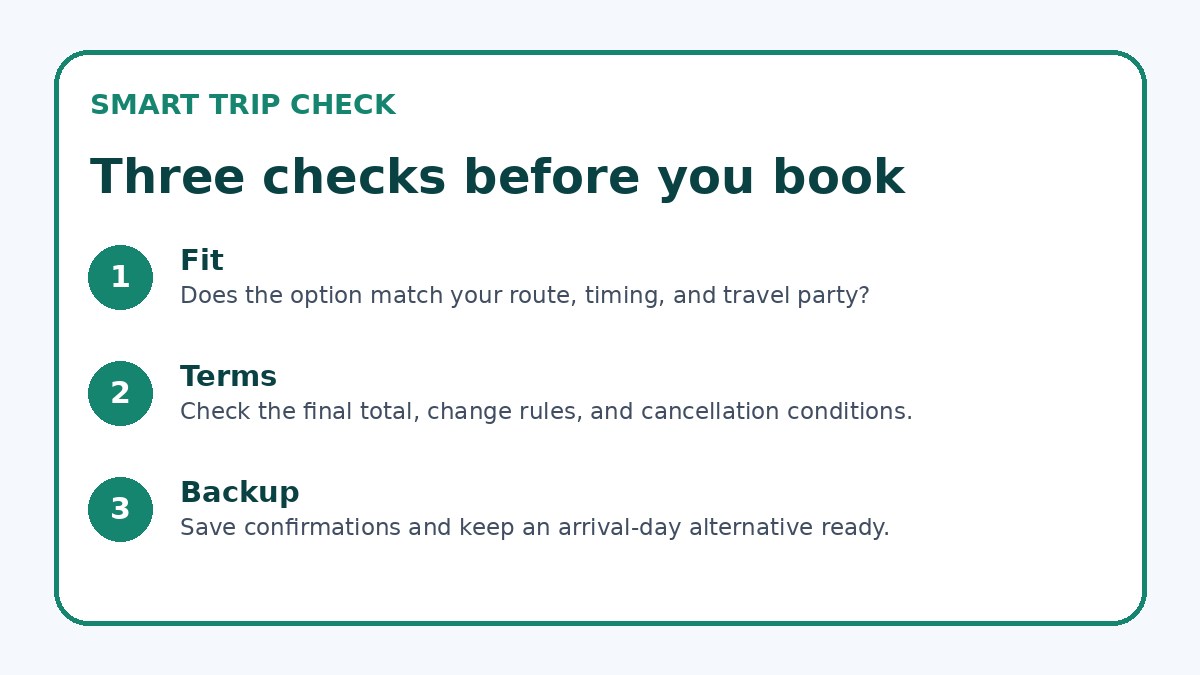
Before you book
- Confirm child age cutoffs for reduced fares and whether proof of age is required at boarding or check-in.
- Read the ticket’s change and cancellation policy on the provider’s final booking page, noting deadlines and possible fees.
- Verify seat-assignment options and whether family seating or adjacent seats can be reserved in advance without penalty.
- Check stroller and luggage rules: whether strollers fold, are carried onboard, or must be checked at the counter.
- If choosing a connecting itinerary, ensure transfer times include buffer for rest, toilet breaks, and unexpected delays.
- Compare the total refund or credit process timeline so you know how long returned funds or rebooking credits will take.
How to compare direct versus connecting options safely
Direct journeys reduce the number of times you must manage luggage and children during transfers, and they lower the risk of missed connections. However, direct services may be less flexible or more expensive than itineraries with a mid-route transfer that allow you to combine lower-cost segments. When direct and connecting options are offered, compare the flexibility rules for each segment: connecting journeys sometimes involve separate tickets with independent change and cancellation rules, which increases complexity for families. If you book separate legs, check how missed connections are handled and whether you’ll need to rebook each ticket yourself.
If the connecting option looks attractive, factor in transfer time, platform changes, station facilities for families, and the chance that one delayed leg could disrupt the rest of the day. Look for buffered connection times that account for toilet breaks and snack changes, especially with small children. If both direct and connecting tickets allow changes, prioritize the itinerary that gives you the simplest rebooking process—ideally one booking with unified change rules, rather than multiple independent tickets with different policies.
Frequently asked questions
Should I buy refundable tickets for young children traveling from Seoul to Jeonju?
Refundable tickets are worth considering if illness, changing plans, or family emergencies are likely. They provide the clearest route to getting paid back without relying on credits. However, refundable fares often cost more upfront. If you expect to change dates rather than cancel, a flexible-change ticket could be a better compromise. Check the exact refund window and whether refunds apply per passenger or per reservation on the provider’s final booking page before you complete payment.
Can I reserve adjacent seats for a family when booking Seoul to Jeonju transport?
Many providers allow seat reservation during booking or for a small fee, which is the most reliable way to get adjacent seats. Policies differ: some let you hold seats for the whole booking, others assign seats at check-in. If seat adjacency is essential—for toddlers, nursing, or peace of mind—choose a fare that explicitly includes seat reservation or pay for the seat-selection option. Always confirm whether changes to reserved seats are permitted and whether fees apply if you need to swap seats later.
Is it safer to book a direct service or a cheaper connecting route for family travel?
Direct services reduce transfer stress because you move between fewer platforms and manage baggage less, which can be crucial with small children. Cheaper connecting routes may save money but introduce the risk of missed connections and separate ticket rules. If you opt for connections, build in generous transfer time and prefer bookings where either the provider protects connections or you can rebook easily. Review the change and protection policies for both direct and connecting options on the booking pages to decide what level of risk you and your family can accept.
Final planning note
For family travel between Seoul and Jeonju, ticket flexibility should be a primary booking factor—not an afterthought. Choose refundable options if you expect cancellations, flexible-change fares if you anticipate date shifts, and seat-reservation features if seating together is non-negotiable. When comparing direct and connecting routes, balance convenience against cost and complexity; direct trips reduce transfer stress, while multi-leg itineraries can offer savings if you’re comfortable managing separate policies. Before you commit, read the provider’s booking page carefully to confirm change fees, refund windows, seat rules, and stroller policies. Use Trip.com or the carrier site to compare current availability and the precise terms you will be accepting at checkout.
Continue planning
Check current options and final conditions
Use the provider page to confirm live availability, the final total, cancellation terms, and every condition that matters to your trip.
This evergreen planning guide was created with AI-assisted drafting and a structured quality review. It does not display live prices, schedules, availability, visa guidance, or provider rankings. Verify current details before booking. Some links are affiliate links; we may earn a commission at no additional cost to you.