Practical answer first: pick the mode that minimizes handling and transfer steps for your specific itinerary. For most business travelers with one or two checked bags or a wheeled carry-on, a direct intercity train or most coach services offer the simplest end-to-end experience because you avoid airport security queues and typically push bag to platform-level storage. If speed and a single-seat ride are the priority, fly—but budget extra time and effort for airport transfers and luggage check-in. If you have excess or bulky equipment, driving or a door-to-door private transfer reduces friction, at the cost of potential traffic delays. Read the sections below to weigh terminal fit, luggage transfer points, timing flexibility, and what to do if a disruption forces a last-minute change.
Terminal fit: where your bags meet the city
Terminal fit is about how closely your departure and arrival points link to your actual start and end addresses. City-centre train stations typically put you within easy taxi, rideshare or subway distance of downtown offices and hotels, cutting last-mile time. Consider whether the station has level boarding or short steps if you’re handling heavy luggage; fewer stairs means less time and strain. For flights, verify which Toronto and Montreal airports and terminals are in play for your booking because different terminals can change transfer time significantly.
For coach services, terminals range from central bus depots to curbside city stops; each affects how quickly you can get a taxi or meet a colleague. If your arrival point is an airport rather than downtown, add door-to-door time for airport-to-city transfers and the effort of moving bags between vehicle types. Always map the final segment from the terminal to your meeting or hotel address, and prefer options that reduce the number of times you must lift or re-check your luggage.
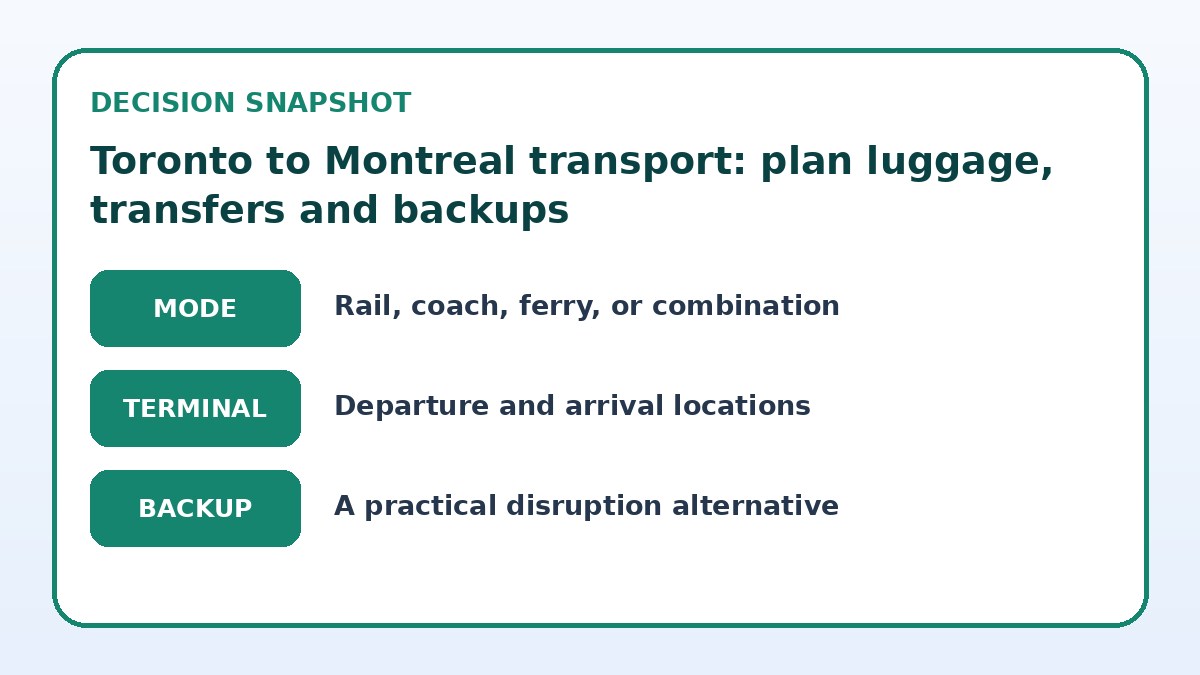
Choose the end-to-end journey plan
| Journey approach | Best for | Friction to check |
|---|---|---|
| Direct intercity train | Business travelers wanting downtown arrivals and minimal repeated handling | May be slower than flying; verify luggage space and station-to-office transfers. |
| Flight plus ground transfers | Those prioritizing shortest airtime between cities | Adds airport transfers, check-in and baggage reclaim steps that increase door-to-door time. |
| Intercity coach | Cost-conscious travelers with moderate luggage and flexible timing | Depots may be less central and baggage loading practices vary by operator. |
| Drive or private transfer | Travelers with bulky gear or who need true door-to-door control | Subject to traffic and parking delays; more expensive and driver availability can vary. |
Check live intercity options
Look beyond the ride itself and compare terminals, transfers, luggage, and arrival fit.
Luggage and transfer friction: handle less, move faster
Assess the number of items, their size, and how often they must be moved. A single wheeled case plus a laptop bag is easiest to manage across modes; you can often stow the case and keep the briefcase for immediate access. On trains, look for luggage racks, overhead shelves and dedicated baggage areas — if these are limited, choose a seat near the doors to speed boarding and disembarking. For flights, you must factor in time for check-in, security lines, and reclaiming checked baggage at arrival.
If you travel with bulky equipment, fragile cases, or crates, driving or a private transfer reduces handling steps and risk, since you keep everything in one vehicle. Alternatively, split items: ship bulky items ahead by courier and travel light for meetings. When using coach or shared shuttles, confirm how baggage is loaded and whether drivers handle the lift — some curbside services require you to load/unload yourself, which adds time and effort.
Timing flexibility: align schedules with meetings
Business travel often mixes strict meeting windows with the need for contingency time. Direct rail services typically run several times daily and offer a predictable timetable that can be paired with local transit or rideshare bookings. Trains generally allow more flexible arrival and departure times close to downtown, which reduces the risk of missing a first appointment. When planning, choose services that leave a comfortable margin before and after meetings to absorb minor delays without frantic luggage juggling.
Flights may save running time between cities but create hard constraints: you must add airport check-in, minimum connection times if connecting, and luggage reclaim time. If you need to be in the office immediately after arrival, prioritize options that arrive downtown or allow rapid transfer. For same-day round trips, prefer options with generous cancellation or rebooking rules — but always verify those policies on the provider’s booking page, since terms change.
Compare the practical alternatives
Use the final page to confirm what is actually offered on your dates and save a workable fallback.
Intercity travel checklist
- Map door-to-door time: estimate travel time from your exact start address to departure point and from arrival terminal to your meeting location.
- Confirm baggage allowances and any size or weight limits on the provider’s final booking page before you commit.
- Choose luggage that fits one-person handling—wheeled case plus a compact laptop bag—to reduce transfer steps.
- If arriving at an airport, pre-book ground transport or reserve a rideshare to avoid curbside delays with luggage.
- Pack an essentials carry-on with charger, documents and a change of clothes in case checked luggage is delayed.
- Identify an alternate later service and a same-day courier option for urgent item delivery if your original plan is disrupted.
Disruption backup: practical options if plans change
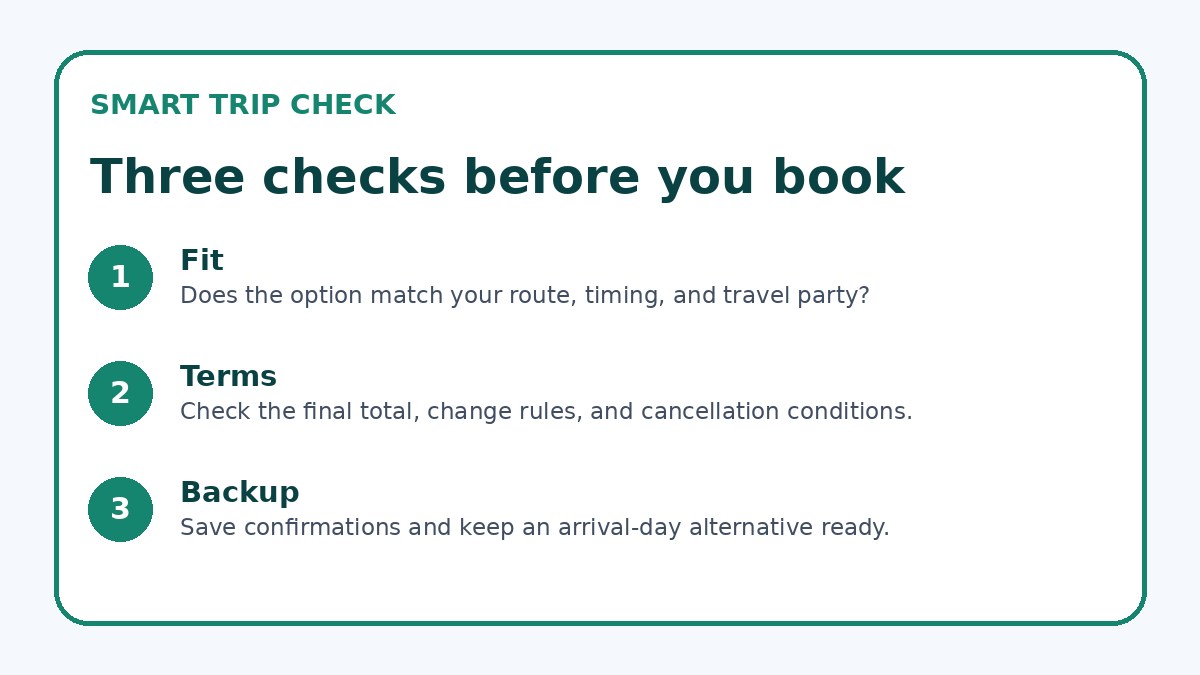
Every business traveler needs a simple backup. First, map secondary departure times on other modes (e.g., next train, coach, or flight) and save those booking pages or provider contacts on your phone. Second, know where to rent a car or book a last-mile private transfer quickly if public services are disrupted. For luggage-critical trips, have a small kit in a carry-on with essentials so you can continue if checked baggage is delayed or rerouted.
Third, prepare a quick-shipment plan for critical items: identify courier services that will pick up and deliver overnight between Toronto and Montreal if you must send presentation materials or equipment. Finally, before you finalize a booking, confirm on the provider’s final page the exact baggage allowances, transfer policies, and change/cancellation procedures; these details are what determine how disruptive an irregular operation will be to your schedule.
Rail & Intercity Transport questions travelers ask
Should I check luggage or travel carry-on when moving between Toronto and Montreal for a day meeting?
For a single-day meeting, traveling with a wheeled carry-on and a laptop bag is usually the most efficient approach. It saves time by avoiding check-in and baggage reclaim and reduces the number of transfer steps. If you must carry presentation materials or samples, consider mailing bulkier items ahead to your Montreal hotel or office and traveling light. Always verify baggage size and carry-on rules with the provider on the booking page, since carry-on allowances vary by carrier and can affect whether you need to gate-check items.
How do I choose between a train and a flight when I have a lot of luggage?
Start by listing your luggage items and whether each needs special handling. If items are bulky, heavy, or fragile, driving or a private transfer reduces handling steps because everything stays in one vehicle. Trains can handle multiple pieces more conveniently than flights, but check station luggage storage and onboard space. Flights may require checked-baggage fees and extra time at both airports, increasing total door-to-door time. Compare the total logistics — terminal locations, transfer time, and handling steps — before you book, and confirm baggage policies on the provider’s final page.
What is a practical disruption plan for a Toronto–Montreal business trip with important luggage?
Have three layers: a secondary travel option (next train or coach), a rapid ground-transfer backup (rental car or private transfer contact), and a courier service that can pick up and deliver critical items the same or next day. Keep digital copies of itineraries and contact info for bookings easily accessible, and pack a compact essentials kit in your carry-on so meetings can proceed if checked luggage is delayed. Before travel, verify change and cancellation policies on your chosen provider’s booking page so you know how quickly you can switch plans if needed.
Final decision note
Choosing the right Toronto to Montreal transport for a business trip with luggage comes down to reducing handling steps and minimizing door-to-door time. Trains and central coach services often win on terminal fit and straightforward baggage handling; flights win when airtime reduction outweighs added airport steps; private transfers win when you must control every move of bulky or sensitive gear. Always map the full journey from your start address to final meeting point, confirm baggage rules and change policies on the provider’s booking page, and prepare a simple disruption plan. With those checks you’ll make a practical choice that keeps luggage friction out of your workday.
Continue planning
Check current options and final conditions
Use the provider page to confirm live availability, the final total, cancellation terms, and every condition that matters to your trip.
This evergreen planning guide was created with AI-assisted drafting and a structured quality review. It does not display live prices, schedules, availability, visa guidance, or provider rankings. Verify current details before booking. Some links are affiliate links; we may earn a commission at no additional cost to you.