When your plane touches down at Prague, the first decision in the first hour is clear: get to your meeting address reliably with the least stress. For a business traveler that means weighing time predictability, luggage handling, and clarity around meeting points against cost and flexibility. If you need a straight, quiet journey to a city-centre hotel or office with minimal coordination, a pre-booked private transfer often wins. If your schedule allows a short ride plus a walk, or you want to avoid booking ahead, Prague’s public transport network can be efficient and inexpensive. This guide gives the quick recommendation up front, then walks through the tradeoffs you should weigh—party size, late or disrupted arrivals, meeting-point clarity, and how well each option drops you at your final door—so you can make the right booking choice while your flight and hotel details are open.
Check options for your arrival details
Use your flight, luggage, party size, and accommodation address to compare current choices.
Size of party and luggage: what fits best
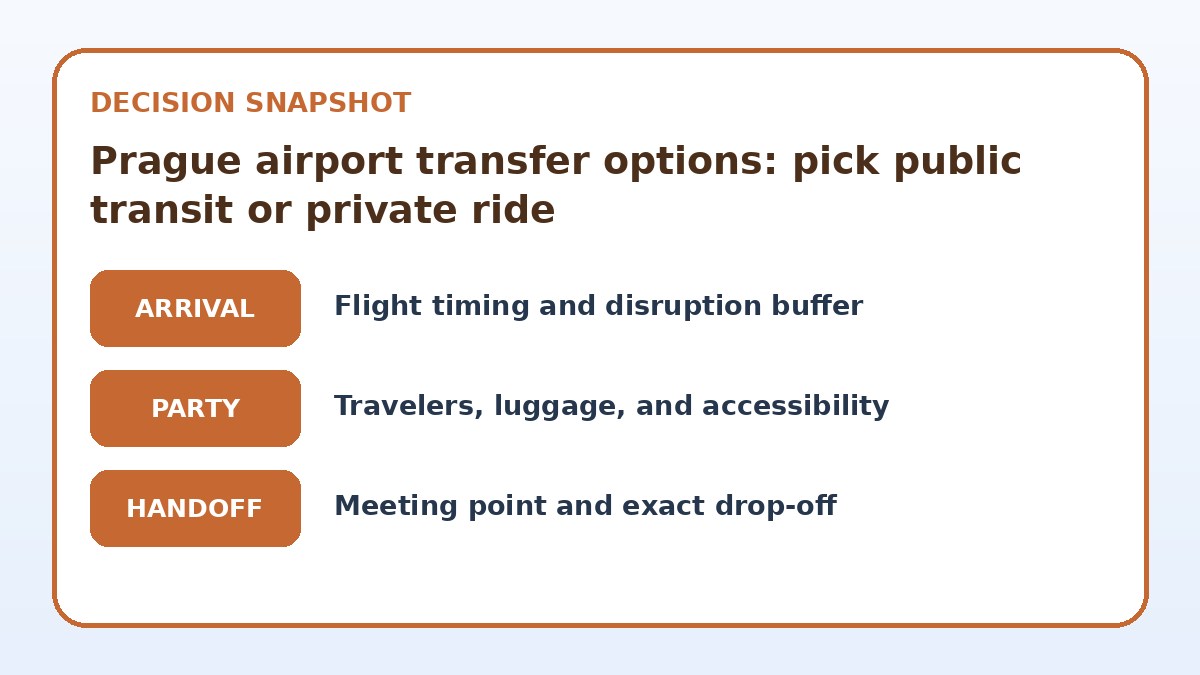
Count people and suitcases before you book. A solo traveler with a carry-on can almost always use tram, bus, or metro, and will often reach central addresses faster than a vehicle stuck in radial roads. But once you add more passengers, larger checked suitcases, or equipment such as wheeled cases or sample kits, the convenience of a single private car or minivan grows. Also consider how many door-to-door trips you want to avoid—private transfers can do multi-stop runs without juggling public-transport connections.
When assessing options, request exact vehicle capacity and luggage allowances from private providers before booking, and verify whether public routes require stairs, long platform walks, or transfers that are awkward with large bags. For airport-to-city rail or bus, check how far the stop is from your arrival terminal and whether there is elevator access. These are the practical differences that determine whether you should pay for a vehicle or save time and cost by traveling on public lines.
Arrival details to have ready
- Confirm your arrival terminal and locate the recommended meeting point or nearest public-transport stop on an airport map.
- Count passengers and suitcases and compare that total to the stated capacity and luggage policy of any private vehicle.
- If choosing a private transfer, give your flight number to the operator and ask their precise late-arrival and waiting-time rules.
- If using public transport, download the local ticket app or buy the correct paper ticket and check how to validate it on board.
- Save the exact meeting-address text in Czech (hotel or office entrance) and a simple walking map from the nearest stop or drop-off.
- Plan one backup: note a reliable taxi rank, rideshare option, or night-bus route in case your primary choice becomes unavailable.
Late or disrupted arrivals: reduce surprise
Business itineraries are vulnerable to delays. If your arrival risk is high—tight connections, weather, or multiple legs—choose transfer options that clearly state their late-arrival policies: how long they wait, whether extra waiting time is charged, and whether they reassign a driver if you miss the scheduled pickup. For public transport, plan alternates: note the last tram or night-bus options, and identify a reliable taxi rank as a backup if services are reduced late at night.
Make contingency steps part of your booking process. When you book a private transfer, leave your flight number and real-time arrival updates with the provider, and retain contact details for the driver or operator. If you rely on public transit, keep a map of the terminal-to-stop route, download the relevant ticketing app or have exact cash for machines, and save an address card of your hotel in Czech to show to drivers in case you need to switch to a paid taxi at short notice.
Match the transfer to your arrival
| Arrival approach | Best for | Detail to verify |
|---|---|---|
| Pre-booked private transfer | Tight schedules, heavy luggage, and clear door-to-door needs | Higher cost and need to verify pickup flexibility for delayed flights |
| Airport taxi or on-demand rideshare | Flexible arrivals and urban drop-offs with immediate availability | Variable wait times and fare uncertainty during peak periods |
| Public transport (bus/tram/metro) | Solo travelers with light luggage and adaptable timing | May require walking and transfers; less ideal late at night |
| Mixed approach (transit plus local taxi) | Cost-conscious travelers who want speed for the final mile | Requires coordination and possibly two ticket purchases or apps |
Make the meeting plan clear
Check the final pickup instructions, waiting conditions, and exact drop-off coverage.
Meeting-point clarity: avoid wasted minutes
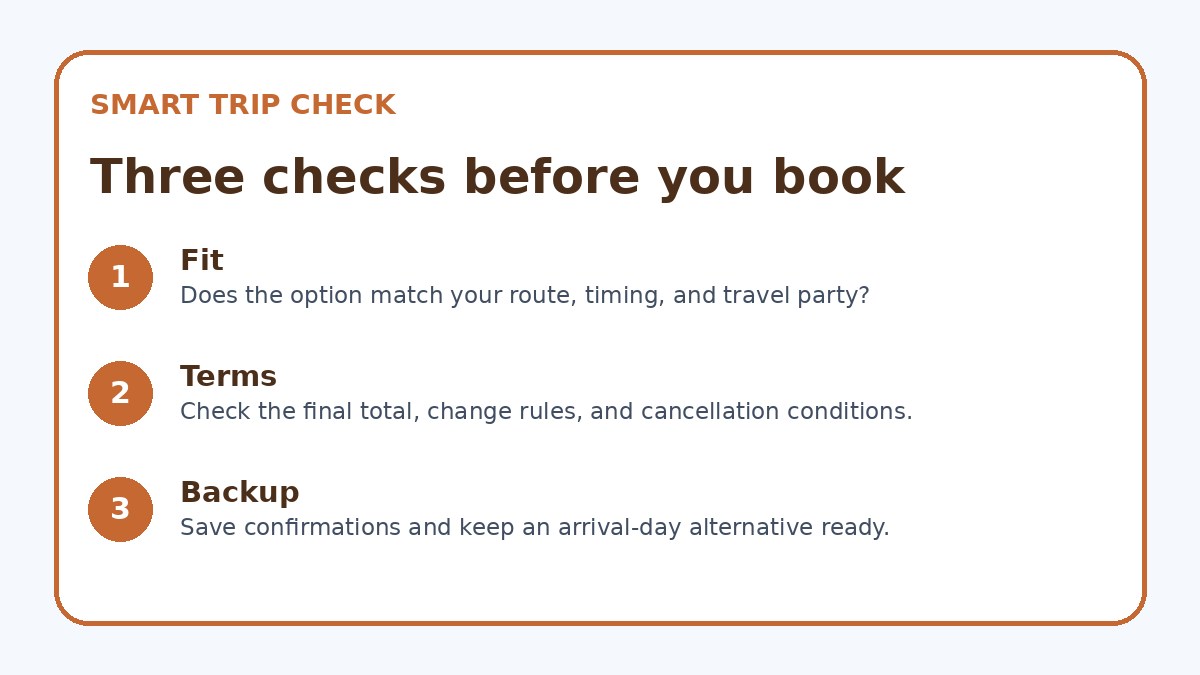
A business traveler’s time is valuable; unclear pickup points can derail a plan. Private transfers often specify a meet location—an arrival-hall gate, a named exit, or a numbered door—so confirm the meeting instructions and the driver’s contact number before you land. If multiple terminals or arrivals exist, confirm which one applies. For public transport, identify the nearest tram or metro stop to your meeting address and whether you will walk, take a short taxi, or transfer between lines—the final leg of the journey should be predictable and quick.
If your meeting address is a modern office complex or a hotel with multiple entrances, verify where vehicles are allowed to stop. Some locations restrict long-term waiting or have security checkpoints. For private transfers, ask whether drivers can enter drop-off lanes or are required to use nearby public kerbs. For public transport, check walking times from the nearest stop and whether the route uses well-lit, accessible sidewalks, especially for arrivals after dark.
Door drop and last-mile fit: where you really end up
The usefulness of a transfer is measured by the last step from vehicle or station to your meeting room. A private transfer’s selling point is the door-to-door drop that minimizes walking and simplifies luggage handling. However, in Prague’s historic centre some streets are pedestrianized or have limited vehicle access; drivers may drop you a short walk away. Ask the provider how close they will actually get to a named entrance and whether additional walking is expected in cobbled or narrow streets.
Public transport typically stops near central hubs where many offices cluster, often requiring a short walk. For meetings in side streets or buildings with restricted access, identify the precise building entrance used by colleagues or reception. Use a mapping app to calculate walking time and terrain (steps, cobbles, slopes). If the last segment is awkward, consider a mixed approach: take efficient public transit into the centre then a short taxi or rideshare for the final door drop.
Airport Transfer & Local Mobility questions travelers ask
Can I rely on Prague public transport for early-morning business arrivals?
You can often use public buses, trams, or metro for early-morning arrivals, but service frequency changes outside peak hours. Check the first service time for the lines connecting to the airport and your destination, and confirm whether early trains or buses require advance tickets or reservations. If your arrival is before standard schedules, plan a backup: a booked private transfer or an airport taxi rank. When in doubt, verify current timetables on the operator’s official page or a trusted transit app before you travel.
What should I verify with a private transfer provider before booking?
Ask the provider to confirm the pickup location within your arrival terminal, the maximum waiting time included, the vehicle model or capacity, and the exact drop-off privileges at your final address. Also request a driver contact number and their policy for flight delays or rebookings. Never assume flexible terms; request written confirmation and check the booking page for cancellation fees, additional waiting charges, and whether live flight tracking is offered. If any detail is unclear, ask for it to be added to your reservation notes.
Is it faster to use a taxi than public transport in Prague city centre?
Speed depends on time of day and your specific origin and destination. During peak traffic, taxis and rideshares can be slower than trams or the metro, which often avoid congested central streets. For short distances with many stops, a taxi may be quicker door-to-door, especially with luggage. Compare route options on a mapping app with real-time traffic and consider a mixed approach—public transit to a central hub, then a short taxi for the final leg—if you want to balance speed and cost.
Final decision note
For business travelers landing in Prague, the simplest rule is: prioritize predictability for tight schedules or heavy luggage and pick cost-effective public options for flexible itineraries. Pre-booked private transfers give clarity about pick-up, vehicle space, and a single point of responsibility for delays, but make sure you verify waiting time, vehicle capacity, and exact drop-off permissions before confirming. Public transport frequently offers fast travel into central Prague if your party is small and you can handle a short walk. Use the checklist while you have your flight and hotel details open, and verify timetables or booking conditions on the provider’s final page; Trip.com can be one place to compare live availability but always confirm policies directly with the operator.
Continue planning
Check current options and final conditions
Use the provider page to confirm live availability, the final total, cancellation terms, and every condition that matters to your trip.
This evergreen planning guide was created with AI-assisted drafting and a structured quality review. It does not display live prices, schedules, availability, visa guidance, or provider rankings. Verify current details before booking. Some links are affiliate links; we may earn a commission at no additional cost to you.