Pick your stay area first: that single decision changes whether your typical Florence day starts with a five-minute stroll to the Duomo or a longer, quieter breakfast routine in a residential quarter. For solo travelers balancing location and room comfort, think in terms of three daily rhythms—sightseeing loops, evening safety and social options, and downtime for work or rest. Choose a compact historic-centre base if you want immediate access to major sights and nightlife; pick an Oltrarno or Novoli area property if you value space, calm, and lower nightly noise. This article gives a practical shortlist method so you can decide an area, evaluate daily-route friction, match room features to your solo needs, and understand the booking terms to verify before you click confirm.
Check live stays in the areas that fit
Use your dates and party size to compare current rooms after you narrow the neighborhood fit.
Choose your neighborhood by daily rhythm
Start by imagining three representative days: a museum-heavy day (Uffizi, Accademia), a people-watch day (Piazza Santo Spirito and cafes), and a transit day (arrival or a rail connection). If most days are museum-heavy and you value walking, the historic centre—around the Duomo, Santa Croce, and Piazza della Signoria—keeps transit time and decision fatigue low. For people-watching and evening cafe culture, the Oltrarno (south of the river) offers a more local vibe and a lively but less tourist-saturated evening scene.
If your priority is calm and lower nightly noise, neighborhoods farther from the medieval core—Campo di Marte or Novoli—tend to offer larger rooms and quieter streets. These areas require planning for daily transit: check tram or frequent bus services and where they stop relative to your likely walking routes. For solo travelers who enjoy meeting people, staying near squares and small streets where locals gather increases the chance of social interactions; if you prefer solitude, pick a residential street or a hotel marketed for business travelers.
Choose an area-selection strategy
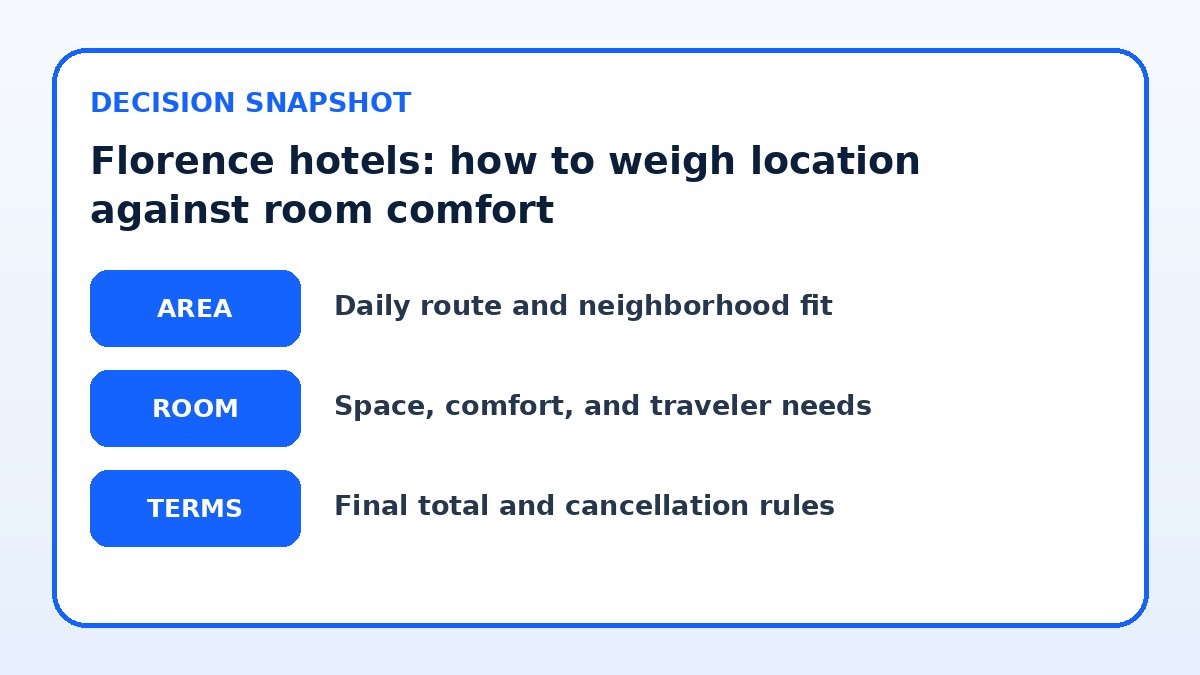
| Area approach | Best for | Tradeoff to check |
|---|---|---|
| Stay in the historic centre (Duomo area) | Walkers who want immediate access to major sights and nightlife | Smaller rooms, higher noise levels, and fewer quiet evenings in-room |
| Oltrarno and Santo Spirito | Solo travelers wanting local cafes, artisan shops, and a relaxed social vibe | Slightly longer walks to some major museums; variable public-transport frequency at night |
| Residential neighborhoods (Campo di Marte, Novoli) | Travelers prioritizing larger rooms, quiet nights, and lower-cost space | Requires tram/bus trips into the centre and more planning for late evenings |
| Near Santa Maria Novella station | Arrivals/departures and day trips by train who value fast transit links | Busy transport hub atmosphere and potential street noise versus central walkability |
Estimate daily-route friction and transport tradeoffs
Calculate friction by counting door-to-door minutes for your typical day: time from your lodging to the nearest tram stop or main attraction, plus return time after dining out. Historic-centre hotels minimize walking to main sites but often mean more crowded streets and shorter, smaller rooms. Staying just outside the centre increases walking or tram time but buys quieter nights and often larger rooms with desks and sitting areas—useful if you’ll work remotely in the evenings.
When comparing transit options, look for frequent, easy connections rather than just theoretical closeness. A 15-minute tram ride every 10–15 minutes can produce less friction than a 5-minute walk with poor late-night lighting or few eateries. Confirm how well-lit pedestrian routes are at night and whether the hotel has a late check-in policy. On the booking page, verify nearest stop names, night service options, and whether the hotel lists recommended walking routes to main sites so you can judge real-world convenience.
Now compare like with like
Keep the same dates, guests, room needs, and cancellation preferences while you compare the final choices.
Match room features to solo-traveler needs
Decide which room attributes matter most: bed size, soundproofing, desk or table, private bathroom, and in-room storage. Solo travelers often overvalue central location and accept very small rooms; instead, prioritize a room where you can sleep well and leave luggage comfortably. If you need to work, look for explicit desk descriptions, business amenities, or a reliable Wi-Fi note on the property page. If social evenings are important, a hotel with a bar, communal lounge, or terrace helps you meet others without sacrificing safety.
Also consider safety and comfort details that affect solo trips: ground-floor vs higher floors, elevator availability, and secure key access. If you arrive late, a 24-hour front desk or clear late-check-in instructions reduce stress—verify these on the final booking. For noise concerns, ask the property about room orientation (street-facing vs courtyard-facing) and whether they can allocate a quieter room. Don’t assume photos show the exact unit; request a room category description when in doubt.
Hotel booking check before payment
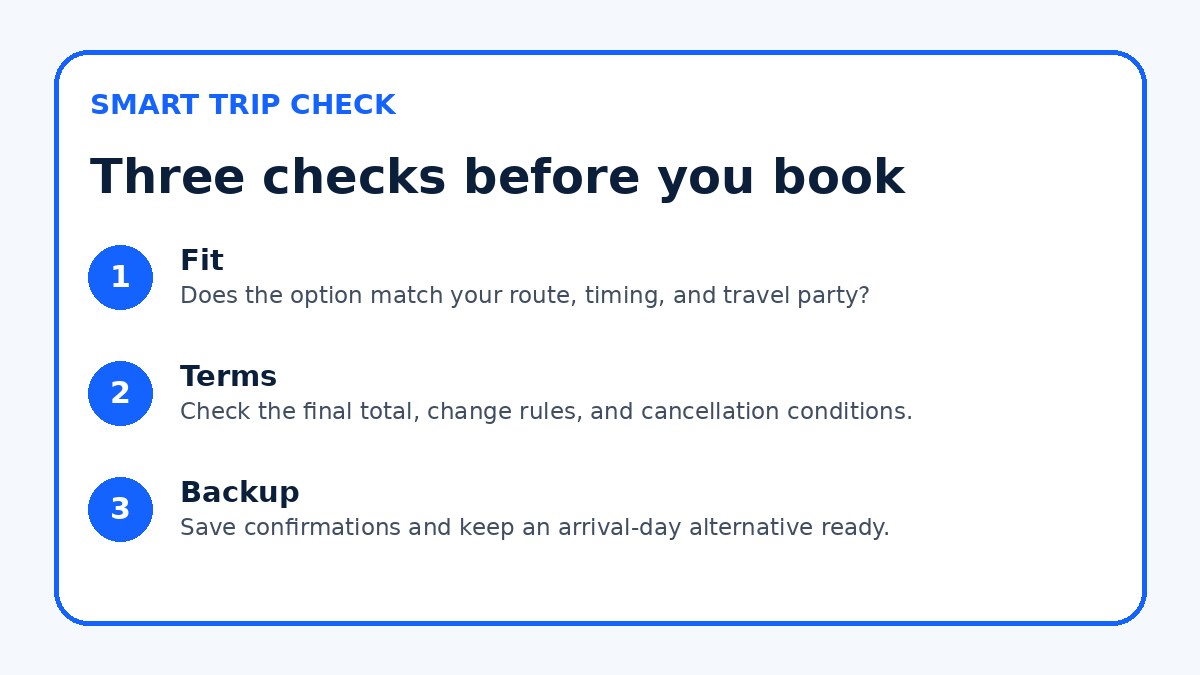
- Map your typical day: plot morning and evening must-see points and measure door-to-door walking or transit minutes from candidate neighborhoods.
- On each hotel page, find and copy cancellation terms, check-in/out times, and any mention of deposits or tourist taxes to confirm before booking.
- Ask the property (email or messaging channel) whether your room will be courtyard- or street-facing and request a quieter room if available.
- Confirm the nearest tram/bus stop names and typical evening service frequency; save taxi pickup instructions for late arrivals.
- Verify the hotel’s Wi-Fi policy and whether a desk, quiet corner, or business lounge is guaranteed for remote work needs.
- Check recent guest photos and reviews for noise, room size, and accurate bed descriptions—then reconcile those findings with the official room category text.
Understand booking terms and what to verify
Before booking, prioritize flexible terms that match your risk tolerance. On the hotel’s final booking page, verify cancellation policy details, whether taxes or city fees are added at checkout, breakfast inclusion, and whether any mandatory security deposit or identity check is required at arrival. Trip.com can be used to compare current availability and basic policy language, but always confirm specifics with the hotel’s official confirmation email or provider page.
Also verify arrival logistics: official check-in and check-out times, early check-in or luggage-holding policy, and whether the property offers airport or station transfers (if you need them). If you rely on public transit, confirm nearest tram/bus stop names and typical time to the station; if you’ll take taxis, check whether the hotel has a convenient pickup zone and if the area is safe to wait at night. Finally, check the payment options accepted and whether any deposit or charge is taken prior to arrival.
Hotel Guide questions travelers ask
Should I always pick the historic centre for convenience when visiting Florence alone?
Not necessarily. The historic centre offers unmatched proximity to major attractions and a lively evening scene, which reduces transit time and makes spontaneous plans easier. However, it often means smaller rooms, more street noise, and higher foot traffic that can be fatiguing for some solo travelers. If you value larger personal space, quieter nights, or a dedicated workspace, compare options in Oltrarno or residential neighborhoods with good tram connections. Balance your tolerance for crowds against how much in-room comfort and quiet you need for sleep or work.
How can I judge whether a room is quiet and comfortable without visiting first?
Look for explicit mentions of soundproofing, courtyard-facing rooms, and double-glazed windows on the hotel page; these are useful signals. Read recent guest comments focusing on night noise and sleep quality, and examine guest-uploaded photos for room size and layout. When in doubt, message the hotel to request a quieter room category and ask about peak-noise times nearby (markets, bars, street cleaning). Always verify these promises on the provider’s final confirmation; policies and room assignments can change between booking and arrival.
What transit considerations matter most if I pick a quieter neighborhood outside the centre?
Check frequency and hours of the nearest tram or bus, especially for early mornings and late evenings, and confirm the walking route from the stop to your hotel for lighting and safety. A high-frequency 10–15 minute tram during the day can offset a longer distance from the centre better than an unlit 5-minute walk. Also verify whether the hotel offers luggage storage for early arrivals and its advice for taxi pickup points. On the booking page, confirm transit stop names and any recommended directions the property provides.
Final decision note
For solo travelers in Florence, the choice between location and room comfort comes down to daily rhythms and personal priorities. If your days are tightly packed with museums and you crave immediate access to nightlife and dining, a central historic stay minimizes travel time but often means sacrificing room size and quiet. If you prefer larger rooms, quieter nights, and space to work or unwind, selecting Oltrarno or a residential neighborhood with reliable transit links will likely improve your overall experience. Use the checklist to map your days, verify policies on the booking page, and ask the property specific room-orientation and noise questions. Shortlist an area first, then compare room photos and cancellation terms so you can confidently book the balance that fits your solo trip needs.
Continue planning
Check current options and final conditions
Use the provider page to confirm live availability, the final total, cancellation terms, and every condition that matters to your trip.
This evergreen planning guide was created with AI-assisted drafting and a structured quality review. It does not display live prices, schedules, availability, visa guidance, or provider rankings. Verify current details before booking. Some links are affiliate links; we may earn a commission at no additional cost to you.