Practical choice first: if you value predictable transfers and easy luggage handling, prioritize direct daytime rail (or a single-connection coach) that connects central Amsterdam and central Berlin with simple station layouts and porter-friendly paths. If cost or schedule flexibility is a higher priority, a coach or a combined rail+coach option may save money but typically increases transfer friction and time with luggage. For those who must keep work accessible, consider a single piece of carry-on and one checked suitcase or a compact wheeled case and a laptop bag—this combination balances mobility with meeting-ready presentation. Whatever option you select, confirm luggage allowances, station-to-office transfers, and connection buffer times on the provider’s final booking page; Trip.com can be used to compare current availability but always verify operator baggage rules and terminal addresses directly before booking.
How to choose between rail, coach, and mixed options
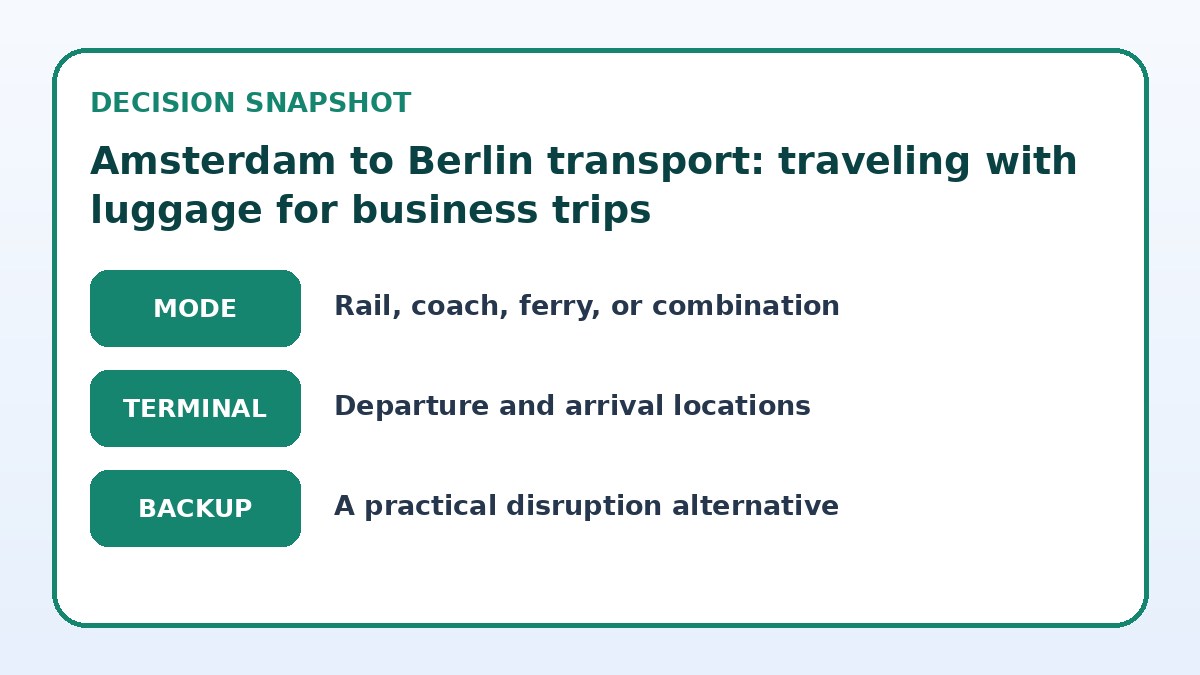
Start by ranking what matters most: fewer transfers, travel-time predictability, or lower cost. Rail between major European cities usually offers dedicated luggage space, level boarding, and stations in city centers—this reduces last-mile friction if your meetings are downtown. Coaches can be cheaper and sometimes direct, but they load luggage into underfloor bays and often require a bus station transfer that adds walking, lifts, or shuttle waits. Mixed options—train plus regional bus or coach—can be useful when schedules don’t align, but they increase the number of times you handle bags and the chance of a missed connection.
For business travelers who must remain presentable and reach central offices without hassle, prioritize routes with single-mode journeys or one easy transfer. Compare door-to-door implications: where will you be dropped, how far is the drop-off from your meeting venue, and whether the transfer requires stairs, long corridors, or crowded metros. When time is critical, direct daytime rail typically gives predictable arrival times and station facilities like luggage trolleys and staffed information desks; if you accept extra handling for lower cost, a coach or mixed itinerary might be acceptable, but plan additional buffer time.
Choose the end-to-end journey plan
| Journey approach | Best for | Friction to check |
|---|---|---|
| Prioritize direct rail (single-mode) | Business travelers needing predictable door-to-door timing and minimal luggage handling | May cost more and require early booking to secure preferred seats and luggage space |
| Choose direct coach or bus | Travelers prioritizing lower fares with a single-mode journey and willing to accept underfloor luggage handling | Often longer journey times and potentially inconvenient station drop-off for downtown meetings |
| Select mixed train+coach connections | Flexible schedules where no single direct option fits arrival or departure needs | More transfers increase luggage friction and the risk of missed connections |
| Plan for rail with taxi/ride-hail last mile | Those who want central train stations’ advantages but need a fast, door-to-door transfer to specific offices | Extra cost and exposure to road traffic variability between station and meeting location |
Check live intercity options
Look beyond the ride itself and compare terminals, transfers, luggage, and arrival fit.
Terminal fit and luggage/transfer friction
Assess each terminal’s layout and the practicalities of moving luggage through it. Major train stations usually have wide platforms, elevators, and level access that simplify wheeled suitcases, business cases, and garment carriers. By contrast, some regional bus stations or peripheral coach terminals may have long walks, curbs, or limited elevator access, which increases the time and physical effort to move bags. Check maps or station plans and note where taxis or ride-hail pick-ups are located relative to platforms or bays.
Luggage friction includes loading, unloading, carrying, and potential storage. If you travel with multiple bags, look for services such as porters, luggage trolleys, or secure left-luggage facilities at stations. Consider a compact trolley and a professional-looking day bag to hand-carry essentials for meetings. When a transfer is unavoidable, choose connections with short, sheltered walkways or single-platform changes; avoid itineraries requiring multiple levels of stairs, long outdoor transfers in poor weather, or late-night moves when staff are reduced.
Timing flexibility and planning realistic buffers
Business travelers should be conservative with timing. While advertised journey durations can look tight on paper, real-world delays, platform changes, and slow luggage handling are common. Build a buffer for each leg: a minimum of 30–45 minutes for simple same-station transfers, and 60–120 minutes when you must change modes, move between distant terminals, or clear border formalities. If you plan meetings soon after arrival, aim for earlier trips that leave more margin for recovery from disruption.
Consider how your schedule handles variability. If meetings are time-critical, favor morning departures that arrive well before appointments rather than last-minute arrivals. If your plans tolerate moderate variability, you can choose a cheaper or later option but keep a contingency plan—a co-working space near the arrival terminal or a flexible meeting slot—to reduce stress. Also factor in peak traffic times for taxi or ride-hail pickups when calculating door-to-door time, especially for stations located at the edge of city centers.
Compare the practical alternatives
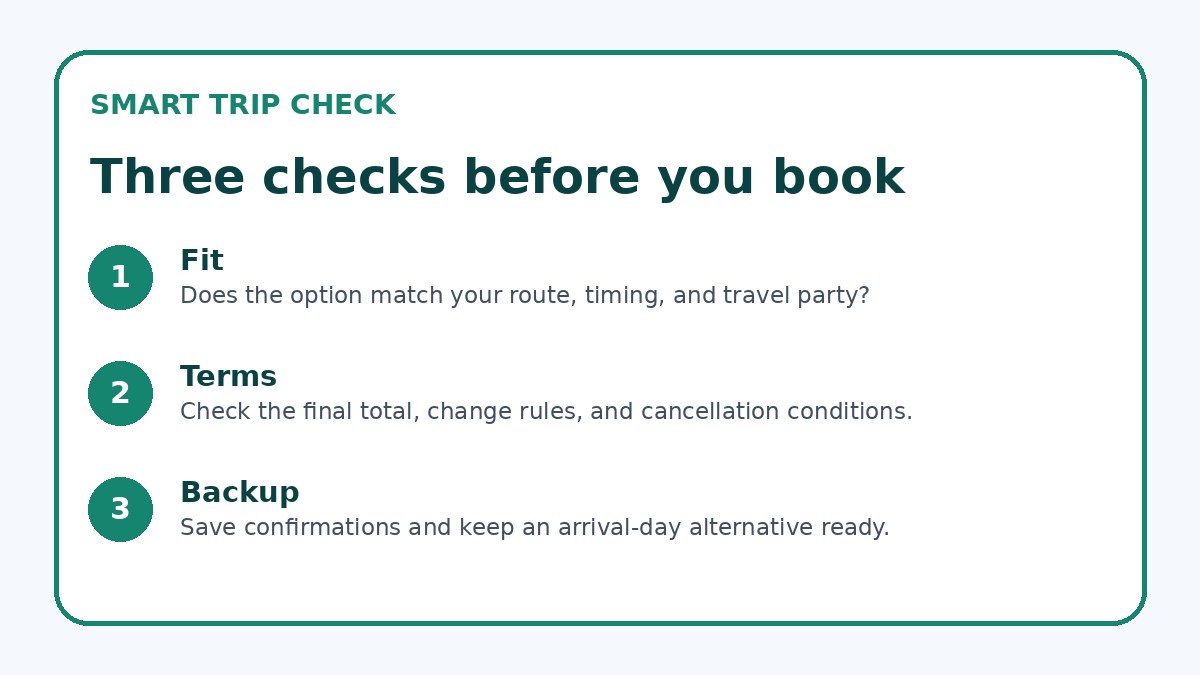
Use the final page to confirm what is actually offered on your dates and save a workable fallback.
Intercity travel checklist
- Measure suitcase dimensions and confirm each operator’s maximum allowed luggage size and number on the final booking page.
- Reserve seats or baggage arrangements when booking trains to secure space for wheeled cases and avoid last-minute juggling.
- Map the station exit to the nearest taxi rank or ride-hail pick-up point and save its walking directions to your phone.
- Pack meeting essentials—chargers, presentation USB, a change shirt—in carry-on to stay operational if checked luggage is delayed.
- Allow at least one hour buffer for in-station transfers and two hours for cross-mode connections or border procedures.
- Save contact info for station customer service and your corporate travel desk for quick rebooking in case of disruption.
Disruption backup: what to prepare if something goes wrong
Create a short disruption plan before you travel: three alternate onward options, contact details for station customer service, and a list of local taxi or ride-hail operators that accept card payment for business expense reporting. If a connection is missed, you may need to rebook on the next train, take a coach, or use a taxi. Know where the staffed help desks are at stations; they can often assist with immediate rebooking or guidance on luggage retrieval if a bag is held elsewhere.
Also prepare document-level backups: digital copies of itineraries, booking references, and a basic packing list accessible on your phone. Keep essential meeting items—chargers, presentation materials, and a fresh shirt or garment bag—in your carry-on so you can still attend a meeting if a checked bag is delayed. Finally, allow a budget line on your corporate card for emergency taxis or same-day luggage shipping services if urgent delivery of a delayed suitcase is required.
Rail & Intercity Transport questions travelers ask
Can I bring multiple suitcases when traveling between Amsterdam and Berlin for business?
Policies on the number and size of suitcases vary by operator and ticket type. Before you book, check the exact luggage allowance on the provider’s final booking page: some rail tickets allow multiple pieces with no formal limit while coaches typically define per-person allowances and may charge for excess. If you must travel with more than one checked bag, plan for added handling and confirm whether station staff or porters are available. Always mark luggage with your contact details and keep important work items in a carry-on.
Is it faster door-to-door to take a train or a coach between Amsterdam and Berlin?
Speed depends on station and terminal locations, connection specifics, and last-mile transfers. Trains often offer more direct, central-to-central service with faster station procedures and level boarding, which reduces handling time for luggage and eases boarding. Coaches can be competitive on direct routes but sometimes stop at peripheral bus terminals that add taxi or shuttle time. To compare door-to-door durations, add scheduled ride times to expected taxi or transit connections and include realistic buffers for luggage handling and traffic variability.
What should I do if a checked bag is delayed on this route?
First, report the delay immediately to the operator’s baggage or customer service desk and get a written or digital record of the report and reference number. Keep proof of any essential items you buy while waiting, as some corporate travel policies reimburse emergency purchases. Ask the operator for an estimated delivery time and whether same-day luggage forwarding is available to your hotel or office. Meanwhile, use your carry-on to stay functional for meetings and notify your corporate travel manager so they can assist with rebooking or arranging courier delivery if your company covers it.
Final decision note
For business travelers moving between Amsterdam and Berlin with luggage, prioritize door-to-door practicality over marginal gains in on-paper journey time. Direct daytime rail often reduces transfers and luggage friction, while coaches or mixed options can be suitable when schedules or budgets demand flexibility. Prepare by confirming baggage allowances on the operator’s booking page, packing meeting essentials in carry-on, and saving local pickup points and customer-service contacts. Finally, plan realistic buffers and a simple disruption plan so you can focus on meetings rather than logistics. Use comparison tools such as Trip.com to check current availability, but verify luggage rules and terminal details with the operator before you commit.
Continue planning
Check current options and final conditions
Use the provider page to confirm live availability, the final total, cancellation terms, and every condition that matters to your trip.
This evergreen planning guide was created with AI-assisted drafting and a structured quality review. It does not display live prices, schedules, availability, visa guidance, or provider rankings. Verify current details before booking. Some links are affiliate links; we may earn a commission at no additional cost to you.