Practical answer first: pick the option that matches how you value time versus risk. If you prioritize fewer hassles and faster door-to-door travel, aim for the most direct schedule available between Seoul and Bali. If you prioritize lower fares or a wider schedule choice, look at one-stop connections—even if they add complexity. For couples, consider comfort, sleep opportunities, and who handles transfers. Before you search fares, lock in exact travel dates, traveler ages, airport choices (Seoul has multiple airports), and how much checked baggage you need. That lets you compare total door-to-door time, transfer windows, and fare rules side-by-side. The sections below walk through routing, baggage and connection risk, schedule fit for couples, and the fare conditions and booking checks to run on the providers’ final pages.
See live routes for your exact travel day
Compare direct and connecting choices with the same baggage and traveler details.
Routing choices: direct versus connecting
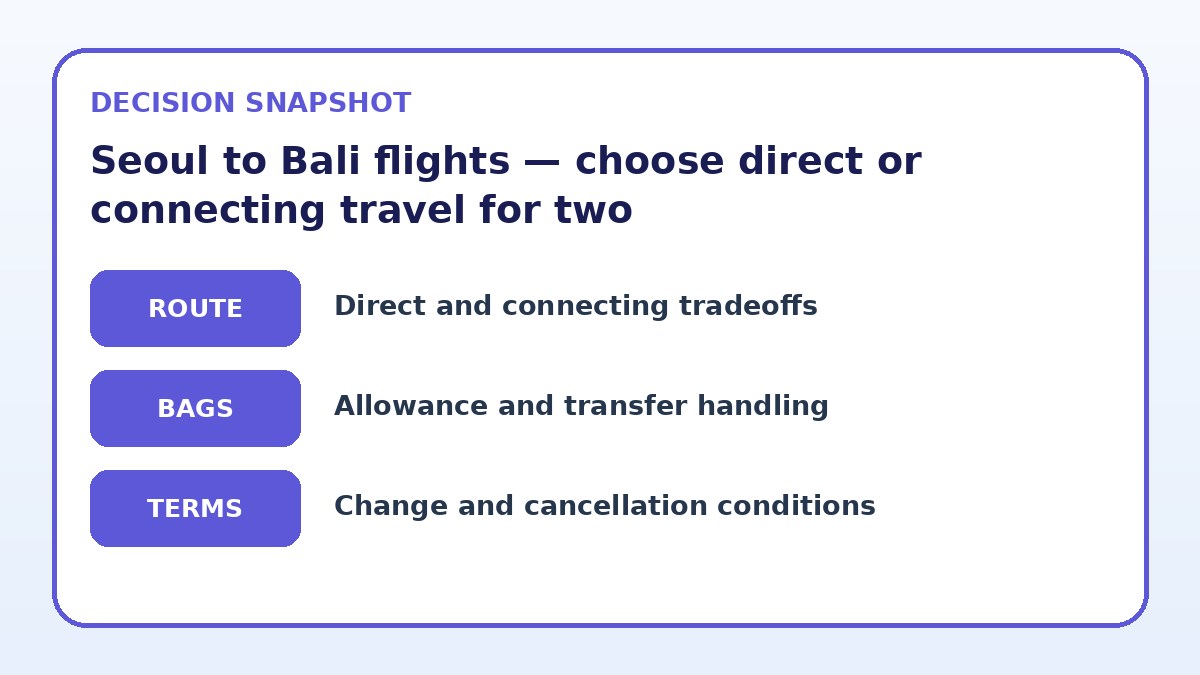
Start by listing direct and connecting itineraries for your exact dates. Many routes between Seoul and Bali may appear as nonstop or one-stop options depending on the carrier and season—don’t assume either will be offered on your dates. When you compare, look at door-to-door travel time (including ground transfers and recommended airport arrival windows), not just airborne time. For couples who want to maximize vacation time together, a shorter total journey often outweighs a small fare saving. If both partners have limited leave or short trip windows, prioritize the itinerary with the most reliable arrival time rather than the cheapest calendar fare.
If direct options exist on your travel days, check multiple departure airports in Seoul because different airports can produce different schedules and fares. For connecting options, note where the stop is located and how long the layover is—some connections are short and riskier, others are long enough to rest or even leave the airport if that interests you. Also check whether the connection requires changing terminals or re-clearing security, which adds transit time. Write down each itinerary’s transfer type and total travel time so you can compare pairs side-by-side.
Baggage and connection risk for couples
Baggage rules and connection handling are one of the biggest practical differences between direct and connecting itineraries. On a single-ticket itinerary where all segments are on one booking, checked bags are usually transferred automatically, lowering the risk and effort during layovers. If you plan separate tickets or a mix of carriers, you may have to claim and recheck luggage and pass immigration at the connection—discover this before booking to avoid surprises. For couples, agree who carries important items and whether you need easy access to passports, medications, or in-flight essentials in a carry-on during transfers.
Also confirm whether the connection includes airline-to-airline transfers under a code-share or interline agreement. If not, build more buffer time and plan for potential additional fees at check-in. When comparing options, quantify the connection risk by noting minimum and recommended connection times, the airport layout at the transfer point, and whether both flights operate on the same ticket. That helps you trade off a lower fare against the added stress and time that comes with more complicated baggage and transfer procedures.
Compare flight-selection strategies
| Flight strategy | Best for | Risk to check |
|---|---|---|
| Direct nonstop (single-ticket) | Couples prioritizing minimal transit time and lower transfer stress | Usually fewer schedule options and sometimes higher fares or limited seat availability |
| One-stop through a single carrier (interline ticket) | Couples wanting a balance of cost savings and protected connections | Longer overall travel time and potential layover discomfort despite automatic baggage transfer |
| Separate tickets or mixed carriers to lower fare | Flexible couples willing to manage baggage and recheck procedures for savings | Higher risk of missed connections, extra fees, and needing to pass immigration at transfers |
| Long layover with planned stopover or overnight | Couples who want to break the journey, rest, or do a brief stopover experience | Adds time and possibly lodging costs, but reduces transfer stress and improves comfort |
Recheck the complete itinerary
Confirm airports, connection handling, baggage, and change conditions before deciding.
Schedule fit and comfort choices for couples
For couples, schedule fit is as much about sleep cycles and joint comfort as about price. Long daytime departures may let you be fresh on arrival, whereas red-eye or overnight options can maximize daytime on destination but leave you tired. Check if either partner prefers a daytime arrival or wants to avoid night transfers. Also look at flight durations and aircraft departure times so you can book seats together, plan in-flight meals, and decide whether extra legroom or bulkhead seats are worth the upgrade to arrive more comfortable and connected as a pair.
Beyond seats, examine layover lengths and the chance to rest versus rushing through an unfamiliar airport. A longer connection might allow you to share a lounge pass or book a short airport hotel room to recharge—useful on longer multi-leg journeys. If direct flights are available, they often reduce the small disruptions couples find annoying, such as separate restroom queues or gate changes. But connecting itineraries sometimes give you better departure times or more flexible return options, so match the schedule to how you want to spend your vacation time together.
Flight details to verify
- Confirm exact outbound and return dates, traveler full names and birth years, and preferred Seoul airport before searching fares.
- Compare total door-to-door travel time for each itinerary, including recommended airport arrival windows and airport transfer times.
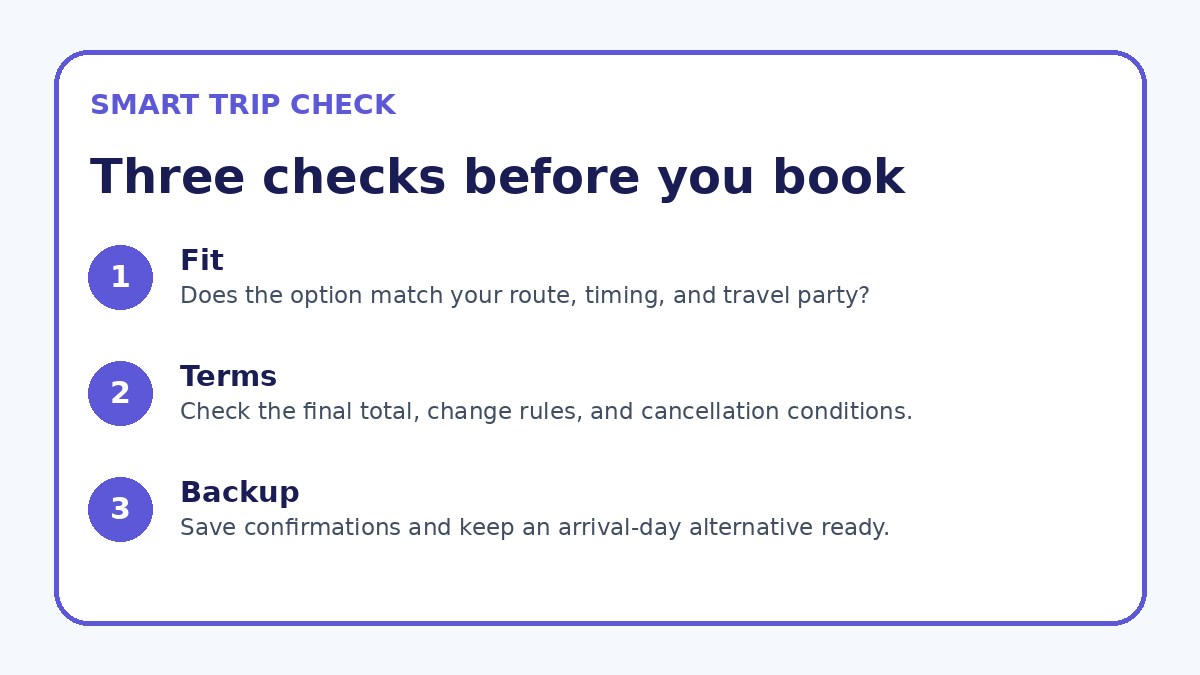
- On the booking page, verify fare conditions: change and cancellation fees, refund rules, and whether baggage is included or charged separately.
- Check whether your itinerary is a single-ticket protected connection or requires separate ticket transfers and rechecking baggage.
- If you need adjacent seats, verify seat assignment rules and fees on the provider page and book seats at purchase if possible.
- Note visa or transit rules for any connection country and confirm required documents on official government or airline pages before departure.
Fare conditions and booking checks to run
Before you click buy, read the fare conditions on the airline or OTA booking page—refundability, change fees, seat assignment rules, and the carry-on and checked baggage allowances. These details determine real flexibility and total cost. For couples, pay attention to seat assignment policies; some low-fare classes block seat selection until check-in or charge for adjacent seats. Also verify whether the fare allows mixing cabin classes on different legs, and if taxes or airport fees differ by departure airport, because the final checkout total can shift as you change dates or airports.
When comparing multi-ticket itineraries, check whether missed connections are protected. If separate tickets aren’t covered by a single agreement, you accept the risk of rebooking at your expense. Also verify visa or transit requirements for any connection country on the carrier’s final page and the embassy pages if needed. On the provider page, confirm exact baggage dimensions and weight limits, seat selection options, the final total with taxes and service fees, and the cancellation/change cost so you avoid surprises after booking.
Flight Guide questions travelers ask
Should couples always choose direct flights between Seoul and Bali when available?
Not necessarily. Direct flights reduce the number of transitions and the chance of missed connections, which suits many couples seeking simplicity. But direct options may be limited by departure times, seat availability, or cost. If your priorities include lower fares, specific departure times, or collecting airline loyalty points, a well-timed connecting itinerary on a single ticket can be a sensible tradeoff. Evaluate directness versus schedule and fare rules for your specific dates and how comfortable you are managing potential layovers.
How long should a layover be to feel safe when booking a connecting flight as a couple?
Aim for a layover that matches the airport’s recommended minimum plus a buffer for delays and transit between terminals. Smaller single-terminal connections can be tighter, while large international hubs often require more time to navigate. If your connection involves immigration, security re-screening, or switching terminals, add at least an extra hour compared with the minimum. Also consider whether you want time to use a lounge, get a meal, or handle unexpected delays—couples often prefer slightly longer layovers to reduce stress.
What booking checks prevent surprise costs or seat separation for two travelers?
Before finalizing purchase, confirm whether seats are assigned and whether adjacent seat selection is complimentary or paid. Check the baggage allowance and the price for additional checked bags at checkout, because low-fare classes sometimes exclude them. Read the fare rules for change and cancellation fees and whether the fare is refundable. If the itinerary involves separate tickets, verify baggage transfer rules to avoid paying recheck fees. Finally, compare the final total price with all taxes and fees visible on the airline or OTA booking page to prevent surprises.
Final decision note
Choosing between direct and connecting Seoul to Bali flights comes down to how you and your partner value time, comfort, and certainty. Direct itineraries typically reduce transfer hassles and shorten door-to-door time, which helps couples arrive rested and together. Connecting options widen scheduling possibilities and can lower ticket prices, but they introduce baggage and transfer risks that you must plan for. Prepare by confirming exact travel dates, passenger details, and baggage needs before you search. Then compare total travel time, protected-connection status, and fare rules on the provider’s checkout page. That disciplined comparison will let you book the itinerary that fits your couple’s priorities with confidence.
Continue planning
Check current options and final conditions
Use the provider page to confirm live availability, the final total, cancellation terms, and every condition that matters to your trip.
This evergreen planning guide was created with AI-assisted drafting and a structured quality review. It does not display live prices, schedules, availability, visa guidance, or provider rankings. Verify current details before booking. Some links are affiliate links; we may earn a commission at no additional cost to you.