Practical answer first: for most first-time visitors, San Francisco International Airport (SFO) is the default practical departure for San Francisco to Vancouver flights because it offers the broadest range of nonstops, consistent international facilities, and clearer connection options. However, travelers on a tight budget, heading from East Bay neighborhoods, or prioritizing airport speed may prefer Oakland (OAK) or San Jose (SJC) depending on schedule and fares. The real decision balances route convenience versus fare and transfer risk. Before you search, gather exact travel dates, number of travelers, baggage needs, and your tolerance for connections or airport transfers. That preparation will let you compare direct versus connecting itineraries, check fare rules, and choose the departure airport that minimizes time, stress and unexpected baggage or connection complications.
See live routes for your exact travel day
Compare direct and connecting choices with the same baggage and traveler details.
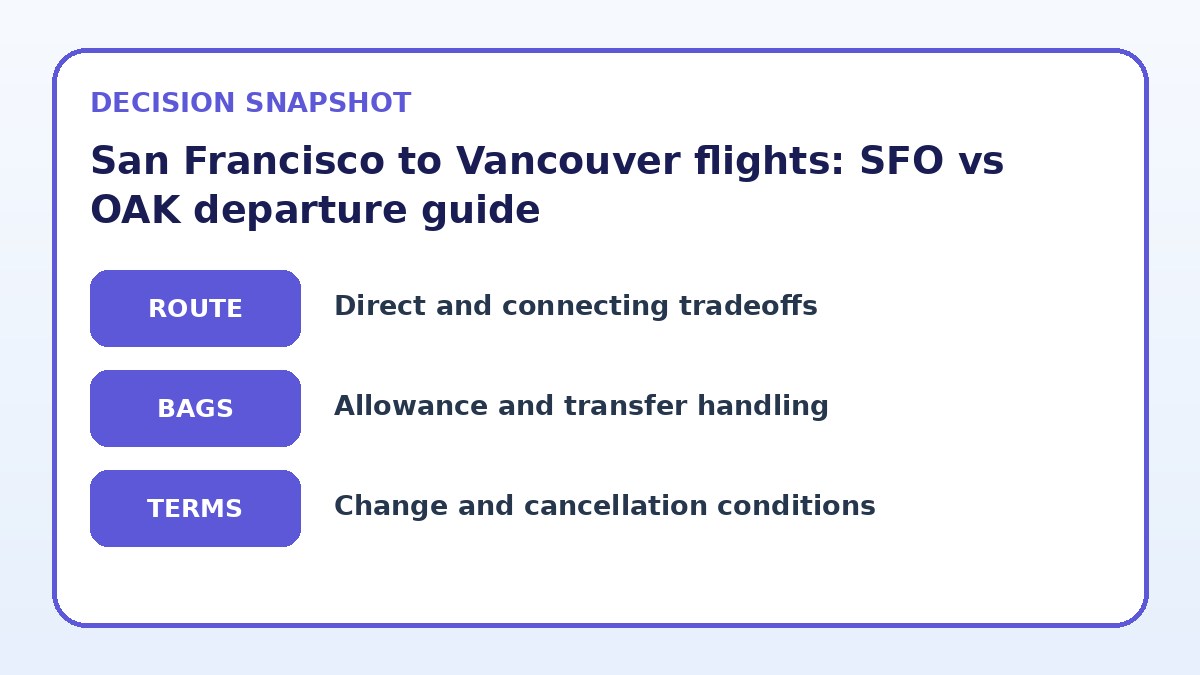
Routing: direct vs connecting and airport access
Start by checking whether direct flights between the Bay Area and Vancouver are offered for your exact dates. Direct flights cut travel-time uncertainty and reduce the chance of missed connections or lost bags. SFO most commonly offers the widest set of nonstop options to Vancouver; OAK and SJC may offer fewer nonstop choices or seasonal service. If a nonstop fits your schedule, that often outweighs a slightly cheaper connecting itinerary, especially on a short trip.
If you must consider a connection, compare where the connection occurs and how tight the layover is. Connecting through another U.S. hub can add customs and re‑screening steps on the return, so prefer a single international carrier that protects your baggage through to the final destination. Also factor ground travel time: SFO sits south of San Francisco city center, while OAK is closer to East Bay neighborhoods and SJC serves South Bay travelers. Add realistic commute times and transit reliability into your routing decision.
Baggage and connection risk: minimizing surprises
Baggage risk rises with connections, multiple carriers, and tight layovers. If you check luggage, prioritize itineraries marketed as a single ticket with through-checked bags; this reduces handling steps. At SFO, international baggage handling and interline procedures are typically more established, which can reduce misrouting risk. If using separate tickets—for example, booking a cheap one-way from OAK to a connecting city and another carrier onward—expect to claim and recheck bags, which increases the chance of delays or loss.
Also evaluate the airport transfer you’ll face before departure. A cheaper fare from OAK becomes less practical if you need a long, uncertain transfer from downtown San Francisco, especially during peak traffic. For returns, remember that clearing customs on arrival in Canada is straightforward but check whether you must present travel documents or complete any forms in advance; verify entry requirements on official government pages. Always read the carrier’s baggage policy and the final booking page for size, weight, and transfer rules before committing.
Compare flight-selection strategies
| Flight strategy | Best for | Risk to check |
|---|---|---|
| Choose SFO nonstop when available | Travelers who prioritize simplicity and fewer connection risks | Often slightly higher base fares and longer ground commute for some Bay Area neighborhoods |
| Pick OAK for lower fares and local convenience | Budget-sensitive travelers or those living in East Bay neighborhoods | Fewer nonstop options and potentially extra fees for baggage or services increase total cost risk |
| Use SJC when South Bay access matters | San Jose–area travelers wanting shorter drive times to the airport | Reduced flight frequency to Vancouver and possible need to connect through another U.S. hub |
| Book connecting itineraries for cheaper total fare | Flexible travelers willing to trade time for lower ticket prices | Higher risk of missed connections, baggage issues, and longer overall travel time |
Recheck the complete itinerary
Confirm airports, connection handling, baggage, and change conditions before deciding.
Schedule fit: daily frequencies and time-of-day tradeoffs
Match departure windows to your trip priorities: early departures maximize your arrival day in Vancouver; late-afternoon flights may give you a later start but reduce the risk of same-day disruption. SFO typically has a denser schedule across several time slots, offering more flexibility to pick a departure that avoids rush-hour traffic into the airport. OAK and SJC sometimes have fewer daily departures, which forces you to accept particular time windows or connection patterns.
If you need a tight onward plan in Vancouver—say a specific check-in time or an event—prioritize flights with higher on-time performance and more buffer between connections. Also consider how your domestic transport to the departure airport interacts with the flight time: an early SFO flight might be harder to reach from the East Bay than a later OAK departure. When checking schedules, make sure to verify total door-to-door travel time, not just airborne duration.
Flight details to verify
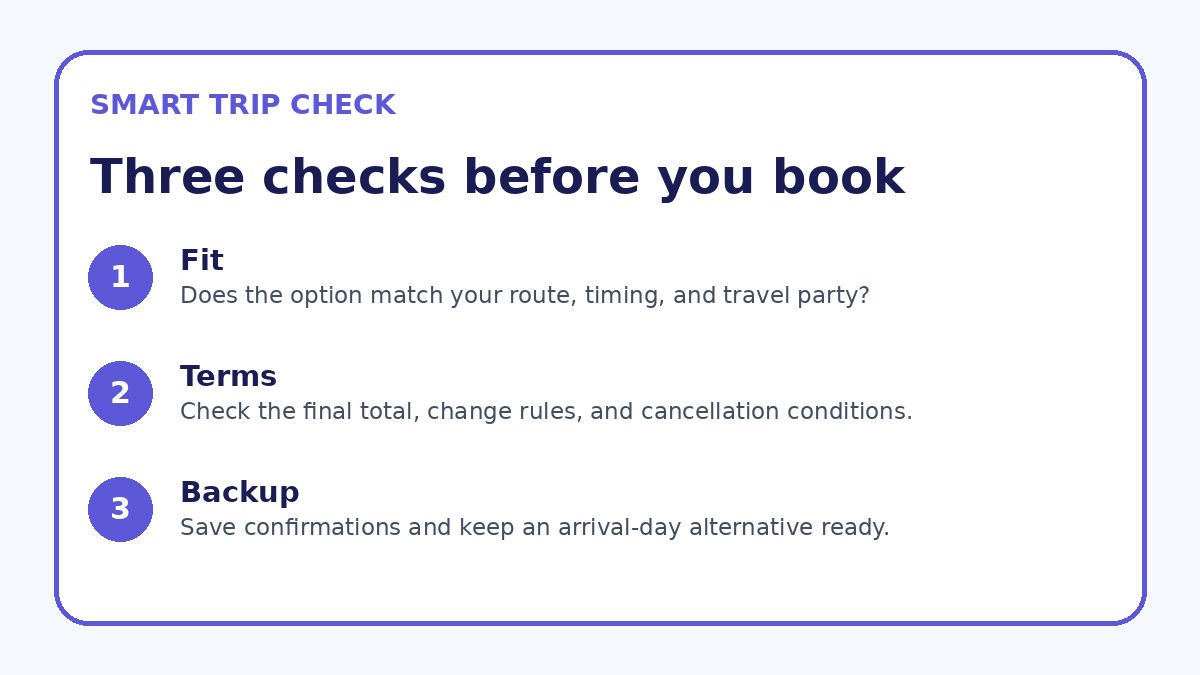
- Confirm exact outbound and return dates, number of travelers, and traveler ages before searching, since fares and fare rules vary by passenger type.
- List required baggage (carry-on and checked) and check the airline’s final booking page for size, weight, and fee details before selecting a fare.
- Compare nonstop vs connecting options and note total door-to-door travel time, not just flight time, to assess practicality.
- If using a different airport (OAK or SJC), calculate realistic ground transfer time from your lodgings and add buffer for traffic or transit delays.
- On the carrier’s booking page, expand fare rules to confirm change, cancellation, and refund policies so you know rebooking options in case plans change.
- If your itinerary mixes separate tickets, arrange minimum connection times, insure for missed connections if needed, and verify you’ll reclaim and recheck baggage where required.
Fare conditions and what to verify before booking
Fare differences can be tempting, but the cheapest fare often carries restrictive change and cancellation rules, baggage fees, and limited seat selection. When comparing San Francisco to Vancouver flights, always expand the fare rules on the carrier’s final booking page to confirm change penalties, refundable status, carry-on and checked bag allowances, and whether seat assignments are included. Low-cost carriers based at OAK or SJC may charge separately for nearly every extra service; factor those add-ons into the total cost.
Also check whether the ticket allows rebooking onto alternate flights in case of disruption and whether fares are clear about connections on separate tickets. If you use a travel site, confirm the final carrier page or contact the airline to verify policies. Trip.com can be used as one place to compare current availability and conditions, but always verify baggage size limits, refundability, and schedule change rules directly with the airline before purchase.
Flight Guide questions travelers ask
Is it worth driving to Oakland or San Jose to save on airfare for a Vancouver trip?
Driving to OAK or SJC can be worth it if your time cost and transfer expense are low and the fare difference is meaningful. However, check total door-to-door time: a cheaper ticket that forces a longer commute or an overnight stay before an early flight can erase savings. Also confirm baggage fees and whether the fare is on a low-cost carrier with many add-ons. For many first-time visitors, the reduced stress and higher chance of a nonstop from SFO outweigh a small fare saving from a different Bay Area airport.
How should I handle baggage when my itinerary includes separate tickets or different carriers?
If your journey uses separate tickets or different carriers, assume baggage will not be through-checked unless the airlines explicitly state otherwise. That typically means you must collect your bags after each flight, clear any necessary security or customs steps, and then re‑check them—adding time and complexity. Build a long connection buffer and verify baggage transfer policies on the airlines’ booking pages. If carrying valuable or essential items, keep them with you in carry-on luggage to reduce risk of temporary loss.
What details should I have ready before I search for San Francisco to Vancouver flights?
Before searching, have these specifics: exact travel dates and preferred departure/return windows, number of travelers and ages, planned checked bags and carry-ons, seat-preference needs, and whether you require refundable/changeable fares. Also note your starting point (city neighborhood) to estimate transfer times to SFO, OAK, or SJC. These details let you filter for nonstop or single-carrier itineraries, accurately calculate total travel time, and compare true total costs after baggage and transfer expenses.
Final decision note
Choosing the most practical departure airport for San Francisco to Vancouver flights depends on a clear look at routing, baggage and connection risk, schedule fit, and fare conditions. If simplicity and a higher chance of nonstop service are your priorities, start with SFO. If you live in the East or South Bay, or you can accept a connection or add-on fees, OAK or SJC might save money and time on ground transfers. Always prepare precise travel dates, traveler details, and baggage counts before comparing live options; expand fare rules on the carrier’s booking page and verify baggage and change policies. That disciplined comparison lets you pick the departure airport that keeps the trip predictable and aligned with your priorities.
Continue planning
Check current options and final conditions
Use the provider page to confirm live availability, the final total, cancellation terms, and every condition that matters to your trip.
This evergreen planning guide was created with AI-assisted drafting and a structured quality review. It does not display live prices, schedules, availability, visa guidance, or provider rankings. Verify current details before booking. Some links are affiliate links; we may earn a commission at no additional cost to you.