If you’re traveling to Osaka with oversized or extra bags, the pickup and return terms for a rental car are often the feature that decides whether driving helps or hinders your trip. Driving adds flexibility for airport transfers, day trips, and reaching neighborhoods with limited luggage-friendly public transit, but it also shifts the burden to vehicle size, trunk space, reservation rules, and return logistics. This guide gives the short answer up front: drive in Osaka only if your itinerary needs door-to-door flexibility and you’ve confirmed pickup/return allowances for bulky items, insurance wording about luggage, and easing the return process near your final stay. Read on for the practical tradeoffs, exact items to verify on a provider’s booking page, and a clear non-driving fallback if a car would just be extra friction rather than freedom.
Decide whether driving truly improves your Osaka itinerary
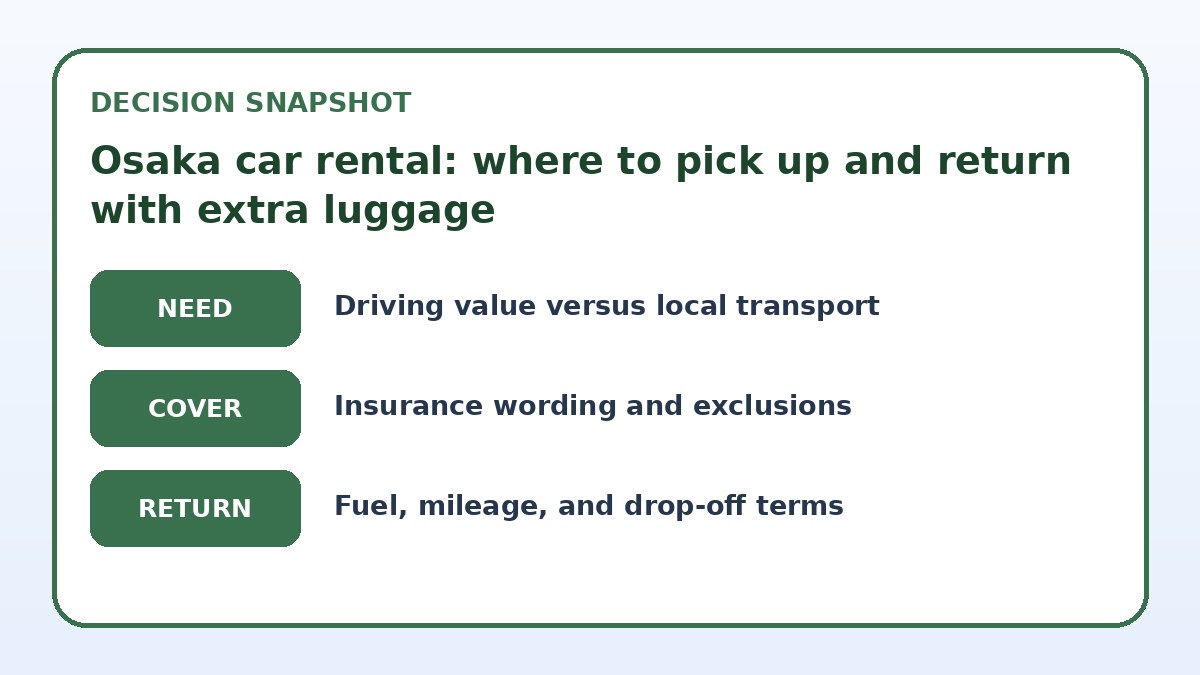
Start by mapping each major movement in your trip: airport to accommodation, day trips, station transfers, and your final departure. Driving best serves itineraries with multiple stops outside central Osaka—near Kansai suburbs, coastal sights, or if you plan early starts and late finishes when public transit is sparse. If your schedule centers on central Osaka neighborhoods (Umeda, Namba, Tennoji) or relies on railway connections to Kyoto or Kobe, a car can create more hassle than convenience because parking and narrow streets add time and stress.
Also factor luggage handling: if you have several large suitcases, sports gear, or musical instruments, confirm whether those items will fit together in a recommended vehicle class. Sometimes reserving a compact SUV or larger category is necessary, but categories differ between providers. If the bulk of your route is within city centers with short transfers, a non-driving plan with taxis or luggage-forward services may be less friction than managing vehicle pickup, city parking, and return logistics.
Decide whether driving earns its place
| Mobility strategy | Best for | Cost or friction to check |
|---|---|---|
| Full rental car for entire trip | Travelers needing maximum door-to-door flexibility with multiple remote stops or heavy baggage. | Higher pickup/return friction, parking hassle, and need to verify trunk space and insurance details. |
| Short-term rental only for specific day trips | Those who mainly use public transit but need a car for one or two bulky-item excursions. | Requires additional pickup/return steps during the trip and may add scheduling constraints. |
| Public transit plus occasional taxis | Travelers staying in central Osaka who want to avoid parking and long-term rental logistics. | Can be costly for many long-distance trips and may require multiple taxi rides when moving lots of luggage. |
| Luggage-forward services and guided day trips | Those who want to move heavy bags without carrying them and still reach remote attractions via guided transport. | Less flexibility on timing and routes; you must coordinate pickup/drop-off times with providers. |
Check live rental choices only after the route test
Use the exact driver, dates, pickup point, and return plan to compare current conditions.
Route value: where a car wins and where it doesn’t
A car shines when it unlocks destinations that are otherwise slow or complex by public transport: remote gardens, seaside parks outside the city, or multi-stop rural routes in Kansai. For heavy-luggage travelers, the ability to stow everything in one trunk and go without juggling bags through stations or multiple taxis is a real time-saver. When day stops are widely spaced, driving reduces the effort of carrying suitcases on and off trains and consolidates luggage transfers.
Conversely, inside Osaka proper and on popular intercity corridors to Kyoto and Kobe, trains are frequent, reliable, and often faster than driving once you account for locating parking and walking to attractions. If parking near your accommodation will be expensive, limited, or require long walks, the route value of a car declines. Evaluate door-to-door travel time, not just driving time, and remember that bulky baggage can increase transfer times at stations and between parking areas and hotels.
Compare the full rental conditions
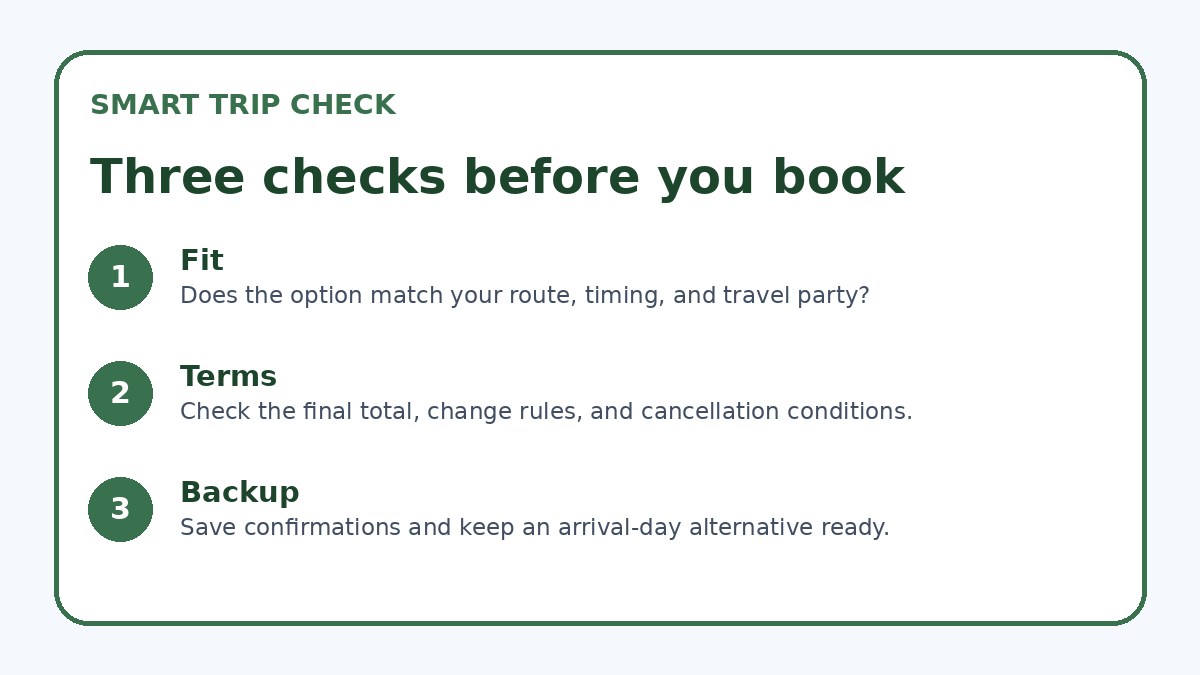
Confirm insurance wording, exclusions, deposit, fuel, mileage, and return terms on the final page.
Pickup and return friction: the terms that matter for bulky luggage
On the provider’s booking page, verify specific pickup logistics: whether the desk is inside the airport terminal or across the road, whether shuttle buses run and if they accommodate oversized bags, exact operating hours, and whether staff will help load items into vehicles. Look for a clear vehicle class description and photos showing trunk space; if none are provided, contact the provider to confirm dimensions or request a larger vehicle. Ask how incremental items (child seats, roof boxes) are handled and whether the provider offers them onsite.
For returns, check opening hours, whether after-hours key drop is accepted, and how final inspection works when you have extra luggage. Many providers penalize for late returns or damage even if caused by awkward loading. Read fuel, mileage, and cleaning policies carefully—some companies charge deep cleaning fees for items left behind or for debris from bulky gear. When provider-specific facts could change, note them and verify them on the final booking page before you commit.
Car rental terms to verify
- Confirm exact pickup location details (terminal desk, shuttle stop, or off-airport lot) and whether staff will assist loading oversized bags.
- Verify the vehicle category’s usable trunk dimensions or request a specific larger category if you have multiple or oddly shaped items.
- Read return instructions for after-hours drop-off, key-drop acceptance, and any inspection process related to luggage left in the vehicle.
- Check insurance and waiver wording for exclusions related to loading/unloading, personal effects limits, and whether roof racks are covered.
- Ask about additional equipment availability (roof box, trailer, cargo cover) and whether these items must be reserved in advance.
- Compare door-to-door travel time and costs against taxi plus rail alternatives before finalizing a full-trip car rental.
Insurance wording and a non-driving fallback
Insurance policies and supplemental waivers often outline coverage for personal belongings and accidental damage. Check whether the rental’s collision and liability coverage excludes damage caused during loading or unloading, or to items secured on roof racks or inside the vehicle. Confirm if personal effects coverage is offered or requires separate travel insurance and whether there are limits for high-value items. Carefully read exclusions for off-road use, permitted drivers, and cross-border travel if your route leaves Japan.
If a car adds too much logistical burden, the non-driving fallback is a hybrid approach: use taxis for airport transfers, rely on trains for intercity legs, and book occasional day-trip taxis or guided tours to reach places that are awkward by public transit. Luggage-forward services, station lockers for day trips, and selecting accommodation with luggage storage can further reduce friction. Trip.com can be used once to compare current availability and conditions, but always verify pickup, return, and insurance wording on the provider’s booking page before booking.
Car Rental & Road Trip questions travelers ask
Can I reserve a specific trunk size or vehicle model in Osaka to fit my extra luggage?
Most providers sell vehicle categories rather than guaranteeing a specific model; categories imply a range of sizes but don’t promise exact trunk dimensions. If trunk space is critical, request explicit dimensions or photos from the provider before booking and ask whether an upgrade to a larger category is possible at pickup. Confirm on the provider’s final booking page whether reserved equipment (like roof boxes) is guaranteed or subject to availability, and check whether any additional fees apply for larger vehicles or special equipment.
What do I need to watch for in pickup and return terms to avoid unexpected fees?
Carefully read policies about fuel, mileage limits, late returns, and cleaning. Providers often charge cleaning or damage fees for items left in the vehicle or for debris from bulky gear. Verify whether after-hours drop boxes accept keys without staff present and whether there’s an out-of-hours surcharge. Also confirm whether shuttles between terminals and off-airport lots can carry oversized bags; if not, you may need to budget for a taxi to avoid multiple transfers.
If I choose not to drive, how can I most easily handle moving extra luggage around Osaka?
Combine taxis for airport transfers with trains for intercity travel: taxis handle door-to-door moves with heavy bags, while trains are efficient within Kansai. Look into luggage-forward services that move suitcases between hotels, and check whether your accommodation offers early check-in or luggage storage. For day trips to remote spots, consider booking a guided tour or private transfer that can accommodate large items—confirm luggage allowances when you reserve the service.
Final decision note
For travelers with extra luggage, the pickup and return terms are often the decisive factor when planning an Osaka car rental. A car can save time and simplify transfers if your route includes remote stops or many early departures, but it brings additional checks: exact pickup logistics, trunk capacity, insurance exclusions, and return procedures. Use the checklist to confirm these items on the provider’s final booking page, weigh the door-to-door advantages against parking and fee tradeoffs, and consider taxis, luggage-forward services, or short-term rentals for specific legs as effective alternatives.
Continue planning
Check current options and final conditions
Use the provider page to confirm live availability, the final total, cancellation terms, and every condition that matters to your trip.
This evergreen planning guide was created with AI-assisted drafting and a structured quality review. It does not display live prices, schedules, availability, visa guidance, or provider rankings. Verify current details before booking. Some links are affiliate links; we may earn a commission at no additional cost to you.