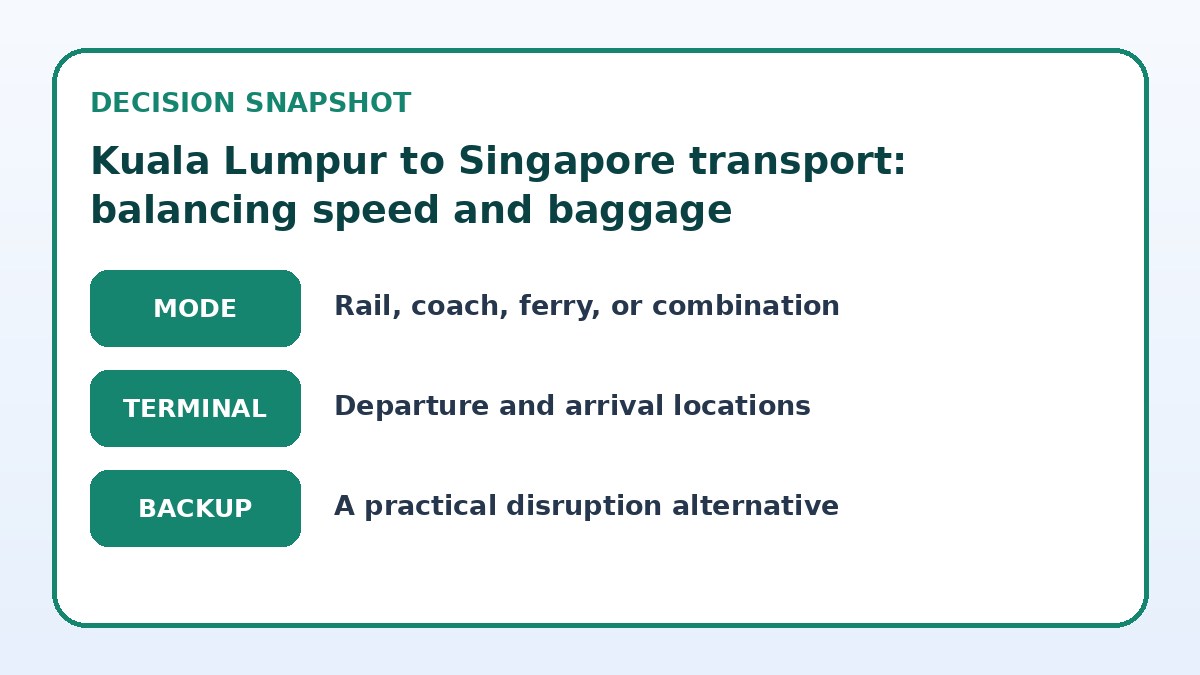
If you must get from Kuala Lumpur to Singapore with business luggage, choose based on how much gear you’re carrying and how tight your schedule is. For a single carry-on and a brief meeting window, a flight usually wins on door-to-door time; for two or more checked bags, bulky cases, or zero-risk transfer plans, a scheduled coach or a mixed rail-plus-coach option can be less stressful because you avoid multiple airport transfers. The practical decision is a balance of terminal fit (where your luggage is handled), transfer friction (taxis, rideshares, or station walks), timing flexibility (how sensitive you are to delays), and a simple disruption backup (clear alternative on the same day). Below I give direct tradeoffs, terminal and transfer notes, and a checklist you can use before you book. If you want a quick comparison of current services and schedules, check Trip.com for live availability before finalizing.
How to choose between rail, coach, air, or mixed travel
Start with two questions: how many bags you’ll carry and how fixed your arrival time must be. If you travel light and need the fastest door-to-door journey, air travel often offers the shortest transit minutes, but you must add time for airport transfers, check-in and potential immigration queues. Coaches and intercity buses usually go to city terminals with easier taxi or rideshare access and often have generous luggage compartments that reduce the need for airport-style check-in. Trains, where available for parts of the route, can provide comfortable seats and table space for working, but they may require coach connections or border transfers that increase handling steps for bags.
For business travelers who prioritize low transfer friction, mixed options can be smart: combine a short rail segment to avoid congested roads, then a coach for the border stretch, or fly one way and take a coach back to avoid airport waits. When you plan, map every handoff: which terminal or station handles checked luggage, where a rideshare picks you up, how far your transfer walks are, and whether porters or luggage trolleys are available. These practical details determine whether a faster segment actually saves you time and stress once luggage is in play.
Choose the end-to-end journey plan
| Journey approach | Best for | Friction to check |
|---|---|---|
| Fly direct and take a taxi at each end | Travelers with minimal checked luggage and tight in-air travel preference | Fast in-air time but adds airport transfer friction and potential check-in delays for larger bags |
| Intercity coach to city terminals | Those carrying multiple bags or bulky cases who prioritize simple curbside transfers | Longer in-vehicle time but fewer baggage handoffs and easier last-mile connections |
| Rail for part of the route plus a connector coach | Travelers wanting stable seating and workspace with moderate luggage | Comfortable journey but may require extra transfers that increase handling steps |
| Mixed strategy (fly one way, coach the other) | Business travelers optimizing return flexibility or avoiding airport queues both ways | Combines benefits but requires careful planning to align luggage rules and transfers |
Check live intercity options
Look beyond the ride itself and compare terminals, transfers, luggage, and arrival fit.
Terminal fit and luggage/transfer friction
Assess each terminal’s layout and first- and last-mile connections before booking. Airports typically require a shuttle or city transfer from central business districts; that adds taxi time and potential queueing if you have multiple bags. City coach terminals and major train stations often have immediate curbside drop-offs and easier rideshare access, which lowers friction and can be faster overall for heavy luggage. Also check whether the operator allows checked items and whether there are size or weight restrictions on overhead storage; these rules affect whether you need to pre-book extra handling or a cargo-style transfer.
Factor porter services, luggage carts, and elevator availability into your plan, especially if you have a trolley case plus a garment bag or tech equipment. If a transfer involves steps, long ramps, or platform changes, those minutes can add up and make an otherwise attractive timetable impractical. For border crossings or coach-to-train handoffs, plan a buffer for baggage retrieval and repacking. Wherever possible, choose a single terminal arrival point that minimizes additional handling and gives you direct access to a taxi rank or quick rideshare pickup.
Timing flexibility and scheduling tradeoffs
Decide how much schedule slack you need. For meetings with no flexibility, prefer options with more predictable door-to-door time and fewer modal changes. Flights might have short in-air time but larger variability when you add airport transfers and security processes; coaches and trains often run at consistent intervals and arrive at city centers, offering steadier total travel time for ground transfers. If your schedule allows a few hours’ leeway, choosing an option with easier luggage handling—like a city-terminal coach—can reduce stress even if it takes longer on paper.
Look beyond departure clocks: include check-in windows, immigration or customs practices, typical traffic at pickup/drop-off times, and the time needed for luggage handling. For evening arrivals in an unfamiliar city, a single-transfer plan with a short, pre-booked ride to your hotel is preferable to juggling public transport with heavy bags. When possible, plan meetings slightly later than your arrival and build in a clear buffer for any unavoidable baggage handling or customs processing.
Compare the practical alternatives
Use the final page to confirm what is actually offered on your dates and save a workable fallback.
Intercity travel checklist
- Count and measure every bag; note which can be a carry-on and which must be checked to choose services that permit your load.
- Map door-to-door time: add taxi/rideshare, security/immigration, and luggage handling to in-vehicle travel time before deciding.
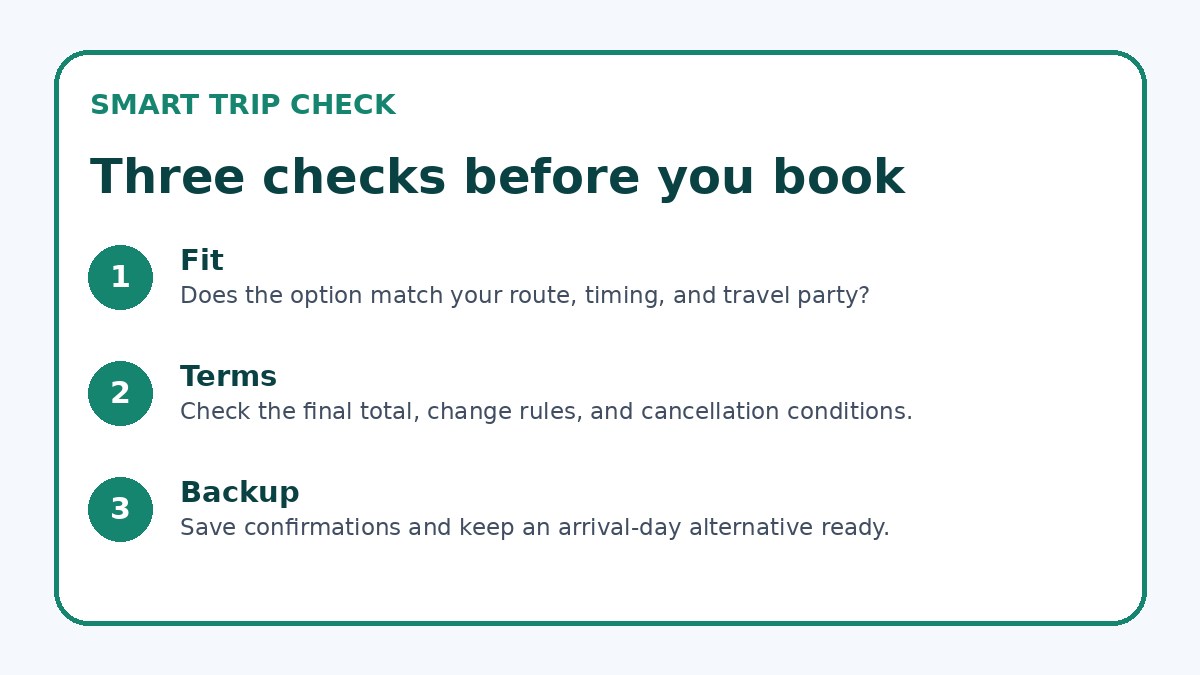
- Confirm luggage allowances and handling policy on the operator’s final booking page, including size, weight, and charges for excess items.
- Identify a same-day backup option and check how luggage is handled if you need to switch services at short notice.
- Arrange pickup/drop-off points that minimize walking or stairs; ask hotels or business centers about holding or receiving luggage.
- Pack a compact work kit and meeting essentials in an accessible carry-on so checked luggage delays won’t disrupt appointments.
Disruption backup and door-to-door practicality
Always identify a same-day fallback: a later coach service, another flight, or an alternative train-plus-coach combination. For business travelers, the best backup is one that keeps luggage handling simple—prefer a second coach or a different city-terminal arrival rather than a complex multi-leg shuffle. Confirm how each operator handles missed connections and late arrivals, and ensure you can reasonably move luggage between services without excessive porter fees or long walks.
Prepare an on-the-ground contingency: a list of local taxi companies with large-vehicle options, a rideshare app that accepts business accounts, and a contact at your hotel who can arrange luggage holding if you arrive early or late. Keep essential documents and a compact carry-on with meeting necessities separate from checked luggage. If you use an online comparison tool, verify luggage rules on the operator’s final booking page before you commit, and consider Trip.com for a quick check of current availability and schedules if you need live service comparisons.
Rail & Intercity Transport questions travelers ask
Can I rely on coaches to handle large or awkward business luggage?
Coaches commonly have external luggage compartments that accept suitcases and certain oversized items, which often lowers handling friction compared with airports. However, size and weight limits vary between operators, and some items may need pre-declaration or incur extra handling fees. Before booking, verify the coach operator’s luggage policy on their official booking page and ask how items are loaded and retrieved at terminals; check whether there are porters or whether you must manage transfers yourself. Choosing city-terminal arrival and departure points typically simplifies the last-mile taxi or rideshare pickup with multiple bags.
How should I plan transfers if I fly into one city and leave from another?
When your itinerary mixes arrival and departure hubs, plan every transfer step with luggage in mind. Map out whether you’ll need to collect checked luggage and re-check it for a different provider, and build time for these tasks. Prefer single-terminal connections where possible, and pre-book ground transfers that can accommodate large bags. If switching modes (air to coach or train), confirm each operator’s check-in and baggage processes on their booking pages. Keep essential documents and a compact carry-on with meeting materials so a delay in checked luggage doesn’t derail immediate business needs.
What’s the best strategy for minimizing door-to-door time with luggage?
Minimize modal changes and choose arrival/departure points close to your meeting location. For light luggage, a flight plus a pre-booked taxi or rideshare often gives the shortest door-to-door window. For heavier or multiple bags, a coach that serves city terminals can reduce handling steps and shave minutes spent moving luggage between services. Pre-booked private transfers can save time but cost more; whether they’re worth it depends on meeting urgency and luggage volume. Always add realistic buffers for luggage retrieval, customs, and ground transfer delays when planning your arrival time.
Final decision note
For business travelers moving between Kuala Lumpur and Singapore, the right choice depends on luggage volume, schedule rigidity, and how many transfers you’re willing to manage. Flights can be fastest for light travelers but add airport transfer steps that become costly in time when suitcases are involved. Coaches and some mixed rail-coach plans offer simpler curbside experiences and often fewer baggage handoffs, which can be more reliable for multiple items. Before booking, count and categorize your bags, map the door-to-door time including transfers, confirm luggage rules on the operator’s final booking page, and identify a same-day backup. These steps keep your focus on the meeting, not on moving bags through multiple terminals.
Continue planning
Check current options and final conditions
Use the provider page to confirm live availability, the final total, cancellation terms, and every condition that matters to your trip.
This evergreen planning guide was created with AI-assisted drafting and a structured quality review. It does not display live prices, schedules, availability, visa guidance, or provider rankings. Verify current details before booking. Some links are affiliate links; we may earn a commission at no additional cost to you.