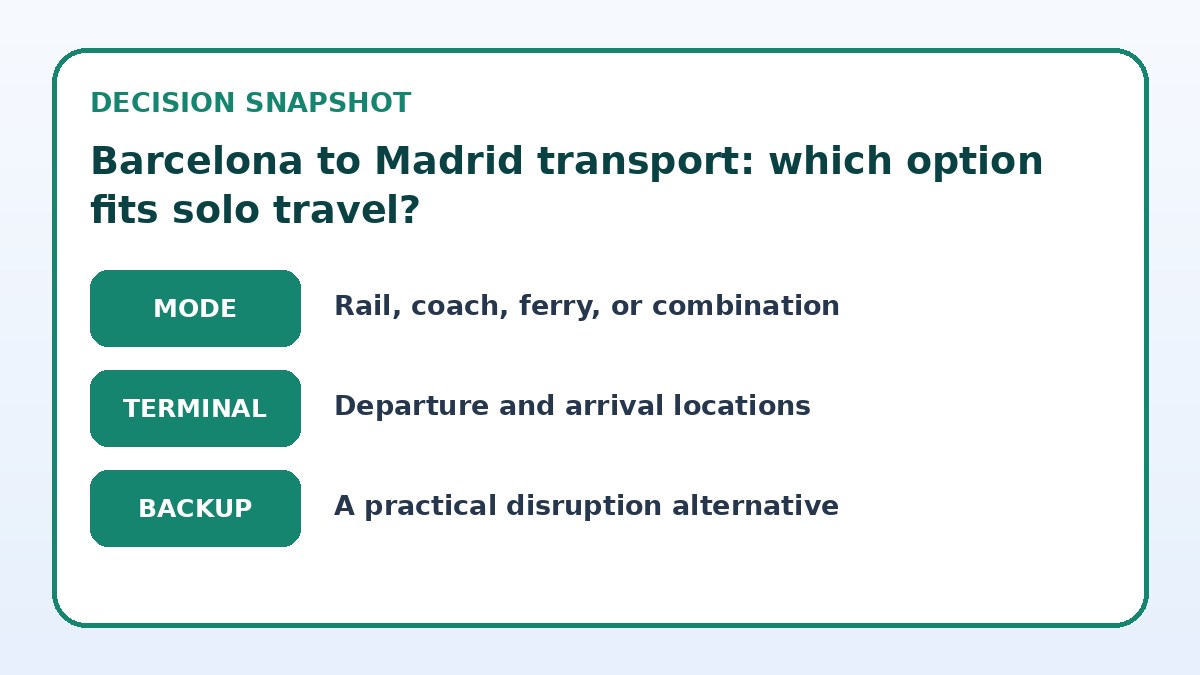
If you’re traveling alone from Barcelona to Madrid, the most practical option is usually the one that balances station fit, luggage handling, timing flexibility, and an easy disruption backup — not the single fastest ride. For many solo travelers that means prioritizing a direct high-speed train if you value simplicity, or a coach if cost and flexible pick-up points are top priorities. Mixed itineraries (train + regional transfer) can make sense when your schedule or arrival neighborhood rules out main terminals. Before you book, decide whether door-to-door convenience matters more than ride time, and what level of transfer friction you will tolerate; those choices determine whether rail, coach, or a combination is genuinely practical for you. The sections that follow explain how to weigh terminals, luggage, timing, and backups, plus a quick comparison and checklist to finalize your decision.
Terminal fit: start and end points matter more than speed
Practical travel begins at each end: check which Barcelona station or coach terminal is closest to where you’re staying or need to be after arrival. A single extra taxi, metro ride, or long walk can erase minutes saved on a faster service. For example, a centrally located coach terminal that drops you near your Madrid neighborhood can be more convenient than a faster train that arrives at a station requiring an additional metro transfer. Think through your door-to-door route and estimate transfer friction — the fewer modal changes, the easier the solo trip.
When comparing options, map not just advertised arrival points but the local transit, taxi ranks, and luggage-friendly routes from those terminals. If you have heavy luggage or prefer minimal handling, favor services that let you wheel bags straight into and out of the terminal without long stair or platform carries. Also consider late-night or early-morning arrivals: if the train arrives at an hour when local transit is limited, that terminal fit can become a liability rather than an advantage.
Choose the end-to-end journey plan
| Journey approach | Best for | Friction to check |
|---|---|---|
| Prioritize direct high-speed rail | Solo travelers who value minimal transfers and station amenities for a straightforward door-to-door trip | May require getting to main stations that aren’t the closest point-to-point match with your neighborhoods |
| Choose intercity coach | Those who prioritize flexible pick-up/drop-off points and fewer awkward last-mile transfers in certain neighborhoods | Longer on-road time and potentially fewer onboard amenities than trains |
| Mix rail and regional connections | Travelers needing to reach suburbs or non-central arrival points where direct services don’t stop | Increases transfer handling and requires tighter timing coordination between services |
| Plan a staged trip with an overnight buffer | Solo travelers who prefer low pressure and an explicit recovery plan for cancellations or late arrivals | Adds extra time and possibly accommodation cost but reduces stress and missed-connection risk |
Check live intercity options
Look beyond the ride itself and compare terminals, transfers, luggage, and arrival fit.
Luggage and transfer friction: what solo travelers should prioritize
Solo travelers often carry backpacks and a main suitcase — and every transfer multiplies friction. Look closely at how each option treats luggage: is there assistance boarding, dedicated storage, or simply overhead racks? Services that leave you handling bags across curbs, stairs, or busy metro platforms will increase mental and physical load. If you’re traveling light, a quick coach or regional train can be perfectly manageable; if you have larger suitcases, prioritize routes with fewer transfers or easy station-level elevator access.
Also factor in security and keeping valuables with you. Solo travelers may prefer modes that allow constant sight of a small daypack. If a transfer forces you to check luggage into separate compartments or wait in lines, that counts against practicality. Make a realistic checklist of how many times you’ll lift your main bag and whether you’ll have help when buying tickets, boarding, or changing services.
Timing flexibility: matching schedules to your travel style
Decide how much schedule flexibility matters. If you need to arrive at a specific time — for a meeting, check-in, or tour — choose a service with frequent departures so you can recover from small delays. High-frequency coaches or multiple daily rail departures give solo travelers options if a first choice is missed. Conversely, if your day is flexible and you want to save effort, an earlier or later coach might avoid crowded trains and simplify transfers.
Check the calendar of likely departure windows for both directions of your trip and plan how late you’re comfortable arriving at your destination. Also consider whether you prefer waiting in a staffed station with seating and amenities or a coach terminal with simpler facilities. When comparing itineraries, add realistic buffer time for transfers, luggage retrieval, and local transit to avoid tight connections that are stressful when traveling alone.
Compare the practical alternatives
Use the final page to confirm what is actually offered on your dates and save a workable fallback.
Intercity travel checklist
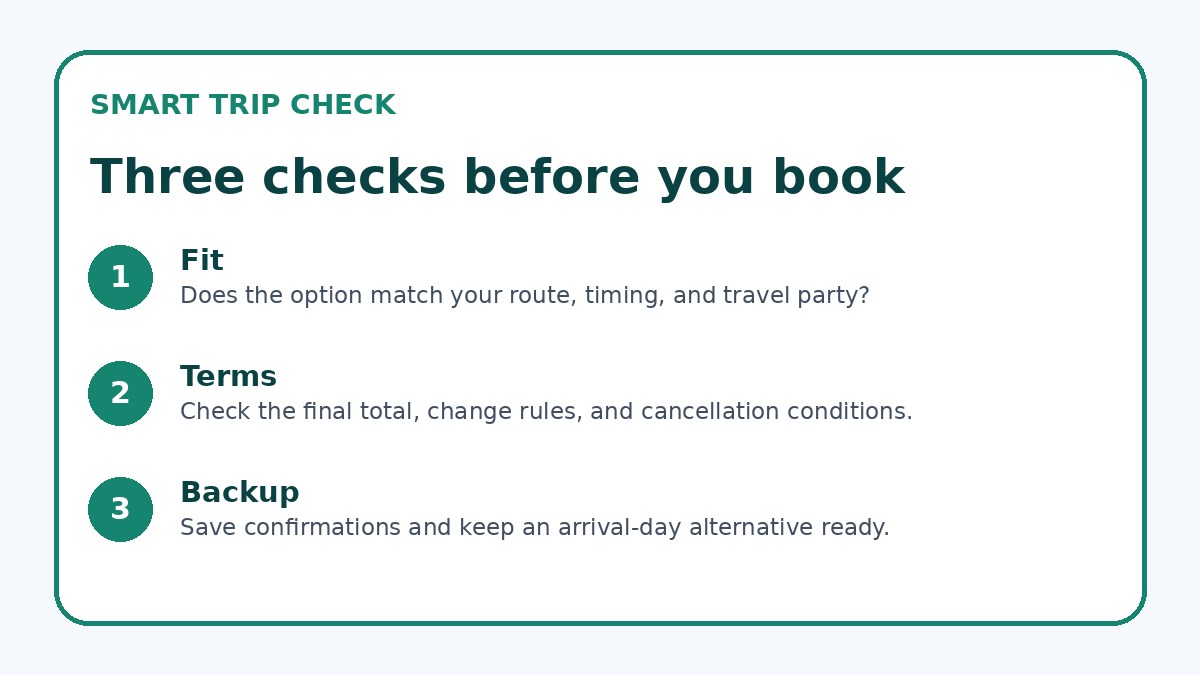
- Map your door-to-door route from your Barcelona accommodation to the chosen terminal and from the arrival terminal to your Madrid destination.
- List how many times and where you will lift or re-check your main luggage and decide if you need assistance or a luggage service.
- Check the frequency of departures for rail and coach around your preferred travel window and note three backup departures.
- Confirm station access details (entrances, elevators, taxi ranks) on the carrier or station official page before booking.
- Prepare a simple disruption plan: one later departure alternative, a taxi app loaded, and a contact method for help.
- Save screenshots or PDFs of electronic tickets and the carrier’s last-change policy so you can rebook quickly if needed.
Disruption backups: practical contingency planning for solo trips
A single experienced backup will save stress: identify one realistic alternative before you depart — a later train, a different carrier’s coach, or a nearby hotel you could use if services are suspended. Write down the options and where to check live status so you can act quickly if delays occur. For example, note the next three departures of each mode and how you would reach them from your arrival point. That proactive approach keeps you from making rushed, costly choices under pressure.
Also plan low-effort recovery steps: a taxi app credit, a local SIM or roaming data plan to buy tickets on the go, or a short list of nearby accommodation options if you must stay overnight. When provider-specific facts matter — like baggage policies, seat-change rules, or boarding windows — verify them on the official booking page before you finalize anything. Trip.com can be used as one comparison point for availability, but always confirm critical operational details on the carrier’s site.
Rail & Intercity Transport questions travelers ask
Is the high-speed train always the most practical option for solo travelers between Barcelona and Madrid?
Not always. High-speed trains often reduce transfer steps because they connect major terminals, which helps solo travelers who prioritize simplicity. However, practicality depends on where you start and end in each city. If the main stations add extra metro or taxi transfers that are inconvenient for your schedule or luggage, a coach that drops you closer to your final address or a mixed route might be more practical. Evaluate door-to-door time and transfer friction, not just advertised ride durations, and verify departure points and station access before you book.
How should I handle luggage rules and benefits when choosing between train and coach?
Different carriers and services have varying rules for carry-on size, checked luggage, and onboard storage. For a solo traveler, prioritize options that let you keep valuables with you and avoid repeated handling. Before booking, check the carrier’s official baggage policy on their website—look for details about hand luggage, hold luggage, and whether staff assist with heavy bags. If a service appears to require multiple platform transfers or long walks, reconsider if you have large or heavy suitcases; the extra effort can turn a cheaper option into a less practical one.
What’s the smartest disruption backup for a solo traveler on this route?
Choose a backup that minimizes additional effort: identify the next few departures by rail and coach, and confirm how quickly you can reach them from your likely arrival terminal. Keep a taxi app ready and enough data or offline maps to find alternate routes. If your schedule is tight or you have important commitments upon arrival, budgeting for a short nearby overnight stay can be the most practical contingency. Always verify rebooking or refund policies on the provider’s booking page so you know your options if plans change.
Final decision note
For solo travelers deciding how to travel from Barcelona to Madrid, focus on end-to-end practicality: which option minimizes transfers, simplifies luggage handling, and matches your arrival and departure neighborhoods. Direct high-speed rail often wins for simplicity and fewer handoffs, but coaches or mixed routes can be more practical when they reduce last-mile travel or fit your schedule better. Before booking, map your door-to-door route, check baggage and station access on the carrier’s official pages, and pick a clear disruption backup with alternative departures or a nearby overnight option. Confirm any provider-specific operational details at the time you purchase — Trip.com can be a comparison resource, but always verify critical facts on the carrier’s site to finalize your plan.
Continue planning
Check current options and final conditions
Use the provider page to confirm live availability, the final total, cancellation terms, and every condition that matters to your trip.
This evergreen planning guide was created with AI-assisted drafting and a structured quality review. It does not display live prices, schedules, availability, visa guidance, or provider rankings. Verify current details before booking. Some links are affiliate links; we may earn a commission at no additional cost to you.