If your family is traveling from Hanoi to Da Nang and you want to build a flexible ground-transport plan, start by choosing the main approach—train, intercity bus, or self-drive—and map sensible stops that split the journey into manageable daily legs. For families with young children or older travelers, prioritize fewer transfers, daytime travel, and accommodation near stations or easy parking. Decide whether you need sleeper trains or daytime seats, book seats together, and allow buffer time for connections if you mix modes. This article gives the practical answer up front: pick the mode that balances comfort and logistics for your party, then layer multi-city stops that minimize long continuous travel days. After the quick plan, read the tradeoffs, step-by-step decision criteria, and a checklist of what to verify on booking pages and at stations so your family trip runs smoothly.
Deciding the main mode: train, bus, or car
For a family multi-city ground plan, begin by choosing the primary transport type. Trains often provide more cabin space, the ability to walk around, and straightforward ticketing options for groups; they're suitable if you want reliable daytime travel or sleeper accommodations that let everyone rest. Buses can offer more departure times and sometimes cheaper point-to-point service, which helps when you need specific arrival times for bookings at the next stop. Self-driving gives complete control over timing, allows door-to-door flexibility, and makes detours easy; it is a strong choice when traveling with lots of luggage, car seats, or a desire to stop at smaller towns.
Weigh family priorities: comfort, number of travel days, and how much sightseeing you want between Hanoi and Da Nang. If minimizing transitions matters most—say you have a baby or elderly family member—favor a direct train or a single-car driving itinerary with one planned overnight. If you prefer to explore towns en route, create shorter driving legs or book trains that arrive mid-morning so you have a full afternoon in each stop. Whatever mode you pick, plan for realistic daily travel limits to avoid exhausted children and missed sightseeing opportunities.
Designing multi-city stops that suit families
When building a multi-city plan, choose stopover towns that offer easy access from the station or highway and provide family-friendly accommodation. Look for places with simple local transport, easy meal options, and low-stress activities for mixed ages. Limit how many transfers you make in a single day—ideally one major leg and one short hop—so the family has downtime. Aim for a pacing rhythm such as travel mornings and relax afternoons, or travel every other day with full rest days in between for longer trips.
Think about practical needs at each stop: where to refill water and snacks, how to manage laundry if needed, and whether medical services are nearby. If you have car seats or strollers, check that onward transport accepts them or plan to store them at your accommodation. Map out backup options like later departures or nearby hostels that accept short-notice stays in case a leg runs long. This kind of planning reduces stress and keeps the trip enjoyable for parents and children alike.

| Approach | Best for | Tradeoff to check |
|---|---|---|
| Train-focused multi-stop plan | Families who value space to move, daytime comfort, and fewer road jolts | May require syncing station locations and limited local transport at some stops |
| Bus-first itinerary | Families needing flexible departure times or specific arrival times | Longer rides and less room to move can be tiring for young children |
| Self-drive road-trip plan | Families wanting full control, detours, and door-to-door convenience | Driver fatigue and parking logistics add planning complexity |
| Mixed-mode plan (train + car or bus) | Families balancing comfort with targeted sightseeing and short local legs | Requires careful buffer times between connections and more booking steps |
How to compare options and what to verify before booking
Compare choices by time of day, total elapsed travel time, number of transfers, and how easy it is to board with children and luggage. For trains, check seat or sleeper configurations, family cabin availability, and whether seats reserve together. For buses, verify seat types, legroom, and whether stops are made for meals and restroom breaks. For car rentals, confirm child-seat policies, insurance coverage, mileage rules, and where to return the vehicle. When comparing, prioritize minimizing overnight transfers and long waits between connections.
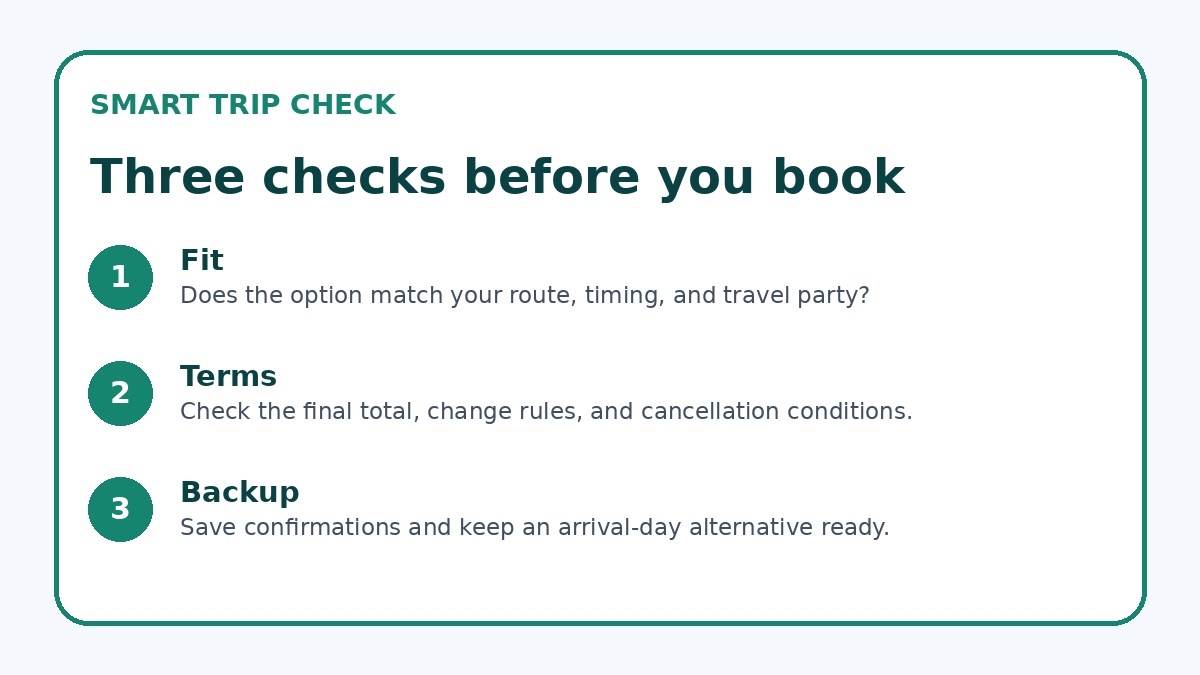
On each provider’s booking page verify specific facts that change frequently: up-to-date schedules, exact station or terminal addresses, luggage limits, seat assignment policies, cancellation and change conditions, and any age-based fare rules. If you use a third-party booking site like Trip.com to compare options, use the provider links to confirm final details on the operator’s official page before completing payment. Always double-check arrival terminal names, because small towns sometimes have separate bus and train stations that are not within walking distance of each other.
Before you book
- Confirm exact station and terminal addresses for every booked leg and map the walk or transfer time between them.
- Reserve seats together on trains or buses and note whether children’s fares, seat belts, or car-seat rules apply.
- Check luggage allowances and whether extra bags, strollers, or car seats incur fees or storage restrictions.
- Book accommodations near your planned stop’s arrival point or with documented late check-in options.
- Download or screenshot confirmations, maps, and local emergency numbers; carry printed copies as backup.
- Verify refund and change policies on the operator’s final booking page before you pay, and note any deadlines.
Packing, pacing and on-the-ground tips for families
Pack a small day bag for each travel leg with snacks, water, wet wipes, a change of clothes, and basic medicines. For longer ground legs, bring quiet activities, headphones, and a lightweight blanket to help children nap on trains or buses. When driving, plan frequent short stops for stretching and restroom breaks; for train travel, schedule seat time so children can move occasionally. Reserve accommodations that allow flexible arrival and a late check-in if an unexpected delay extends your travel day.
At stations and stops, arrive early to find family-friendly seating and to get settled without rushing. If you need a stroller, verify whether it can be stored on board or whether folding it before boarding is necessary. For sleeper trains, label luggage clearly and keep essential items with you. Finally, keep digital and paper copies of itineraries, booking confirmations, and emergency contacts, and make sure at least one adult has a local SIM card or working phone for navigation and last-minute changes.
Frequently asked questions
Is taking the train from Hanoi to Da Nang the best family option?
Trains often suit families because they allow children to move and rest, and they can split long distances into comfortable legs. Whether a train is the best choice depends on your family’s tolerance for travel length, need for daytime versus overnight travel, and station locations relative to your planned stopovers. Compare the total door-to-door time, the number of transfers, and whether sleeper berths or day seats are available together. Also check on-seat spacing, food options, and accessibility features on the specific train you consider before booking.
How many stopovers are sensible when traveling with children?
A good rule for families is to limit active travel days and keep daily legs short enough to allow for afternoon relaxation—often one to three stopovers depending on trip length. For a longer route like Hanoi to Da Nang, two stopovers can let you explore without rush while avoiding fatigue. Plan at least one full rest day after a longer travel day. Choose stops that offer easy access, basic services, and simple activities so everyone has time to recover and enjoy the trip.
What should I check about stations and terminals when building a multi-city plan?
Confirm the station or terminal name and address, how far it is from your accommodation, available local transport options, and where taxis or ride-hailing pick up passengers. Note whether the station has family facilities such as restrooms, waiting areas, or storage lockers, and whether you need to change stations between modes. If a transfer requires a local taxi, estimate the transfer time and cost. Always verify these operational details on the operator’s booking or official site because station names and services can change.
Final planning note
Building a family-friendly ground-transport plan from Hanoi to Da Nang is a practical exercise in tradeoffs: pick the mode that best balances comfort, flexibility, and the number of transitions, then arrange stopovers that split travel into manageable days. Book seats together, verify terminal locations, and plan buffers between connections to reduce stress. Use the checklist to confirm luggage rules, seat assignments, and accommodations near arrival points. If you want to compare current schedules and options in one place, Trip.com can be a starting point—always confirm final details on the operator’s site before you pay. With a clear plan and a few realistic pacing rules, a multi-city ground trip can be enjoyable for every family member.
Continue planning
Check current options and final conditions
Use the provider page to confirm live availability, the final total, cancellation terms, and every condition that matters to your trip.
This evergreen planning guide was created with AI-assisted drafting and a structured quality review. It does not display live prices, schedules, availability, visa guidance, or provider rankings. Verify current details before booking. Some links are affiliate links; we may earn a commission at no additional cost to you.