If your Bangkok business trip relies on flexible meetings across the city and nearby provinces, driving can save time compared with waiting for taxis or arranging multiple transfers. But whether you should rent a car depends heavily on the fine print: fuel policy, daily or total mileage limits, insurance wording and airport pickup/return friction often change the true cost and convenience. For most intra-city meetings in central Bangkok, driving adds hassle with traffic and parking; for multiple day trips to industrial parks or provincial sites, a rental may be the right tool. Before booking, decide how many kilometers you expect to drive, whether you’ll cross provincial borders, and how important a hassle-free pickup and drop-off are to your schedule. This article gives practical checks and decision criteria so you can choose between driving and reliable, non-driving alternatives.

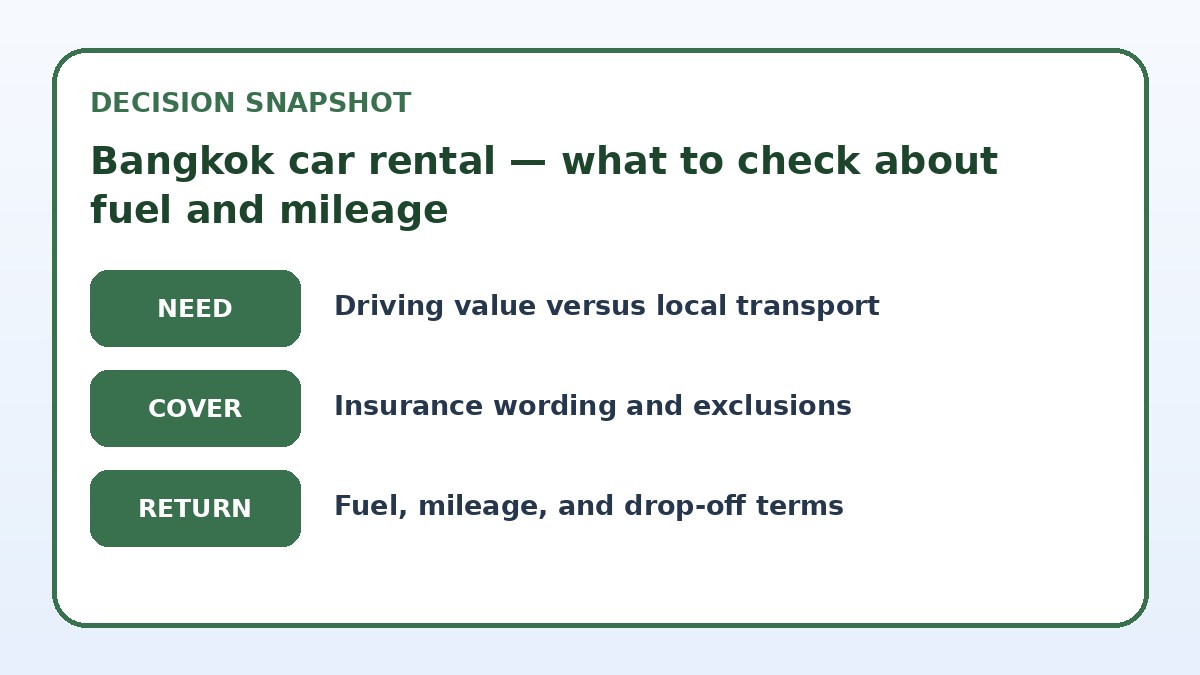
Decide whether driving actually improves your business itinerary
Start by mapping the meetings and sites on your calendar. If all appointments are clustered within central business districts such as Sathorn, Silom or Siam, the time advantage of a car is often lost to peak-hour congestion, restricted parking, and parking fees. Conversely, if your schedule includes multiple visits to suburban industrial estates, convention centers, or provincial trips to nearby provinces, the predictability of a hired car may justify the overhead. Consider door-to-door travel time estimates at your meeting hours and build buffer time for Bangkok traffic; travel advisors should compare median transit times rather than optimistic off-peak estimates.
Also weigh convenience for multi-person travel. If you frequently need to move colleagues and materials between venues, a rental can be more economical than repeated ride-hails. But if your itinerary involves short hops where parking or garage access is uncertain, relying on taxis, ride-hailing apps, or a hotel-arranged driver may save time and administrative effort. Decide upfront whether you value control, flexibility, or the lowest operational friction—this decision shapes which fuel, mileage and insurance features matter most on the booking page.
Decide whether driving earns its place
| Mobility strategy | Best for | Cost or friction to check |
|---|---|---|
| Self-drive rental | Travelers who need flexible, multi-stop travel or to transport samples/equipment. | Greater paperwork and responsibility—fuel, mileage caps and damage excess can raise costs and administrative risk. |
| Rental with driver (chauffeur) | Business travellers who want local navigation and no parking/searching burden. | Higher hourly or daily rates and less privacy; verify whether fuel and tolls are included in the quoted rate. |
| Ride-hailing and taxis | Short, single transfers within central Bangkok with unpredictable parking or tight schedules. | Less suitable for multiple-stop day trips or moving equipment; fares can rise with traffic and surge pricing. |
| Hotel or corporate transport | High-frequency short transfers and guaranteed bill-back to your company. | Limited availability outside peak hours and to out-of-area destinations; ask about mileage or overtime charges. |
Check live rental choices only after the route test
Use the exact driver, dates, pickup point, and return plan to compare current conditions.
What to verify about fuel and mileage on the booking page
Fuel policy: look for the exact phrase used by the provider—common options are full-to-full (pick up full, return full), prepaid fuel (pay up front and return empty), or full-to-empty with refueling fees. If the provider charges refueling on your behalf, the booking page should list their per-liter charge or an administrative fee in addition to the fuel cost. Never assume a flat 'refuel charge'—check how they calculate it and whether an inspection report documents the tank level at pickup and return; the documentation determines how disputes are resolved.
Mileage rules: confirm daily or total mileage allowances and the excess rate per kilometer or mile. Providers sometimes bundle short-term rentals with generous daily limits but cap long-term deals, or vice versa. If you plan cross-province travel, check whether there’s a different mileage policy for interstate or multi-day rentals. The booking page should also state whether satellite tracking or odometer readings are used for enforcement and whether any grace allowance is applied to account for route detours.
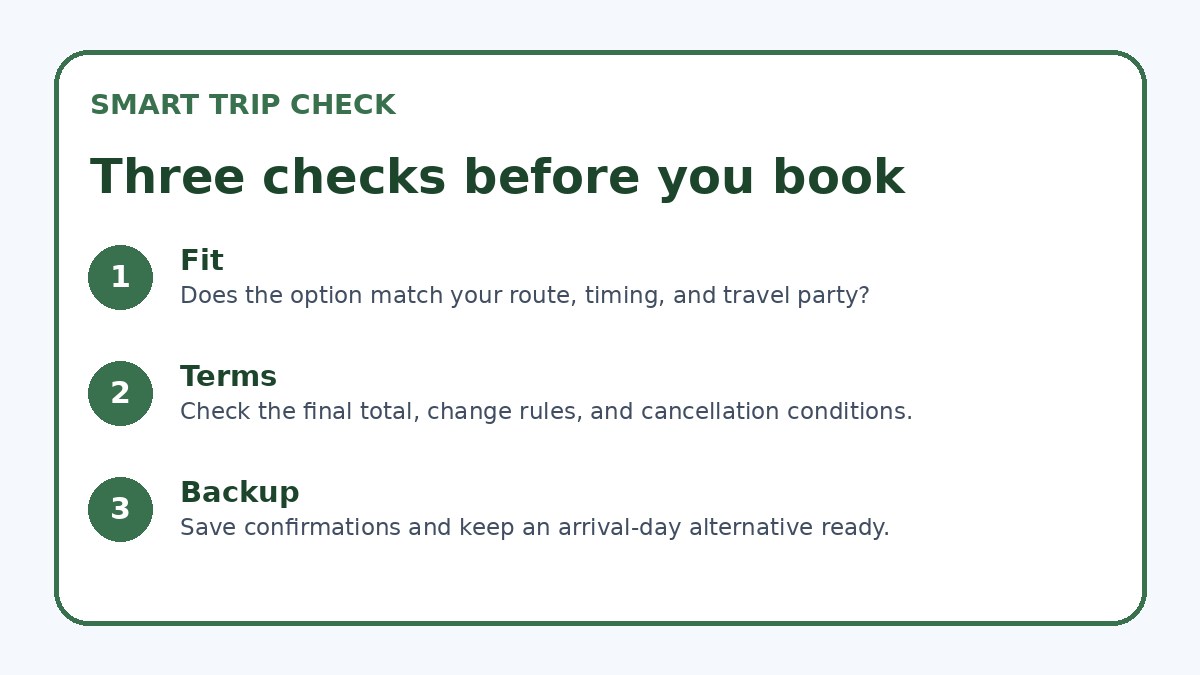
Compare the full rental conditions
Confirm insurance wording, exclusions, deposit, fuel, mileage, and return terms on the final page.
Insurance wording and other coverage details to read closely
Insurance labels like 'CDW' (collision damage waiver) or 'LDW' (loss damage waiver) are shorthand; the exact coverages, deductibles, and exclusions live in the policy wording. Verify the damage excess amount, any mandatory local insurance, and what circumstances void coverage—common exclusions are unauthorized drivers, off-road use, driving under the influence, and using the car for hire. For business travelers, confirm whether the insurance covers rental use during work activities and whether company credit cards or corporate policies provide secondary coverage. Always save a screenshot or PDF of the insurance terms shown on the final booking page.
Also check liability limits for third-party damage and personal accident coverage amounts. When you add extra protection at pickup, ask for the contract page showing the new total and the revised excess; verbal assurances at the counter are insufficient. If you plan to cross land borders or drive into neighboring countries, verify whether the provider permits it and what additional coverage is required. Finally, confirm who is an authorized driver—some contracts limit coverage to named or licensed drivers only.
Car rental terms to verify
- On the booking page, confirm the exact fuel policy wording (e.g., full-to-full) and whether refueling fees are calculated by liters plus admin charges.
- Note the mileage allowance and per-kilometer excess rate; estimate your planned route kilometers and calculate potential excess charges.
- Download or screenshot the insurance policy page showing deductibles, exclusions, and authorized drivers before completing the booking.
- Check pickup and return procedures for airport and off‑hour returns, and record any stated late return or out‑of‑hours fees.
- Ask whether tolls and parking fees are billed to the renter or driver, and how toll payments are handled (cash, transponder, or provider billing).
- If you might cross provincial borders, verify cross-border permission and additional insurance or paperwork required on the final booking page.
Pickup, return friction and a non-driving fallback plan
Pickup and return logistics influence whether a rental is workable for short business trips. Airport counters may be busiest during flight arrival windows and can add 20–60 minutes for paperwork and vehicle inspection. Out-of-hours returns often incur additional fees or require leaving keys in a dropbox, which complicates dispute resolution about fuel or damage. On the booking page, find the exact pickup window, after-hours procedure, and any documented administrative fees; these details affect whether the rental fits a tight meeting schedule.
Always prepare a fallback: arrange reliable ride-hailing, a hotel car service, or a local chauffeur if driving becomes impractical. For day trips, consider booking a driver-only service that offers the convenience of door-to-door travel without rental paperwork and fuel concerns. If you choose a rental expecting to use it only if traffic or costs make ride-hailing unattractive, set cancellation or modification reminders based on the provider’s policy so you can switch strategies with minimal penalty. Trip.com can be useful to compare current availability and stated policies, but always verify key rules on the provider’s final booking page.
Car Rental & Road Trip questions travelers ask
How does a fuel 'full-to-full' policy work and why does it matter on short business trips?
Full-to-full means you pick up the car with a full tank and must return it full; if you return with less, the provider refuels and charges you. For short business trips, full-to-full is often the fairest option because you only pay for fuel you actually use. The critical detail on the booking page is whether the provider documents tank level at pickup and return and whether the refuel rate includes an administrative surcharge. Without that documentation, disputes about tank levels at return become harder to prove, so take photos at pickup and before return to protect yourself.
If I exceed the stated mileage limit, how are excess charges typically applied?
Excess mileage is normally charged per kilometer (or per mile) at a rate listed in the rental terms. Providers may calculate excess using the odometer reading at return or via GPS/telemetry. On the booking page you should find the per-kilometer rate and whether there's a grace allowance. For business travelers who plan day trips outside the city, estimate total kilometers and multiply by the excess rate; if the cost looks high, negotiate a higher mileage package or consider a different mobility option that includes unlimited or higher mileage.
Will my corporate credit card or company insurance cover collision excess and third-party liability?
Corporate cards and company policies vary—some offer primary rental insurance, others provide secondary coverage that kicks in after the rental supplier’s excess is paid. The booking page will state the supplier’s insurance and excess; you must verify with your card issuer or corporate insurance administrator what they cover and any documentation they require. If they don’t fully cover the supplier’s excess, consider buying the supplier’s excess reduction at pickup or arranging a separate excess-protection product, and always collect the supplier’s insurance terms to submit with any claim.
Final decision note
For business travelers, the choice to rent a car in Bangkok comes down to realistic route value versus administrative burden. If your calendar includes suburban or multi-site days with equipment or multiple passengers, a rental—especially with clear fuel and unlimited or high mileage—can improve productivity. If your meetings are central or you prefer no-questions transfers, taxis, ride-hailing, or a chauffeur may reduce friction and hidden fees. In every case, use the booking page to verify fuel policy, mileage caps and excess rates, insurance wording and pickup/return conditions before finalizing. Prepare a non-driving backup and keep screenshots of the provider’s terms to prevent surprises during or after your trip.
Continue planning
Check current options and final conditions
Use the provider page to confirm live availability, the final total, cancellation terms, and every condition that matters to your trip.
This evergreen planning guide was created with AI-assisted drafting and a structured quality review. It does not display live prices, schedules, availability, visa guidance, or provider rankings. Verify current details before booking. Some links are affiliate links; we may earn a commission at no additional cost to you.