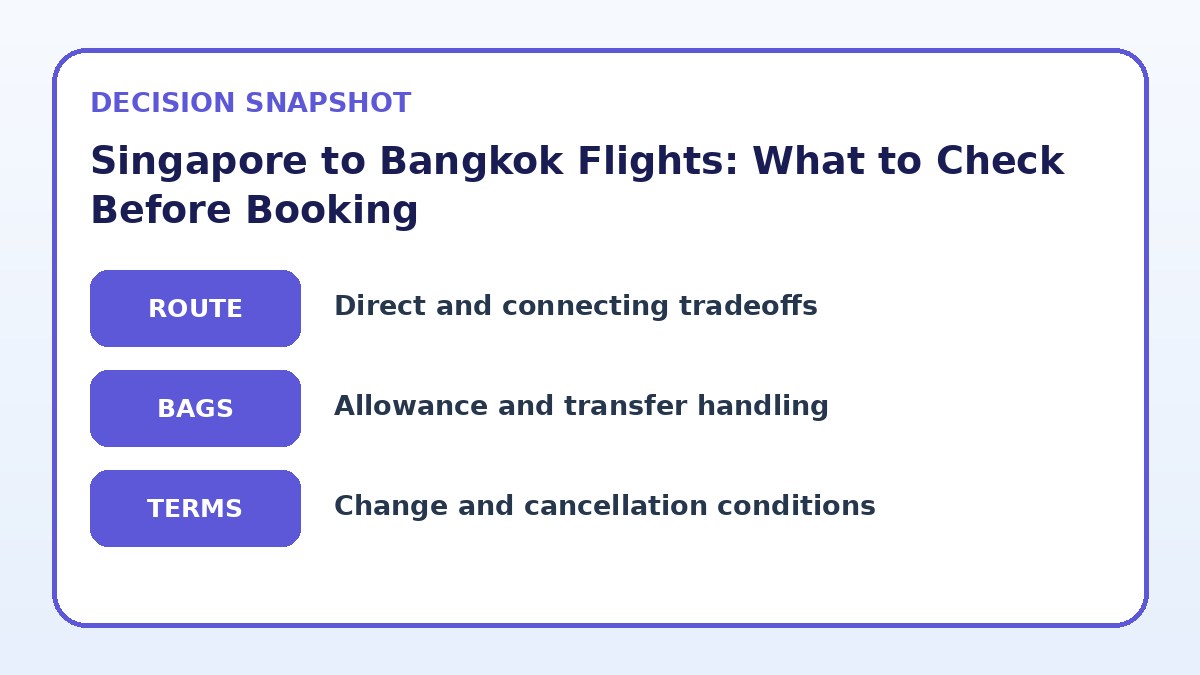
Practical answer first: if you value speed, simplicity, and fewer moving parts, prioritize a direct Singapore to Bangkok flight; if you want lower fares, broader schedule choices, or a multi-stop itinerary, compare connecting options carefully. For first-time visitors, the decision usually comes down to three questions: how much extra time are you willing to spend, how important are fewer transfers, and what level of risk around missed connections are you comfortable accepting. A direct flight typically reduces hassle at both airports and makes airport transfers and arrival logistics easier. A connecting itinerary can open more departure times, airlines, and sometimes lower published fares, but it adds complexity—separate terminals, immigration steps on some routings, luggage transfer rules, and the possibility of a tight layover. Read the sections below to weigh tradeoffs, what to verify when booking, and a step-by-step checklist to finalize a safe, practical choice.
How direct and connecting options differ in practice
A direct Singapore to Bangkok flight means you board once in Singapore and disembark in Bangkok with no scheduled stops that require you to change aircraft. That simplicity usually makes navigating terminals, collecting baggage and onward transfers quicker and more predictable—important for first-time visitors who may be unfamiliar with local transportation or jet-lagged on arrival. Direct flights also reduce the number of times you pass through security and immigration, which lowers the chance of missing a transfer due to gate changes or delays.
Connecting itineraries involve one or more intermediate stops and can include plane changes, terminal transfers, or even short surface transfers between airports in some regions. For travelers on a single itinerary with a single ticket, airlines generally protect connections and rebook you if a delay causes a missed connection—still, the rebooking process takes time and can be stressful. If segments are booked on separate tickets, you may need to collect and recheck luggage, clear immigration at the transit point, and allow significantly more buffer time.
Time, cost and convenience: choosing what matters most
If your priority is minimizing travel time and complications, direct flights win. They typically have shorter scheduled durations and eliminate the need to coordinate transfers between terminals or carriers. For first-time visitors, less time in transit means more time to orient yourself in the city and less chance of confusion at unfamiliar airports. Consider how much total door-to-door time matters: a saving of two hours on a short international hop can meaningfully change arrival day plans.
If you are budget-conscious or need a specific departure window that direct flights do not offer, a connecting itinerary may be worth the tradeoff. Connecting options can also let you use frequent-flier awards or combine different carriers to match loyalty programs. However, when evaluating price differences, include the value of extra travel time, potential overnight layovers, and the stress of tight connections. For first-time visitors, a slightly higher fare for a direct option can be justified by peace of mind and easier arrival logistics.
| Approach | Best for | Tradeoff to check |
|---|---|---|
| Direct flights | Travelers prioritizing speed, simplicity, and fewer transfer points. | Often fewer schedule options and sometimes slightly higher fares compared with multi-leg itineraries. |
| Single-ticket connecting flights | Passengers wanting broader carrier options with connection protection included on one itinerary. | Still exposed to rebooking delays if a connection is missed; more complex airport navigation. |
| Separate-ticket connections | Travelers seeking lower fares or unique combinations of airlines and schedules. | Higher risk: you may need to reclaim luggage, clear immigration, and book a new onward flight yourself if delays occur. |
| Long layovers or planned overnight stops | Those who want to break the journey, add a short stopover visit, or avoid tight connections. | Increases total travel time and may add lodging or additional local transport costs. |

Practical checks and booking criteria
Before you book, compare total door-to-door time rather than only airborne time. Look up how long it takes to reach Changi Airport from your accommodation and how you will travel from Bangkok’s arrival airport to your hotel. For connecting flights, check whether your connection is an intra-terminal walk, a transfer bus, or requires passing through immigration. Verify on the airline’s or booking page whether baggage is checked through to the final destination and whether the itinerary is sold on a single ticket—these details determine how much ground work you need to do at the layover.
Confirm the minimum connection time displayed during booking and then allow additional buffer for unexpected delays. If you have a very short connection, check whether the booking says 'protected connection' or similar language; still, plan conservatively. When provider-specific facts could change, such as boarding gate procedures, baggage transfer rules, or whether you must clear transit immigration, check the operating carrier’s final booking page and the airports’ official sites. You can use Trip.com as one place to compare availability and conditions, but treat the airline’s website as authoritative for policies.
Before you book
- Compare total door-to-door travel time, including transit to airports and from Bangkok’s arrival airport to your accommodation.
- Verify whether all flight segments are on a single ticket and whether baggage is checked through to Bangkok before booking.
- Check minimum connection times and read the airline’s notes about protection for missed connections on the booking page.
- Plan ground transport in advance: prebook an airport transfer or learn public transit and taxi options for your arrival airport.
- Pack an essentials kit in carry-on luggage with chargers, medication, travel documents, and a change of clothes for possible delays.
- Confirm visa and entry requirements for any transit country on official government sites if your itinerary includes an international stopover.
Managing risks and easing arrival for first-time visitors
If you choose a direct flight, prepare by noting ground transport options from Suvarnabhumi or Don Mueang (whichever is listed on your ticket) and book transfers or study public transit routes in advance. Carry digital copies of your booking, a printed itinerary, and confirmation of any booked airport transfers. Also review the arrival airport layout online so you know where immigration and baggage claim are located. Having cash in the local currency and a ride-booking app preinstalled will make the first hour in Bangkok smoother.
If you pick a connecting itinerary, plan for contingencies: pack essentials in your carry-on, including any medication, chargers, and a change of clothes, in case checked luggage is delayed. Note the ground connection rules for each carrier and whether you may need transit visas at the stopover country—verify visa requirements on official government sites. Build comfortable layover time into your itinerary; a longer layover reduces stress and gives you room to rebook on the next flight if schedules shift.
Frequently asked questions
Is it safer for a first-time visitor to book a direct Singapore to Bangkok flight?
For most first-time visitors, a direct flight reduces complexity and the chance of missed connections, which often makes it a safer and less stressful choice. You avoid extra security checks, terminal transfers, and potential confusion over baggage transfer rules. That said, ‘safer’ depends on your priorities: if a connecting flight significantly lowers costs or matches loyalty benefits, it can still be reasonable—provided you allow generous connection times and confirm baggage handling. Always verify on the airline’s booking page whether your baggage will be transferred and whether the itinerary is covered by a single ticket.
How much layover time should I allow if I choose a connecting flight?
Minimum connection times vary by airport and whether you need to change terminals or pass through immigration; the booking system will show a minimum, but it’s wise to add buffer beyond that. For international-to-international connections without immigration, 60–90 minutes can be sufficient in many airports, but first-time visitors may prefer 2–3 hours to account for delays, navigating unfamiliar terminals, and potential queuing. If you must change terminals or recheck luggage, aim for a longer layover. Always check the airline’s recommended minimum and the airports’ transit procedures on their official sites.
What should I verify on the booking page before completing my purchase?
Confirm whether the itinerary is on a single ticket, baggage transfer rules, whether seats are assigned, and the exact airports involved (Bangkok has more than one airport). Check whether the fare allows changes or refunds and review any COVID-era or temporary health requirements stated by the carrier. Look for language about connection protection and re-accommodation policies in case of delay. If you see conflicting information, contact the operating carrier for clarification. Trip.com can be used to compare options, but always double-check final terms on the airline’s website.
Final planning note
Choosing between a direct Singapore to Bangkok flight and a connecting option comes down to balancing speed, cost, and complexity. Direct flights simplify the process and are often the least stressful choice for first-time visitors who want to minimize what can go wrong en route. Connecting itineraries can offer savings and schedule flexibility but require more planning—verify single-ticket status, baggage rules, and layover logistics before you commit. Use the checklist above, compare door-to-door times, and confirm policy details on the airlines’ final booking pages. With a little preparation, you can pick the option that matches your comfort level and travel priorities and arrive in Bangkok ready to explore.
Continue planning
Check current options and final conditions
Use the provider page to confirm live availability, the final total, cancellation terms, and every condition that matters to your trip.
This evergreen planning guide was created with AI-assisted drafting and a structured quality review. It does not display live prices, schedules, availability, visa guidance, or provider rankings. Verify current details before booking. Some links are affiliate links; we may earn a commission at no additional cost to you.