
If your flight or train lands late in Amsterdam and you need to be ready for meetings the next morning, prioritize proximity, easy check-in, and a quiet room. The fastest practical choice is a hotel close to your arrival point—Schiphol or the major train stations—so you reduce transfer uncertainty and can go to bed sooner. If you value control over cost and schedule, choose a hotel that publishes late check-in policies and 24-hour reception; if you need guaranteed rest, book a room with blackout curtains and minimal street noise. Before you click confirm, double-check the hotel's stated late-arrival procedures, whether they hold keys, if there are late check-in fees, and the transport options from your specific arrival service. Trip.com can be useful for comparing live availability, but always verify check-in details directly on the hotel’s booking page or by contacting the property.
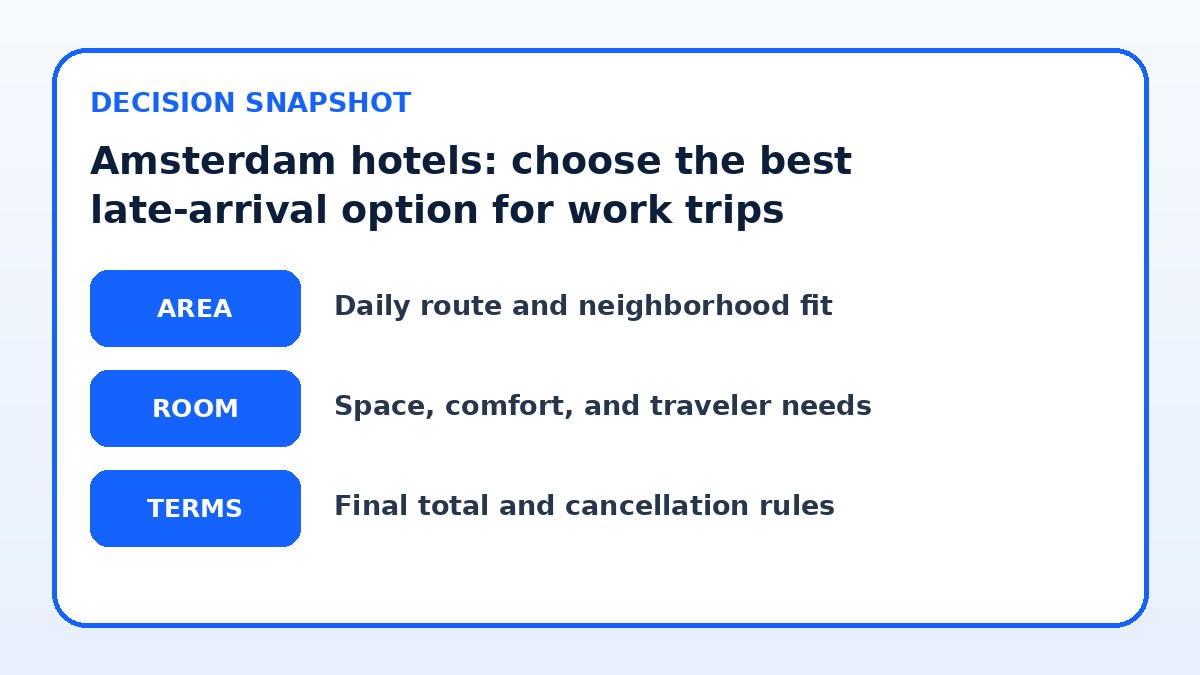
See current options before you compare the details
Availability and final conditions change. Open Trip.com now or keep reading for the practical comparison.
Decide by arrival point and transfer complexity
Start by mapping where you'll land and the realistic transfer options at that hour. Schiphol offers multiple onward connections, and Amsterdam Central has frequent late trains and night trams, but service patterns and the number of available taxis can vary by time of night. For business travelers, the simplest rule is to estimate transfer time conservatively and aim for a hotel that keeps that time under 30 minutes if possible. Shorter transfers reduce the chance of delay cascading into exhaustion before important meetings.
Compare three transfer approaches: direct walk or short tram from the station, a single taxi or rideshare, and a longer public-transport sequence. A short walk is the least friction but limits your hotel choices. A taxi or rideshare is flexible but can be affected by night surges or strikes. Multiple public transfers are cheapest but increase complexity. Choose the approach that matches how tired you'll be and how much transfer uncertainty you can tolerate; record backup contact numbers and pickup points for your driver.
Check-in logistics: policies and practicalities
Verify whether the hotel has a 24-hour reception, an express check-in kiosk, or a documented late check-in procedure. Some properties publish how they handle arrivals after standard desk hours—pin this information in your reservation notes and screenshot the policy in case you need to show it. If late check-in requires key collection at a separate location or a code, confirm the exact instructions and request a confirmation email. When provider-specific facts could change, tell readers exactly what to verify on the provider's final booking page: opening hours, contact phone numbers, and any requirements to prepay or provide an arrival time.
If you expect to arrive without luggage or want to minimize contact, ask about digital keys or mobile check-in. Request a room near the elevator to avoid long corridors in the dark, and ask whether late arrivals can still order a light meal or breakfast-to-go if kitchens are closed. If the hotel cannot guarantee staff overnight, confirm how keys are handled—left at a night desk, in a lockbox, or with a security team—and get explicit step-by-step pickup instructions before you arrive.
| Approach | Best for | Tradeoff to check |
|---|---|---|
| Hotel near the arrival hub (Schiphol/station) | Minimizing transfer time and arrival-night stress | Often higher cost or fewer boutique choices farther from city center |
| Central hotel near meetings | Short morning commute to appointments | May be noisier at night and risk longer late-night transfers |
| Budget hotel with flexible check-in | Cost-sensitive travelers who need changeable plans | Possibly limited amenities and less convenient locations |
| Premium hotel with 24-hour reception | Guaranteed staff support and reduced arrival uncertainty | Higher nightly rates and sometimes stricter prepayment terms |
Ready to check the option that fits your plan?
Use your exact dates and traveler details so the provider page can show the current total and conditions.
Room selection and sleep priorities for next-day productivity
After a late arrival the next morning’s productivity depends on the quality of rest. Select rooms away from busy streets or nightlife, request higher floors for less street noise, and ask for a room with blackout curtains. If you are sensitive to lights and sounds, bring earplugs and an eye mask as backups; hotels may offer them but availability varies. Also check whether the property offers a room type with a comfortable desk and reliable Wi-Fi if you need to prepare overnight for meetings.
Consider bed type and easy access to amenities you’ll need immediately: a hotel that offers early breakfast, grab-and-go options, or a wake-up service removes last-minute stress. If you need an early shower and a strong coffee, confirm whether the property’s breakfast or room service begins before your meeting. Where facts could change, call or message the hotel to confirm breakfast hours and wake-up options so you can plan prep time; include transit time to your first appointment in that calculation.
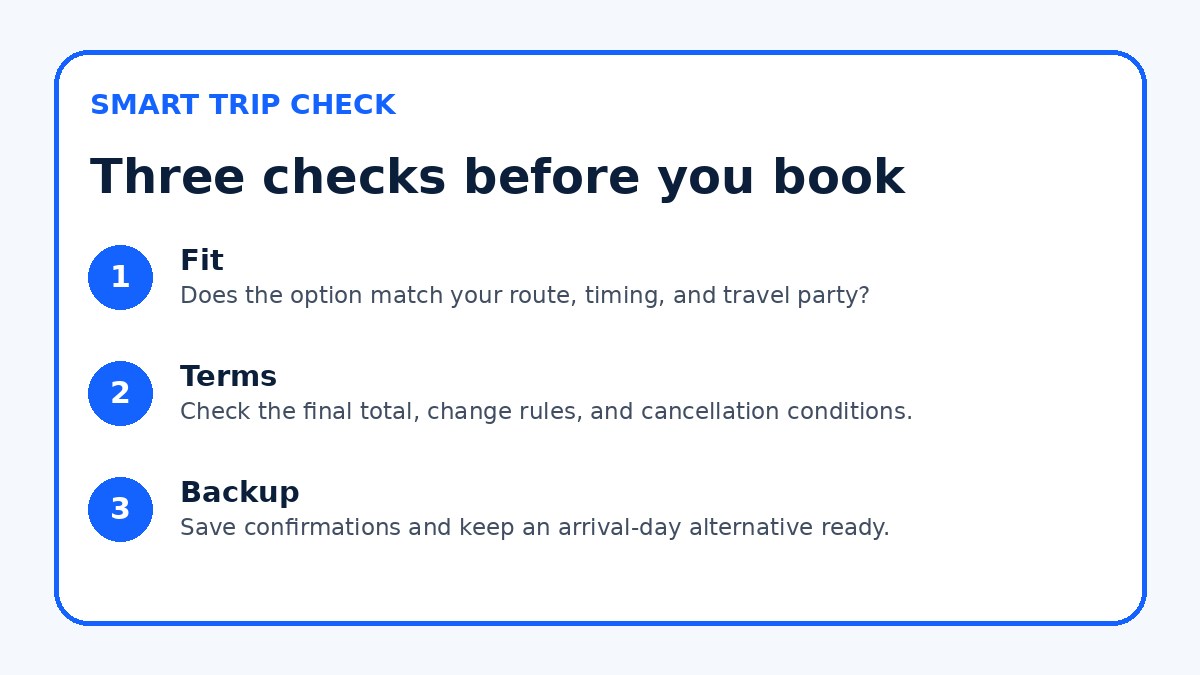
Before you book
- Confirm your arrival point and the realistic transfer options and times for your expected hour of arrival.
- Call or message the hotel to confirm late check-in procedures, reception hours, and exact instructions for key collection.
- Request a quiet room with blackout curtains and specify floor preference to reduce street noise.
- Ask the hotel about early breakfast, wake-up call service, and whether they can provide a grab-and-go option.
- Save screenshots of the hotel’s late-arrival policy and the staff contact number to your phone and email.
- Compare refundable and prepaid rates, then verify cancellation and change terms on the hotel’s final booking page.
Booking strategies and tradeoffs for business travelers
Decide whether to book a flexible rate or a non-refundable option based on how certain your arrival time is. Flexible rates let you adjust for unexpected delays without penalty, while prepayment can simplify late check-in but may limit changes. If arrival uncertainty is high—late flights, connections, or potential taxi shortages—favor flexibility. If you have a firm arrival time and prefer a streamlined process, prepaying can reduce check-in friction, but verify the hotel’s change and cancellation policy before committing.
Also weigh hotel location against in-room amenities and cost. A centrally located hotel near meeting venues reduces morning travel time but may be noisier or pricier. A quieter, peripheral hotel might offer better sleep but add transfer complexity in the morning. For peace of mind on arrival nights, many business travelers accept a slightly higher rate for a straightforward transfer and guaranteed reception. Use comparison sites like Trip.com to check current availability, then confirm crucial check-in details directly with the property before finalizing.
Frequently asked questions
What is the simplest hotel choice when I arrive in Amsterdam very late at night?
The simplest choice is a hotel that minimizes transfer complexity from your arrival point—ideally within a short taxi or walk from Schiphol or Amsterdam Central. That reduces the chance a late-night delay or limited transport options will leave you stranded. But simplicity has tradeoffs: these hotels can be more expensive or located in busier areas. Before booking, confirm the hotel’s late check-in policy, 24-hour reception availability, and the pickup point for taxis or rideshares; verify those specifics on the property’s booking page or by direct contact.
How do I handle check-in if I land after the front desk closes?
Many properties use lockboxes, night desks, or digital key systems for late arrivals—ask for precise step-by-step instructions when you book. Request a confirmation email or screenshot showing the process and the phone number for any night staff or security team. If the hotel requires codes or separate collection points, save those details offline in case mobile data is unreliable. If you’re uncertain, consider a hotel with 24-hour reception to avoid needing third-party key collection.
Should I book a hotel near my morning meeting or near the airport for a late arrival?
If your morning meeting is early and you value a stress-free commute, book close to the meeting location to reduce travel risk. If your arrival is extremely late or you anticipate delays, a hotel near the airport or main station shortens the transfer after landing and can improve sleep quality. Balance the importance of morning convenience against arrival uncertainty: when in doubt, prioritize where you will most want to cut travel time and disruption. Always check specific transit options and estimated morning travel times before finalizing.
Final planning note
Managing a late arrival in Amsterdam as a business traveler comes down to three practical choices: shorten your transfer, guarantee smooth check-in, and secure real rest. Pick a hotel that matches the arrival realities of your itinerary—close to Schiphol or the station for minimal transfer time, or near your meeting for a short morning commute. Before booking, verify late check-in procedures, reception hours, and any key-collection steps on the hotel’s booking page or by direct message to the property. Use that information to weigh cost, convenience, and risk; a slightly higher rate for a straightforward arrival often pays off when you need to be sharp the next morning.
Continue planning
Check current options and final conditions
Use the provider page to confirm live availability, the final total, cancellation terms, and every condition that matters to your trip.
This evergreen planning guide was created with AI-assisted drafting and a structured quality review. It does not display live prices, schedules, availability, visa guidance, or provider rankings. Verify current details before booking. Some links are affiliate links; we may earn a commission at no additional cost to you.