If you need clear direction: pick the flexible (refundable or lightly restricted) rate when your travel dates, arrival time, or itinerary could change; choose a stricter rate only when you are confident about dates and want a lower upfront cost. Solo travelers often juggle jet lag, meetings, sightseeing, and last-minute plans—flexibility reduces stress when you arrive in Tokyo and want to adjust length of stay, change neighborhoods, or rearrange nights around day trips. Rates labeled refundable, free cancellation, or flexible tend to allow full or partial refunds up to a deadline; semi-flexible options offer limited changes or credit toward future stays. Before booking, check exact change and cancellation deadlines, whether taxes or service fees are refundable, and how a refund will be processed—these details live on the hotel’s final booking page and can vary even within the same chain.
See current options before you compare the details
Availability and final conditions change. Open Trip.com now or keep reading for the practical comparison.
What flexible, semi-flexible, and nonrefundable terms actually mean
Booking labels—'flexible,' 'refundable,' 'semi-flexible,' and 'nonrefundable'—summarize very different protections. Flexible or refundable rates usually let you cancel without a penalty up to a stated cut-off time (often 24–72 hours before check-in, though the exact hours vary). Some refundable rates require full prepayment but return the money if you cancel by the deadline; others allow pay-at-hotel with free cancellation. Semi-flexible or credit-based options might let you change dates or receive a partial credit toward a future stay instead of a cash refund. Nonrefundable rates generally offer the lowest price but almost always forfeit the payment if you cancel or no-show.
For solo travelers, the practical difference matters: refundable rates reduce stress if flights change, if you plan to extend a Tokyo stay after deciding to linger in a neighborhood, or if you might take or skip a domestic side trip. Semi-flexible terms are a middle ground when you want some backup but want to keep costs down. Keep in mind that what looks like a flexible label on a listing page can hide multiple restrictions—by the time you reach the hotel’s final booking screen you must check whether taxes, service fees, and third-party fees are refundable and how the refund is issued.
Tradeoffs: price, convenience, and peace of mind
The core tradeoff when choosing a rate is price versus uncertainty. Nonrefundable rates often come with meaningful discounts compared with refundable ones, but you assume the full cost risk if plans change. For a solo traveler on a tight budget who has immovable dates—such as a fixed conference—nonrefundable may be sensible. Conversely, if you're booking before you purchase a firm return flight, expect possible transit delays, or anticipate sightseeing choices that could change your night-by-night plan, paying for flexibility can be worth the extra cost. Factor in the cost of a single night in Tokyo relative to the extra you’d pay for a refundable option—sometimes a small premium buys large peace of mind.
Convenience also matters: some refundable rates allow easy online changes and immediate refunds, while others require contacting the hotel or a central reservations desk. If you value self-service and speed—especially useful after a long flight—look for policies that explicitly permit online modifications. If the hotel requires emailing or phone calls for changes, that extra friction can be a real inconvenience late at night or when you are adjusting to the time zone. Always confirm the process and time frame for refunds and changes before you finalize the booking.
| Approach | Best for | Tradeoff to check |
|---|---|---|
| Fully refundable rates | Travelers with uncertain schedules, late arrivals, or who value worry-free changes | Higher nightly cost but cash refunds up to the stated cut-off time |
| Semi-flexible / credit-based rates | Those who want some flexibility and are willing to accept credits or limited changes | Lower cost than fully refundable but refunds may be partial or issued as hotel credit |
| Nonrefundable prepaid rates | Budget-constrained travelers with fixed dates comfortable assuming cancellation risk | Lowest upfront price but payment is typically forfeited on cancellation or no-show |
| Pay-at-hotel flexible rates | Solo travelers who prefer to decide closer to arrival and avoid prepayment | May require a credit card hold and sometimes higher nightly rates than prepaid deals |
Ready to check the option that fits your plan?
Use your exact dates and traveler details so the provider page can show the current total and conditions.

How to compare flexible terms across listings and channels
When comparing Tokyo hotels across websites or aggregator listings, don’t take summary labels at face value. Check the hotel’s final terms on the booking page: look for exact cancellation deadlines (date and local time), whether the booking is prepaid or pay-at-hotel, and if any portion of taxes, service charges, or cleaning fees are nonrefundable. If booking through a third party, verify whether changes must go through that third party or the hotel; some platforms process refunds faster than hotels and some require you to accept a voucher rather than a cash refund. Trip.com can be used as one place to compare current availability and conditions, but confirm the primary provider’s final policy before paying.
Also compare how each option handles modifications: can you shift nights to different dates without penalty, is there a rebooking fee, and do credits expire? For example, a rate that allows date changes but not full cancellations might be ideal if you expect to shorten or lengthen a stay but less helpful if you might cancel entirely. If you frequently travel to or within Japan, consider whether the hotel issues open credit that can be used later—this can be a practical compromise between price and flexibility, but check the expiration and blackout rules carefully.
Before you book
- Note the exact cancellation cut-off: record the date and local time shown on the final booking page.
- Confirm whether the rate is prepaid or pay-at-hotel and whether taxes or service fees are refundable.
- Check who issues refunds (hotel or booking platform) and typical processing times listed on their policy.
- Look for explicit terms about date changes: whether nights can be moved without penalty and any rebooking fee.
- Save screenshots or confirmation emails of the cancellation and change policy at the time of booking.
- Verify whether credits or vouchers have expiration dates or blackout periods before accepting non-cash refunds.
Decision checklist for solo travelers selecting a rate in Tokyo
Start with the most likely scenarios you face: a flight delay, an unexpected day trip to Hakone or Nikko, or a sudden desire to extend nights in Shinjuku. For each scenario, ask what outcome you want—full cash refund, credit for future nights, or simple date-change without fees—and then eliminate rates that don’t offer that outcome. Consider your arrival time: arriving late reduces the chance you can handle administrative changes quickly, so favor self-service-friendly flexible rates if you expect late-night arrivals. Also weigh how essential your booking is to your overall trip plan; if the hotel is a small part of a longer journey, you may accept tighter terms.
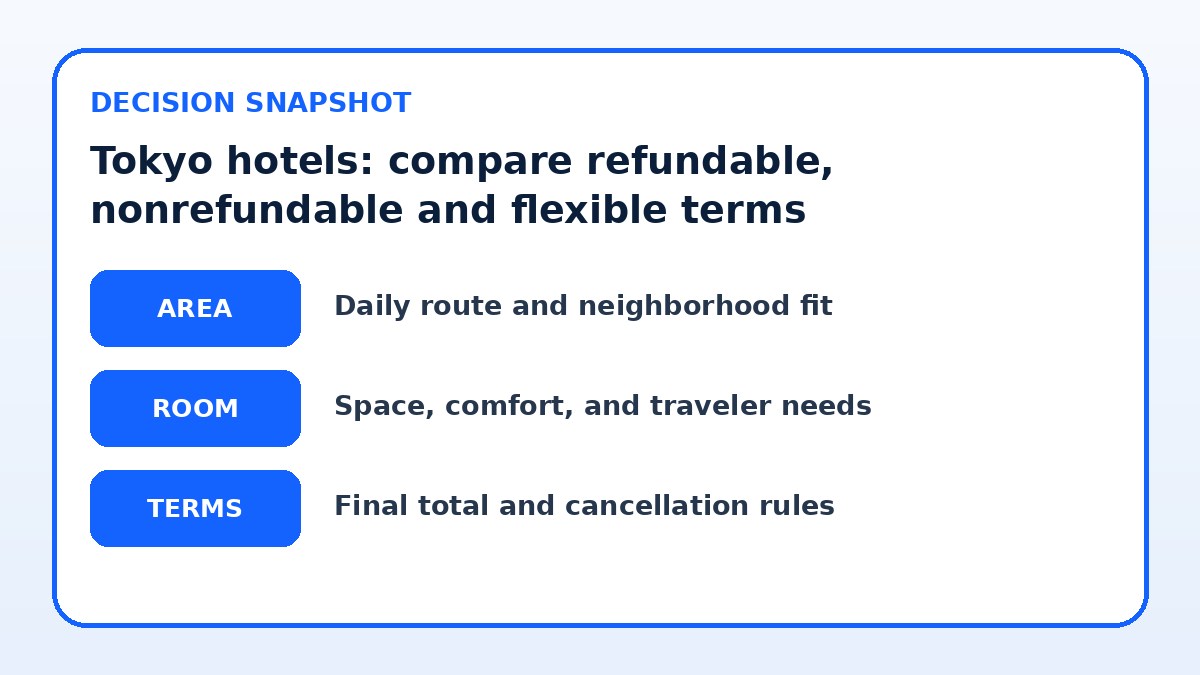
Finally, check payment and refund mechanics: does the rate require prepayment, and if so, how long until a refund posts after cancellation? Who processes refunds—the hotel or the booking site—and how long does each say it will take? Make a habit of saving screenshots or confirmation emails of the cancellation policy at booking time; if disputes arise later, those records speed resolution. Small steps during booking reduce stress later when you are exploring Tokyo and want the freedom to change plans without losing money.
Frequently asked questions
If I book a nonrefundable rate and my flight is delayed, can I get a refund?
Nonrefundable rates normally do not allow refunds for cancellations or no-shows. If your flight is delayed, contact the hotel immediately to explain the situation; some hotels may offer goodwill changes or allow date adjustments for a fee, but any exception is at the hotel’s discretion. If you booked through a third-party site, check that site’s travel protection or cancellation policies—some platforms offer paid trip protection that covers delays. Always verify the provider’s stated policy and any travel insurance coverage before assuming a refund will be granted.
Is it better to book refundable rates directly with the hotel or through an online travel agency?
Both choices have pros and cons. Booking directly with the hotel can simplify communications and sometimes makes it faster to modify or cancel, but online travel agencies may offer easier dashboards for making changes and processing refunds. If you use an agency, confirm whether modifications must go through them and how long refunds take. Regardless of channel, read the final cancellation terms shown at checkout and save the booking confirmation; those final terms govern the transaction, not the summary listed earlier in search results.
How do taxes, service charges, and third-party fees affect refunds for Tokyo hotel bookings?
Taxes and service charges may be treated differently from the room rate depending on local rules and the hotel’s policy. Some bookings refund the full amount including taxes and fees; others refund only the room portion and retain certain charges. If you booked through a third party, their platform might collect some fees that are nonrefundable or have separate refund timelines. To avoid surprises, check the final booking breakdown to see which line items are refundable and read the provider’s refund policy carefully before you pay.
Final planning note
For most solo travelers planning a trip to Tokyo, the practical choice is to prioritize flexibility unless your dates and plans are locked. Fully refundable rates reduce stress around late arrivals, flight changes, and on-the-fly decisions about where to stay in the city. Semi-flexible or credit-based options are useful cost-saving compromises, while nonrefundable rates are sensible only when you are confident your itinerary will not change. In every case, read the provider’s final booking page: record exact cancellation deadlines, who issues refunds, any fees or nonrefundable line items, and the process for making changes. Thoughtful comparison at booking time keeps your Tokyo trip adaptable and saves time and money if plans shift.
Continue planning
Check current options and final conditions
Use the provider page to confirm live availability, the final total, cancellation terms, and every condition that matters to your trip.
This evergreen planning guide was created with AI-assisted drafting and a structured quality review. It does not display live prices, schedules, availability, visa guidance, or provider rankings. Verify current details before booking. Some links are affiliate links; we may earn a commission at no additional cost to you.