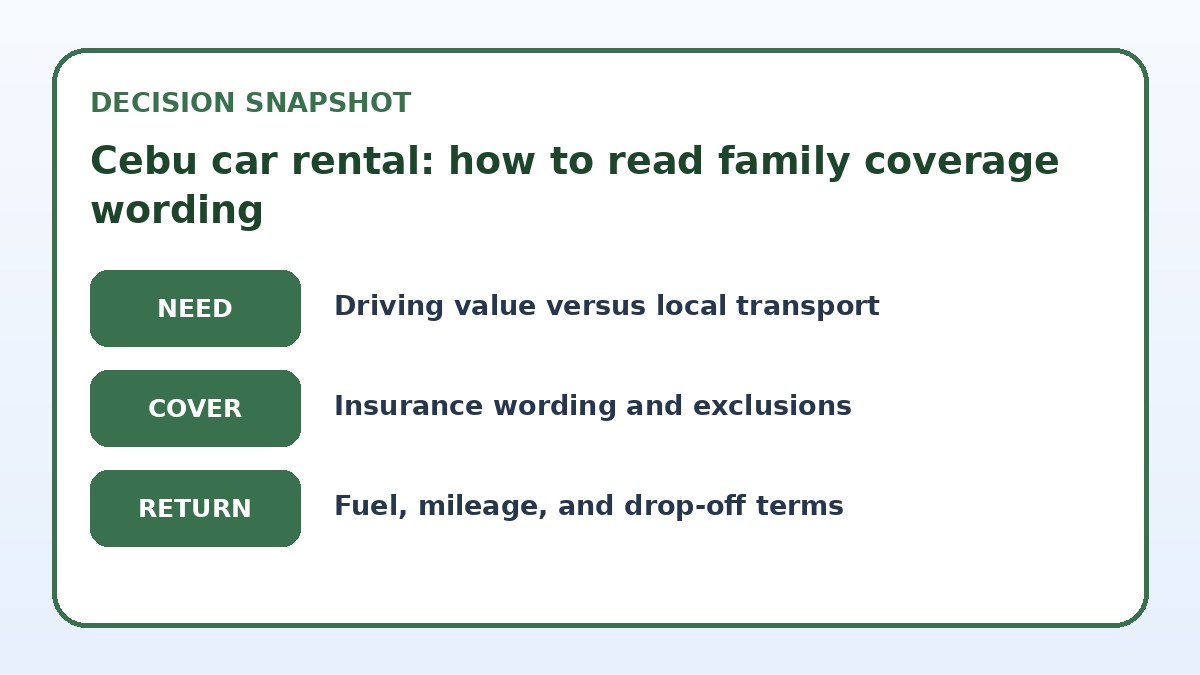
If you’re renting a car in Cebu for a family trip, the fastest way to avoid surprises is to learn which words change responsibility and cost. “Collision damage waiver,” “loss damage waiver,” “third-party liability,” “super cover,” and “excess” are the terms that most affect whether you’ll pay out of pocket after an incident. Read the rental contract and insurance pages with those phrases in mind and compare what’s included and optional. Families should prioritize bodily injury and third-party liability limits, child-seat rules, and whether additional drivers (spouse, parent) are covered without a surcharge. This article gives practical decoding of common policy wording, decision criteria for what to buy or skip, and the tradeoffs families face when balancing peace of mind against extra daily charges.
See current options before you compare the details
Availability and final conditions change. Open Trip.com now or keep reading for the practical comparison.
Key insurance words and what they actually mean
Start by searching contract language for a short list of phrases. Collision Damage Waiver (CDW) or Loss Damage Waiver (LDW) is often marketed as removing responsibility for damage to the vehicle, but the wording matters: some waivers only reduce the company’s claim and still leave an excess or deductible. Excess, deductible, or customer liability is the amount you must pay if a claim is accepted. If the contract says “zero excess” or “full waiver,” confirm those exact words on the provider page because they can be conditional—restricted by driver age, approved roads and authorized drivers.
Third-party liability covers damage you cause to other people or property; local minimums may be low, so a supplement that raises the limit can prevent personal exposure. Supplemental Liability Insurance (SLI) or third-party top-up usually increases limits above the rental base policy. Loss of use, administrative fees and towing are other charges that contracts might pass to you even when the CDW applies. Read exclusions such as off-road driving, unlicensed drivers, or driving under the influence—these frequently void waivers and reassign full responsibility back to you.
What families should prioritize in coverage wording
Families should treat bodily injury and third-party liability limits as top priorities because a serious accident can involve multiple passengers or other vehicles. Look for wording that clarifies per-person and per-accident maximums for bodily injury and total third-party liability limits. If child seats are mandated for your children, check whether damage to child seats is covered and whether using your own seat affects insurance terms. Make sure the policy allows multiple named drivers—if spouses or grandparents will swap driving, verify whether additional drivers are free, need registration, or require extra fees.
Consider protection for roadside incidents that commonly affect families: accidental lockouts, lost keys, flat tires, and towing. Some policies exclude roadside assistance from CDW and bill those costs separately; others include limited assistance but still charge recovery fees. Review the wording on what constitutes an authorized repair shop and who pays for immediate fixes during a trip. If you plan to drive to smaller islands or on ferry routes, check for explicit exclusions that could void coverage in certain provinces or on unpaved roads.
| Approach | Best for | Tradeoff to check |
|---|---|---|
| Buy full CDW/LDW from the rental company | Families wanting minimal hassle and immediate zero-excess protection | Higher daily cost but simpler claims process and fewer up-front payments |
| Rely on existing credit-card coverage | Travelers with clear, documented card benefits who accept higher admin steps | Requires verifying card terms and may still force you to pay excess at pickup |
| Purchase third-party rental insurance | Cost-conscious families seeking lower daily rates with separate claim handling | Potential delays in reimbursement and more paperwork after an incident |
| Keep only mandatory local liability and add targeted extras | Families who prefer customized protection (child seats, roadside assistance) | May leave gaps for vehicle damage unless excess is otherwise covered |
Ready to check the option that fits your plan?
Use your exact dates and traveler details so the provider page can show the current total and conditions.
How to compare insurance options on the booking page
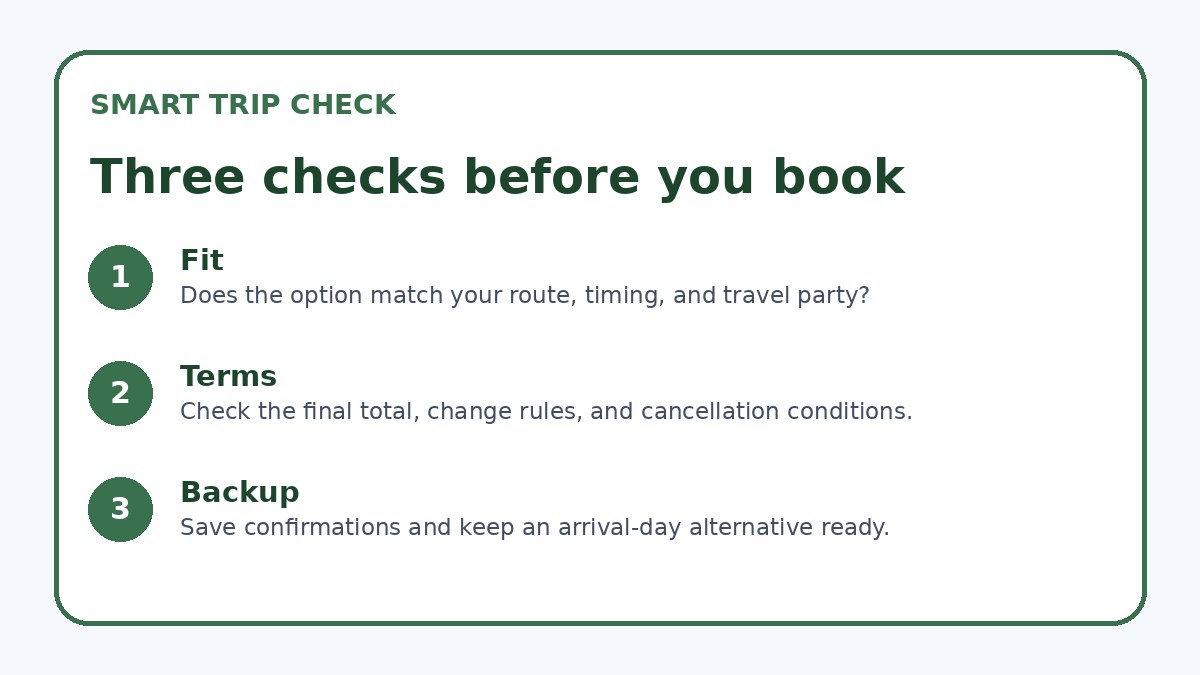
When comparing offers, place insurance wording on the same mental checklist as price and vehicle suitability. On each provider’s booking page, copy or screenshot the insurance section and check: the exact term (CDW, LDW, SLI), the excess amount, which events are excluded, who is an authorized driver, and whether child seats or additional drivers are included. If a line says ‘insurance included,’ expand the policy summary or request the full policy document; online summaries may omit important exclusions. For any optional add-on, note whether it is refundable if you cancel and whether it is offered by the rental company or a third-party insurer.
Remember to confirm what happens at the scene of an accident—some contracts require immediate police reports, and failure to follow steps can void coverage. Also check who handles the claim: the rental company may bill you first and seek reimbursement, or a third-party insurer may manage claims directly. Ask whether credit card coverage is accepted by the rental company and whether using such coverage conflicts with the company’s own waivers, because some offices insist you buy their CDW even if your card already provides similar protection.
Before you book
- Read the rental page’s insurance section and save a screenshot of the exact wording for CDW/LDW, excess amount, and exclusions before you book.
- Confirm who is an authorized driver and add any spouse or regular driver on the contract to avoid coverage voids.
- Ask the rental company whether child seats are covered for damage and whether using your own seat affects insurance.
- Verify whether roadside assistance is included or billed separately and what procedures trigger coverage.
- If relying on credit-card insurance, get written confirmation from the card issuer that it covers Cebu rentals and any age or vehicle restrictions.
- Note the required steps after an accident (police report, rental company notification) and store local emergency numbers and the rental office contact.
Tradeoffs families face: cost versus risk and convenience
Buying the rental company’s top waiver often removes the excess and simplifies the post-accident process—no upfront large payments, fewer paperwork headaches, and quicker vehicle swaps. That convenience can be valuable on family trips when time and stress matter more than small savings. But fully waiving all liability increases daily cost; weigh that against your financial ability to cover an excess temporarily and the likelihood of needing it. If you have strong personal or credit-card coverage that explicitly covers local rentals, you might accept a higher excess and save on daily rates, provided the rental company allows that arrangement.
Rejecting add-ons to save money exposes you to financial risk and potential administrative bills that can be higher than the add-on cost. Also account for what a claim would mean for your trip rhythm—time lost to police reports, inspection, and arranging alternative transport. Families with young children or multi-driver itineraries often benefit from paying for convenient cover that reduces friction. Ultimately, balance the cost of extra protection against your risk tolerance, clarity of policy wording, and your readiness to handle claims while traveling in Cebu.
Frequently asked questions
Does CDW/LDW mean I won’t pay anything if the car is damaged in Cebu?
Not always. CDW or LDW often reduces the rental company’s financial claim but may still leave an excess or deductible you must pay after an accepted claim. Some waivers advertise “zero excess,” but those words can be conditional. Carefully check the policy wording for exclusions—events like driving on unpaved roads, using the vehicle on ferries, or failing to report an accident to police may void the waiver. On the rental booking page, ask the company to confirm whether zero-excess is unconditional and whether any driver age, territorial or behavior restrictions apply.
Can I rely on my credit card’s rental insurance when renting a car in Cebu for my family?
Possibly, but you must verify specifics with the card issuer first. Card insurance often covers collision damage for rental cars but may exclude certain vehicle types, drivers under a certain age, or rentals in particular countries. The rental company may still require you to pay their excess at the counter and submit a claim to the card later for reimbursement. Obtain written confirmation of coverage limits, required documentation, and whether the card’s insurer requires immediate police reports or additional forms. Also check whether using the card’s insurance forbids you from buying the rental company’s CDW.
What should families do at the scene of an accident to protect coverage?
Immediately follow the rental company’s stated steps: secure safety first, call local emergency services if needed, and report the accident to local police to obtain a formal incident report. Photograph the scene, all vehicles involved, and road conditions; gather contact and insurance details from other parties and witness statements if possible. Then notify the rental company as required—some contracts demand immediate notification to preserve coverage. Keep copies of police reports and all receipts for repairs, towing, or alternative transport to support any claim or reimbursement later.
Final planning note
For families renting in Cebu, the most practical approach is to decode the key insurance words on the booking page and choose coverage that matches your risk tolerance, trip complexity, and available alternate protections. Prioritize clear third-party liability limits and confirm how excess and exclusions are handled. If you value stress-free travel with children and multiple drivers, paying for a comprehensive waiver can be worth the daily cost; if you have reliable credit-card insurance and are comfortable managing claims after the fact, you can accept a higher excess. Whatever you choose, document the exact policy wording, ask the provider to confirm any verbal assurances in writing, and keep emergency contact details and the rental contract with you while driving.
Continue planning
Check current options and final conditions
Use the provider page to confirm live availability, the final total, cancellation terms, and every condition that matters to your trip.
This evergreen planning guide was created with AI-assisted drafting and a structured quality review. It does not display live prices, schedules, availability, visa guidance, or provider rankings. Verify current details before booking. Some links are affiliate links; we may earn a commission at no additional cost to you.