If you need to travel from Brisbane to Sydney for work, the practical first step is to pick the mode that fits your meeting schedule and risk tolerance — then confirm the details. Decide whether time-in-transit, airport or station access, and the ability to work en route matter most. With those priorities set, check availability, ticket flexibility, and the transfer options at both ends. On the travel day itself, prepare digital and physical backups: boarding passes or tickets, a charged laptop and power bank, snacks, and a quiet plan for calls if needed. This article walks through what to check and compare so your travel day runs smoothly and your focus stays on the business at hand.
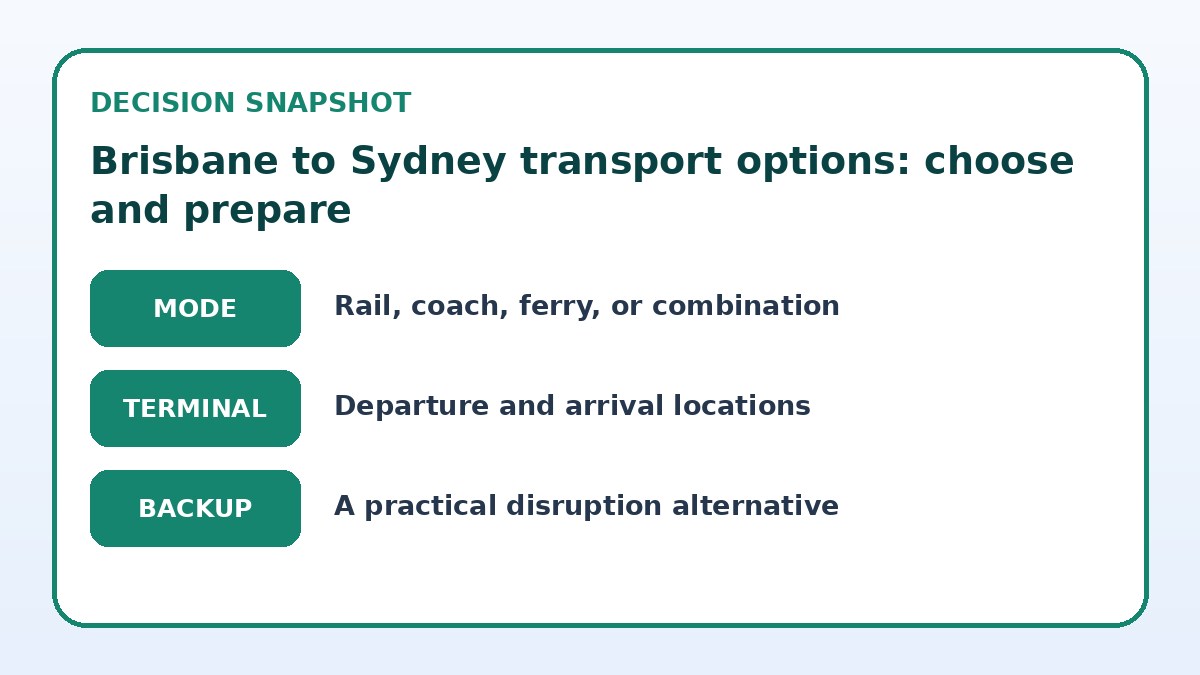
See current options before you compare the details
Availability and final conditions change. Open Trip.com now or keep reading for the practical comparison.
Set priorities and compare door-to-door times
Begin by listing what matters most for your trip: arriving early for a meeting, minimizing risk of delay, keeping travel costs under a set budget, or having uninterrupted work time. For instance, if you must be contactable continuously, a mode that offers reliable mobile signal or on-board Wi-Fi may be preferable. If avoiding the stress of airport transfers and security lines is key, train or driving options might win. Put these priorities in order before you compare options; it saves time and frames which tradeoffs you'll accept when a choice isn't perfect.
When comparing options, calculate door-to-door time rather than the advertised vehicle duration. Include travel to the station or airport, recommended check-in or arrival buffers, transfer times on the far end, and the commute to your final meeting or hotel. For example, a faster scheduled flight can lose its advantage when railway links, traffic to the airport, and security queues are added. Make a realistic timeline for the whole journey and use that to compare the total travel burden between trains, flights, and driving.
Confirm schedules, flexibility, and what to verify before booking
After choosing a preferred mode, check schedules across providers and validate whether routes are direct or require connections. For trains, confirm whether services are express or make multiple stops; for flights, verify whether options are non-stop or include layovers and how tight connections are. Before booking, read the provider's fare rules: cancellation and change penalties, name-change policies, baggage allowances, and whether you can pick specific seats. Because these operational details change, always verify them on the final booking page of the carrier or agent you plan to use.
Also confirm on-the-day access requirements: recommended arrival times, online check-in windows, and boarding gate or platform change policies. If your business schedule could shift, prioritize tickets that let you move to another service with minimal fees. Where local transfers matter, map the connection — for example, train station to meeting venue or airport shuttle schedules — and check the latest local transport options. Trip.com can be used as a comparison tool to see current availability, but verify all fare and schedule specifics on the provider’s official booking pages.
| Approach | Best for | Tradeoff to check |
|---|---|---|
| Flight (airline) | Travelers prioritizing the shortest scheduled in-air time | Requires added time for airport transfers, check-in, and security; verify direct vs connecting options before booking |
| Intercity train | Those who prefer station-center arrivals and the ability to work with fewer transfer steps | May take longer than flying in total; check express vs stopping services and onboard connectivity options |
| Drive or hire car | Groups, flexible schedules, or when door-to-door control is important | Subject to road traffic and parking logistics; factor in driver time and company travel policies |
| Hybrid (flight + train or car) | Balancing speed and last-mile convenience when direct options are limited | Introduces an extra transfer and potential coordination risk; check connecting times carefully |
Ready to check the option that fits your plan?
Use your exact dates and traveler details so the provider page can show the current total and conditions.
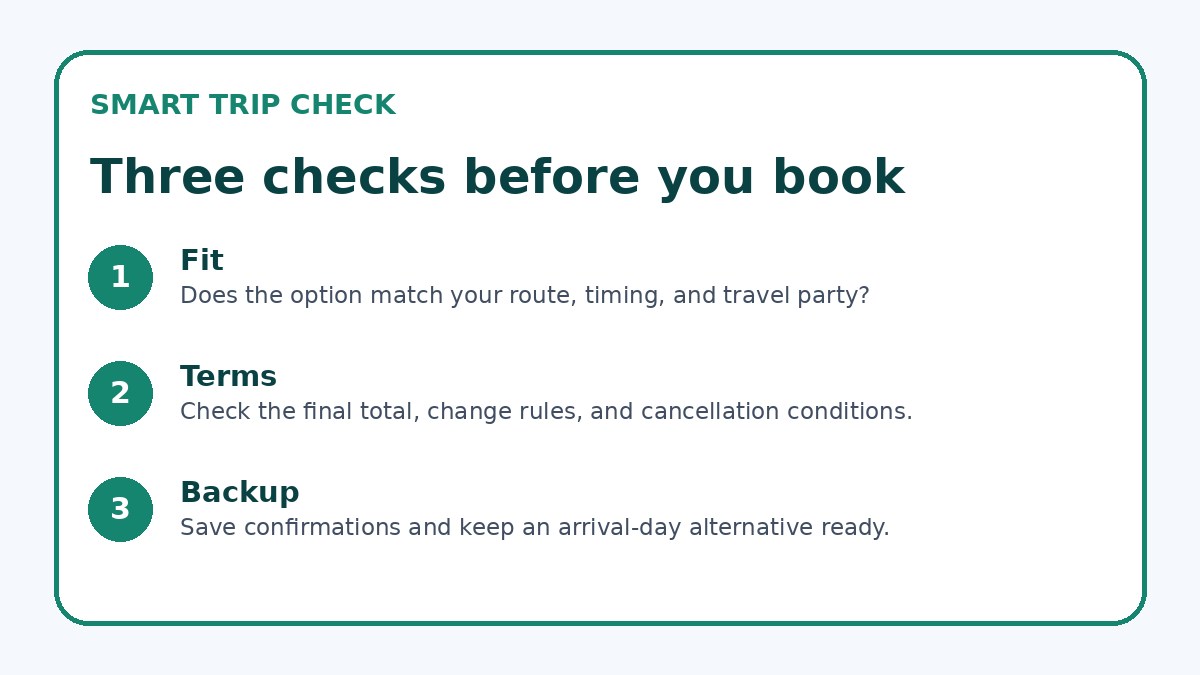
Prepare for productivity and comfort on travel day
Pack a slim business kit and test it the evening before: a charged laptop and phone, a power bank, charging cables, a compact headset, a lightweight notepad, and any presentation materials you need. Choose a carry option that fits airline or train carry-on rules so you can access essentials during transit. If important calls are scheduled during travel, preload any meeting documents and test conference links and VPN access. Consider battery-saving settings and portable hotspots if you rely on steady connectivity; having offline copies of critical documents is a small redundancy that can prevent big problems.
Plan clothing and personal comfort to minimize time on arrival; a wrinkle-resistant outfit or a small travel steamer in your bag can help. Pack healthy, easy-to-eat snacks and a reusable water bottle (empty through security if flying). Note quiet seating areas or business lounges available at your origin and destination — some require membership or day passes, so check access rules in advance. Finally, have a simple contingency plan for delays: updated contact info for colleagues, a message template explaining late arrival, and backup ways to join meetings remotely if you miss an in-person slot.
Before you book
- Calculate total door-to-door time including transfers and commute to your meeting, then choose the option that meets your arrival window.
- Verify whether the service is direct or requires connections and confirm minimum connection times on the provider’s booking page.
- Select a fare with change or cancellation flexibility if your meeting schedule is not fixed, and confirm the exact rules before purchase.
- Charge all devices and pack a small power bank; test VPN and conferencing tools the evening before travel.
- Pre-arrange or research ground transport at both ends (rideshare app, shuttle, station taxi rank) and note typical wait times.
- Save screenshots of tickets, directions, and contingency contacts; leave the meeting host a planned arrival update and backup contact.
Handle transfers, ground transport, and arrivals smoothly
Think through the end-to-end transfer to your meeting or hotel. When arriving at Sydney, check which terminals or stations serve your chosen provider and the ground transport options to your destination: rail, shuttle, taxi, rideshare, or hired car. Note peak traffic patterns and whether public transport options are frequent at your arrival time. If you need to be somewhere quickly and reliably, consider pre-booked airport transfers or arranging a car through your company’s preferred travel partner to reduce uncertainty on the ground.
Prepare digital and physical navigation aids: a screenshot of the route, the destination address in local format, and a small list of alternate meeting points in case of delays. Inform the meeting host of your estimated arrival window with updates if your schedule shifts. If you expect to arrive early and need a workspace, identify co-working spaces, hotel lobbies, or lounges where you can set up briefly. Make sure your phone has the necessary local apps installed for rideshare, maps, or ticketing to save minutes on arrival.
Frequently asked questions
Should I choose a flight or a train for Brisbane to Sydney transport when I have a tight schedule?
If your schedule demands the least time in the vehicle, flying often offers the shortest in-air segment, but you must include airport transfers, check-in buffers, and security in your planning. Trains can be more reliable for city-center to city-center travel and reduce transfer steps, letting you work more consistently en route. Compare realistic door-to-door times for your exact origin and destination addresses, check if direct options exist for either mode, and factor in the risk of delays that would affect meeting attendance before selecting.
How far in advance should I arrive at stations or airports for a business trip on this route?
Recommended arrival windows differ by operator and mode, so verify the provider’s guidance on its booking page. Generally allow extra time for baggage, security procedures, and platform or gate changes. If you prefer to avoid last-minute stress, aim to arrive earlier than the minimum recommended time, especially during peak travel periods or when hotel check-out coincides with your departure. Also consider time to set up and test devices if you plan to take calls en route or immediately after arrival.
What can I do if my meeting time changes on the travel day?
First, check the change and cancellation terms of your ticket so you know whether you can move to a different service and what fees apply. If you cannot switch easily, contact the meeting organizer to explore remote participation or slight rescheduling; provide a clear arrival estimate and ask if someone can start without you. Have backup connectivity (mobile hotspot, power bank) and offline copies of materials to join remotely. If ground transport is the constraint, consider faster last-mile options like a pre-booked car to reduce further delays.
Final planning note
Preparing for a Brisbane to Sydney transport day as a business traveler means making one clear decision early: what you value most—speed, reliability, or convenience—then matching providers and tickets to that priority. Work out door-to-door timing, verify service directness and fare flexibility on the provider’s booking page, and pre-plan transfers and on-the-day productivity needs. Small preparations—charged devices, backup connectivity, and a simple contingency plan—turn travel friction into manageable steps and keep you focused on the meeting. When in doubt, compare current schedules with a service like Trip.com for availability, but always confirm operational details with the carrier before you commit.
Continue planning
Check current options and final conditions
Use the provider page to confirm live availability, the final total, cancellation terms, and every condition that matters to your trip.
This evergreen planning guide was created with AI-assisted drafting and a structured quality review. It does not display live prices, schedules, availability, visa guidance, or provider rankings. Verify current details before booking. Some links are affiliate links; we may earn a commission at no additional cost to you.