Practical answer up front: if you value lower cost and predictable arrival times when avoiding central-area traffic, public transport (train or coach) can work with extra luggage; if you prioritize door-to-door convenience, minimal walking, and help handling bags, a pre-booked private transfer or taxi is usually the better choice. Which to pick depends on your tolerance for carrying and maneuvering suitcases, how many changes you will make, mobility needs, budget flexibility, and the exact airports and arrival times involved. This guide walks you through the tradeoffs for London airport transfer choices, shows how to compare options when you have bulky or multiple bags, and gives a checklist of facts to verify on provider pages before you book. Use the practical criteria here to match the transfer style to your luggage, itinerary, and energy level.
See current options before you compare the details
Availability and final conditions change. Open Trip.com now or keep reading for the practical comparison.
Assessing your luggage and mobility needs
Start by listing what counts as extra luggage: checked suitcases, sports equipment, strollers, or large boxes. Count pieces, note weights if you know them, and imagine moving them between platforms, up ramps, or across busy streets. If anyone in your party has limited mobility, or if you have awkward items that need two people to handle, that should push you toward private transfer options where staff assist with loading and unloading. Also consider time of day: late-night or early-morning arrivals reduce public transit frequency and increase the effort needed to manage heavy bags alone.
Think about your final London destination and its access to roads versus stations. Central hotels may be close to Tube stations but up several steps or down narrow corridors; coordinated private drop-offs can be easier for door-to-door access. If your accommodation is near a major rail hub and you are comfortable carrying luggage a short distance, rail options become more practical. Making a realistic mental run-through of the walking routes and likely transfers will reveal whether convenience or cost should drive your London airport transfer decision.
Public transport: when it makes sense
Public transport is a strong choice when you have one or two reasonably sized suitcases, you’re traveling light on companions, and you want to manage costs. Trains and express coaches typically offer luggage space, but availability varies during peak periods and vehicles sometimes fill up. If your trip involves a direct rail link or a coach that drops you near your accommodation, the tradeoff of carrying bags for a short distance can be worthwhile. Also consider luggage-friendly alternatives like services that allow off-peak travel or short taxi rides from a station to your door to cut down on carrying.
To make public options easier, plan your route in advance: identify the number of changes, platform layouts, and whether step-free access exists between platforms and exits. Choose services with minimal transfers and check station maps for elevators and ramps; if you need step-free paths, verify them on official transport sites. Bring luggage with wheels and secure straps, pack lighter where possible, and set arrival buffer time for unexpected waits or slower moving through busy terminals.
| Approach | Best for | Tradeoff to check |
|---|---|---|
| Public transport (train/coach) | Travelers with one or two suitcases who want lower-cost travel and are comfortable carrying bags short distances. | May involve stairs, platform transfers, and limited luggage space during busy times. |
| Pre-booked private transfer | Groups or travelers with oversized, numerous, or fragile items needing door-to-door service and luggage assistance. | Higher cost and need to confirm vehicle size and pickup details on booking pages. |
| Metered taxi / ride-hailing | Short notice arrivals or when immediate departure is needed and you prefer curbside pickup. | Variable vehicle size and luggage capacity; confirm driver can take large items before starting the trip. |
| Hybrid—station transfer plus short taxi | Travelers balancing cost and convenience: use rail/coach for long leg, then a short taxi for the final stretch. | Requires a handover with luggage between modes and may add coordination time. |
Ready to check the option that fits your plan?
Use your exact dates and traveler details so the provider page can show the current total and conditions.
Private transfers and taxis: advantages and what to confirm
A private car or pre-booked transfer will reduce the physical effort required and often allows curbside pickup and drop-off. That matters if you have multiple large bags, fragile items, or if you’re traveling with children and equipment. Private options also simplify navigation at unfamiliar airports because a driver meets you at an agreed point, handles loading, and drops you at your accommodation’s door or nearest legal curb. For many travelers the time saved and reduced hassle outweigh the higher cost compared with public transport.
Before you book a private transfer, verify critical on-page details: the vehicle category and maximum luggage capacity, whether child seats or special equipment are provided at extra cost, the exact meeting point at arrival, expected wait time policies for flight delays, and cancellation or amendment rules. If you need a larger vehicle, select and confirm a model or van that explicitly states it can take your number of suitcases. Always check final booking terms on the provider’s page rather than relying on summary descriptions.
Before you book
- Count each piece of luggage, note approximate dimensions, and decide which items you can carry yourself.
- Look up step-free access and elevators for arrival station exits and your accommodation’s nearest public stop.
- If booking private, confirm vehicle type, stated luggage allowance, and whether a driver assists with loading.
- Check pickup meeting point instructions and allowable wait time on the operator’s final booking page.
- Plan arrival time buffer for delays and verify refund or amendment terms in case your flight schedule changes.
- If using public transport, map the full route including platform changes and walking distances between stops.
Practical decision steps and booking strategy
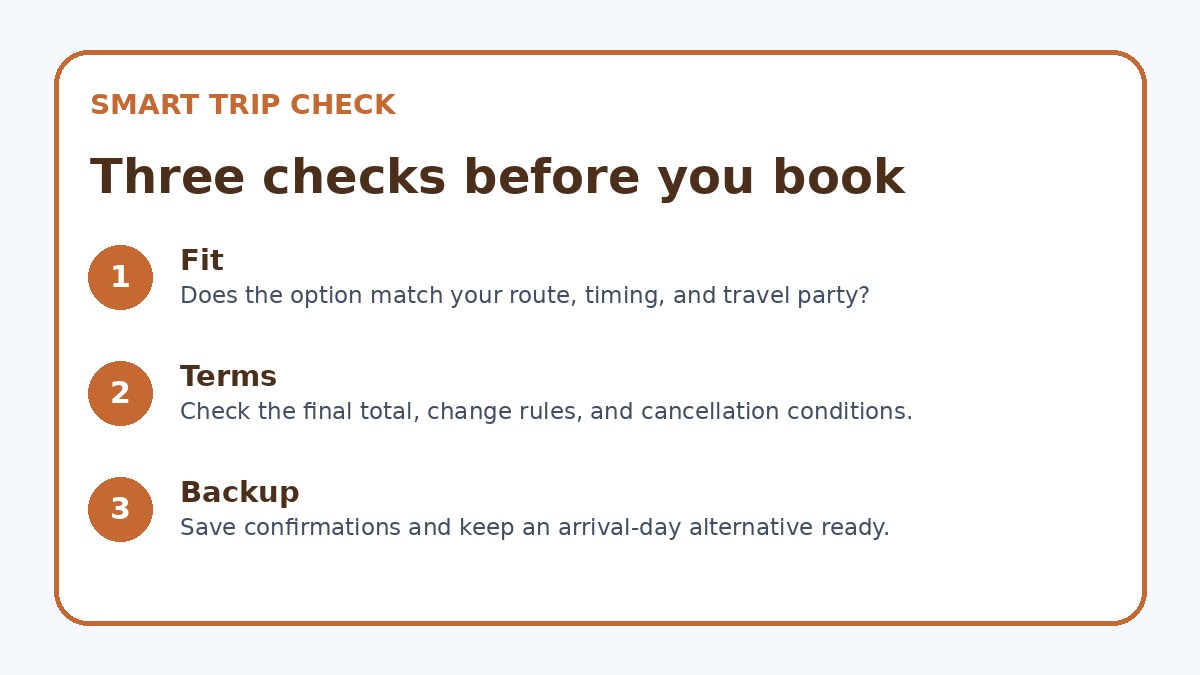
Decide by answering three clear questions: how many pieces and what sizes are you bringing; how many changes or short walks are on the public route; and how important is door-to-door convenience versus saving money. If luggage plus changes is greater than your comfort threshold, lean private. If you and your group can handle a single direct train or coach and the walk from station to accommodation is short and level, public transport is an efficient choice. Factor in time of day, mobility needs, and whether you want guaranteed assistance on arrival.
When you’re ready to book, compare options side-by-side: total door-to-door travel time, transfers and walking required, vehicle or carriage luggage rules, and supplier policies on flight delays. Use provider booking pages to confirm the exact pick-up instructions and allowed luggage. Trip.com may be a place to compare current availability and conditions, but always cross-check the final terms on the operator’s own site before payment. If you’re unsure, consider booking a private transfer with clear luggage allowances for peace of mind.
Frequently asked questions
Can I bring oversized sports equipment or musical instruments on London public transport?
Many trains and coaches allow large items but space is limited and policies vary by operator. For items like surfboards, bicycles (outside restricted times), or large instruments, check the specific carrier’s luggage and special-item rules before travel. If the item is bulky or fragile, a private transfer gives more predictable handling and avoids squeezing into crowded carriages. Regardless of choice, measure dimensions, protect the item in a hard case if needed, and have a backup plan—such as a pre-booked taxi—if the public route proves impractical on arrival.
How can I reduce stress if I choose public transport with heavy bags?
Minimise what you carry: consolidate items into fewer pieces, use wheeled luggage with sturdy handles, and pack a small day bag for essentials. Time your arrival to avoid peak commuting hours when trains and platforms are most crowded, and look for services advertised as direct or with fewer changes. Identify step-free routes and elevators on station maps ahead of time. If helpful, split duties—one person manages bags while another handles tickets and navigation—or add a short taxi from the station to the door to avoid long walks.
What should I verify on a private transfer booking page before paying?
Confirm the exact vehicle category and the maximum luggage capacity stated in clear terms, not inferred from photos. Check pick-up location instructions, the provider’s policy on flight delays and how long they wait without extra charge, cancellation and amendment rules, and whether gratuity or extra fees apply for additional stops. If you require child seats, ramps, or assistance with bulky items, make sure those services are explicitly offered and reserved. Always rely on the booking page’s detailed terms rather than brief summaries.
Final planning note
Choosing between public transport and a private transfer for a London airport transfer comes down to luggage, mobility, and how much convenience you’re willing to pay for. Public rail and coach options are sensible when bags are few and manageable and when you can handle short walks or a single change. Private transfers reduce physical effort and offer door-to-door service, but require confirming vehicle size, pickup details, and luggage policies before booking. Use the checklist to verify key facts on provider pages, compare total door-to-door time, and weigh the comfort of assistance against additional cost. With those checks done, you’ll pick the option that fits your luggage and your tolerance for carrying it through London.
Continue planning
Check current options and final conditions
Use the provider page to confirm live availability, the final total, cancellation terms, and every condition that matters to your trip.
This evergreen planning guide was created with AI-assisted drafting and a structured quality review. It does not display live prices, schedules, availability, visa guidance, or provider rankings. Verify current details before booking. Some links are affiliate links; we may earn a commission at no additional cost to you.