If you’re traveling with children from Seoul to Osaka, the central question when booking flights is whether a nonstop or a connecting itinerary will save you stress, time, or money. The practical answer: prioritize direct flights when you value simplicity, door-to-door time, and minimizing transfers with young children; choose a connection when schedules, price, or loyalty benefits make it meaningfully more convenient. Which path is right depends on three family-specific factors: airport transfers at each end, how well your children handle waits and plane changes, and your tolerance for split itineraries (separate tickets, possible rechecking of bags). Below you’ll find clear decision criteria, the common tradeoffs families face, step-by-step checks to run on booking pages, and a checklist of actions to take before you finalize any reservation.
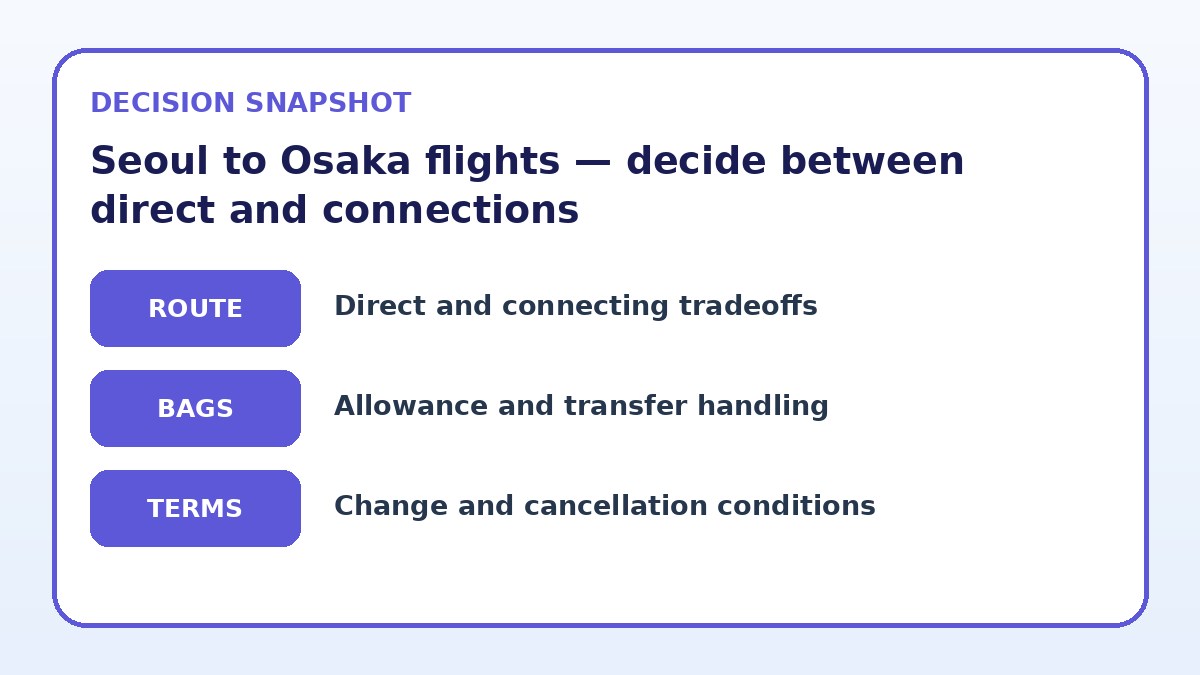
See current options before you compare the details
Availability and final conditions change. Open Trip.com now or keep reading for the practical comparison.
When a direct flight is worth choosing for families
Direct flights remove the added layer of airport-to-airport logistics that complicates family travel. With no intermediate stop, you avoid the stress of hustling through unfamiliar terminals, re-clearing security, and lining up to re-check strollers or car seats. That matters most for families with very young children, toddlers who need predictable routines, or anyone traveling with mobility gear. Simpler journeys reduce the number of micro-decisions on the day: fewer boarding passes to manage, fewer gate changes to monitor, and less chance that a tired child will need to be moved between flights.
Choosing direct service also reduces the number of touchpoints where delays or human error can cascade into missed connections. If your itinerary must fit a narrow arrival window — for school pickups, immediate hotel check-in, or planned activities — minimizing transfers reduces schedule risk. Before booking, confirm on the airline’s final booking page which flights they list as nonstop, what aircraft types are used if that matters for seat options, and the exact baggage allowance included with your fare class.
When connecting flights make sense for your family
Connecting itineraries often open up more departure times, carrier choices, and price flexibility — useful when direct options don’t align with your family’s schedule. A single well-timed connection can split a long travel day into manageable segments, allowing for a proper meal or a stroll in an airport play area. Connections also increase the likelihood of finding seats together in preferred classes, or using frequent-flyer availability that isn’t offered on nonstop legs.
But connections introduce variables that require planning: transfer time, potential terminal changes, and baggage transfer rules. If you consider a connecting itinerary, check whether the connection is operated on the same ticket (which usually protects you if a delay causes a missed onward flight) and whether the carrier transfers checked baggage automatically. On the airline or booking page verify minimum connection times, transfer procedures for families, and whether your infant’s or child’s equipment travels free or needs separate handling.
| Approach | Best for | Tradeoff to check |
|---|---|---|
| Direct flights | Families prioritizing simplicity, fewer transitions, and lower risk of missed connections | Often fewer departure times and potentially higher fares or limited seat availability |
| Single well-planned connection | Families needing more schedule flexibility or better alignment with daytime routines | Requires careful transfer timing and confirmation that baggage is through-checked |
| Separate tickets for lower cost | Price-sensitive families willing to manage transfers and recheck baggage | No automatic protection for missed connections and more logistical work on travel day |
| Mixed-carrier connecting itinerary | Families with loyalty benefits or seat options split across airlines | May involve differing baggage rules, terminal changes, and extra verification before booking |
Ready to check the option that fits your plan?
Use your exact dates and traveler details so the provider page can show the current total and conditions.
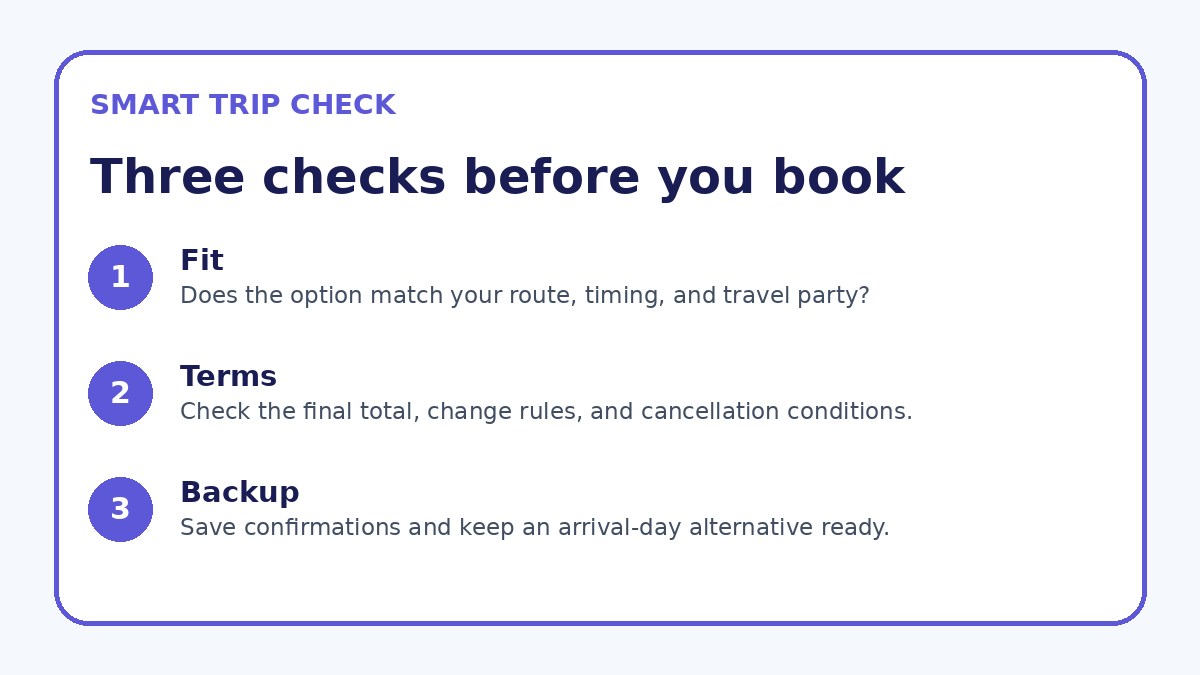
Practical tradeoffs: time, cost, and family comfort
Time is rarely just flight time for family travel. Account for airport transfers, recommended early arrival for check-in with children, and potential layover activities like eating or bathroom breaks. A short nonstop that departs very early or late might be effectively worse than a daytime itinerary with a single connection that aligns with your child’s nap schedule. When comparing total door-to-door plans, map the full journey — home to airport, security processing, and onward transport in Osaka — and weigh how each option affects family comfort.
Cost considerations go beyond the ticket price. Add potential fees for extra seats, checked equipment, or priority boarding, and remember that a low fare on a connecting itinerary could be offset by the need for hotel stays, overnight layovers, or paid lounge access to keep children comfortable. Always calculate the full outlay and non-monetary costs: sleep disruption, the energy of parents, and flexibility to rebook. Verify refund and rebooking terms on the booking page so you understand your flexibility if plans change.
Before you book
- Confirm whether each flight option is listed as nonstop or a connection on the airline’s official booking page.
- Verify baggage allowance and whether checked bags are transferred automatically for connecting itineraries.
- Check minimum connection times, terminal transfers, and whether separate tickets require reclaiming luggage.
- Look up airport transfer times and methods for both Seoul and Osaka to estimate door-to-door duration.
- Confirm seat assignments for all passengers and whether bulkhead or bassinet seats are available if needed.
- Review ticket change, rebooking, and refund terms on the final booking page before you pay.
How to compare options and verify details before booking
Set up a side-by-side comparison: list total elapsed travel time, number of transfers, whether checked bags are through-checked, and ticket protection on missed connections. Use the booking provider’s final page to confirm baggage allowances for each passenger type, whether infant fares or child discounts apply, and whether seat assignments are guaranteed. If you’re using separate tickets for price reasons, confirm whether separate check-ins are required, and whether you’ll need to reclaim and re-check luggage at the layover airport.
Don’t forget ground transport: check which Seoul airport the flight uses, how long transfers to your departure terminal take, and the arrival airport in Osaka — different airports change onward travel choices. If you value certainty, pay attention to flight swap and cancellation protection offered at booking. For real-time comparisons of availability and conditions you can check Trip.com, but always cross-check the airline’s official site to confirm baggage, connection protection, and the exact terms that apply to your chosen fare.
Frequently asked questions
Are direct Seoul to Osaka flights always quicker for families?
Direct flights cut the number of airport touchpoints, which usually reduces the risk of delays causing missed connections. But total travel time depends on door-to-door factors such as airport transfer times, the time you need to arrive early for check-in with children, and onward transport after landing. A well-timed connecting itinerary that avoids very early departures or late-night arrivals can sometimes feel quicker and less disruptive. Compare full journey times and consider your children’s routines, not just airborne minutes.
How much connection time should I plan when traveling with kids?
Plan more buffer than typical single travelers: account for slower movement through terminals, restroom and snack breaks, and the time to re-clear security if needed. If the connection requires changing terminals or reclaiming luggage, add extra margin to avoid stress. Check the airline’s stated minimum connection time as a baseline but add an allowance for family needs. Verify transfer procedures and facility maps on airport websites so you can estimate realistic walking and processing times.
Can checked baggage be transferred automatically on connecting flights?
Sometimes yes — when both segments are on the same ticket or flown by partner carriers that transfer luggage. If segments are on separate tickets or with unrelated carriers, you may need to reclaim and re-check bags during the layover. Always check the final booking page or contact the airline to confirm baggage transfer rules for your exact itinerary. If automatic transfer is critical for your family’s comfort, prioritize same-ticket itineraries or confirm interline baggage handling before booking.
Final planning note
For families traveling Seoul to Osaka, the choice between direct and connecting flights is a pragmatic tradeoff: choose direct service for simplicity and lower connection risk, choose a connection when it meaningfully improves schedule alignment, seating, or fare. Balance total door-to-door time, how your children cope with waits or transfers, and whether baggage will travel with you automatically. Before you book, compare complete itineraries side-by-side, verify baggage and connection protections on the airline’s final page, and use the checklist above to avoid surprises. A few minutes of verification will often save hours of stress on travel day.
Continue planning
Check current options and final conditions
Use the provider page to confirm live availability, the final total, cancellation terms, and every condition that matters to your trip.
This evergreen planning guide was created with AI-assisted drafting and a structured quality review. It does not display live prices, schedules, availability, visa guidance, or provider rankings. Verify current details before booking. Some links are affiliate links; we may earn a commission at no additional cost to you.