If you’re planning a family trip from Hanoi to Da Nang, the most practical question at booking is how flexible your ticket needs to be. For many families the priority is simple: avoid stress if plans shift — a child falls ill, weather forces a day change, or you want to extend a stopover. That means comparing refundable tickets, changeable tickets with small fees, and the operational flexibility of different transport modes (train, bus, plane). Practical tradeoffs are predictable: more flexible tickets usually cost more or have restrictions; the cheapest, nonrefundable fares lock you in. Read on for a clear approach to evaluate options, the decision criteria that matter for families, and a checklist of what to verify on the provider’s final booking page.
See current options before you compare the details
Availability and final conditions change. Open Trip.com now or keep reading for the practical comparison.
Modes and where flexibility matters most
When families compare Hanoi to Da Nang transport, the main modes are trains, domestic flights, and long-distance buses or private car hires. Each mode has different operational flexibilities: trains sometimes let you change dates if berths are available; airlines often sell distinct fare buckets (refundable, changeable with fee, or non-changeable); buses can have rigid seats or flexible open-date tickets depending on operator. For parents, the decision isn’t only refundability — consider the ease of changing bookings, how clearly child fares are defined, and whether the provider will let you hold or reserve adjacent seats for a family.
Also factor in trip complexity. If an option involves connections (for example, a flight with a change or a rail itinerary with a transfer), each segment’s ticket rules matter: a cheap connecting itinerary may be less flexible because independent tickets treat each leg separately. For door-to-door planning, flexibility in baggage allowances, seat assignments, and the ability to rebook without long calls to customer service are often as valuable as a formal refund policy. Families should prioritize the practical steps they’ll need to take if plans change, not just the headline fare.
Refunds, changes, and family-friendly seat rules
Refundable tickets remove the fear of losing the fare entirely, but they usually come with higher base fares or restrictions on how far in advance you must cancel. Changeable tickets that charge a fee can be a middle ground; they let you rebook dates for a predictable cost. For families, the predictability of change fees matters: a clear, published fee is easier to budget for than an opaque policy that requires phone calls. When researching, look specifically for how providers handle changes for children and infants — some systems require you to change all names on a booking, others let you modify only certain passengers.
Seating matters more with kids than with solo travelers. On trains and flights, being able to reserve adjacent seats or cabins can turn a long journey from stressful to manageable. Some fare classes block free seat selection and only allow it for a fee; others include it. Verify whether the provider will hold seats for infants or children traveling without assigned seats, and whether group seating can be added after purchase. Always check what documentation or ID is needed for child fares and whether any seat-change policies differ by fare class.
| Approach | Best for | Tradeoff to check |
|---|---|---|
| Fully refundable fare | Families who expect significant date changes or want full peace of mind | Usually higher upfront cost and stricter cancellation windows |
| Changeable fare with set fee | Families who might adjust dates but want predictable, lower-change costs | You pay a change fee and may still face fare differences on rebooking |
| Nonrefundable but change-permitted tier | Parents who need some flexibility without paying for full refunds | Often less forgiving cut-off times and possible seat or baggage restrictions |
| Lowest-cost nonrefundable ticket | Families with fixed plans prioritizing lowest fare over flexibility | Little to no ability to change or recover costs if plans shift |
Ready to check the option that fits your plan?
Use your exact dates and traveler details so the provider page can show the current total and conditions.
Comparing direct and connecting choices
Never assume a direct option is available or simplest. If direct trains or flights run between Hanoi and Da Nang, they reduce the number of separate tickets and the risk that a delay on one leg ruins the next. Connecting itineraries may be cheaper or more available on short notice, but each connection adds a point of failure and a place where different ticket rules apply. For families, a single direct ticket that allows simple changes often beats two independent low-cost legs that require separate rebookings if plans change.
When reviewing connecting options, treat each segment’s flexibility independently: note the change and refund rules for every carrier or operator. If the connection is sold as a through-ticket by a single provider, the provider’s combined policy applies; if you book segments separately, you’re responsible for missed connections. For young children, prioritize itineraries with longer minimum connection times and straightforward rebooking procedures so you don’t end up navigating complex customer-service calls at a stressful moment.
Before you book
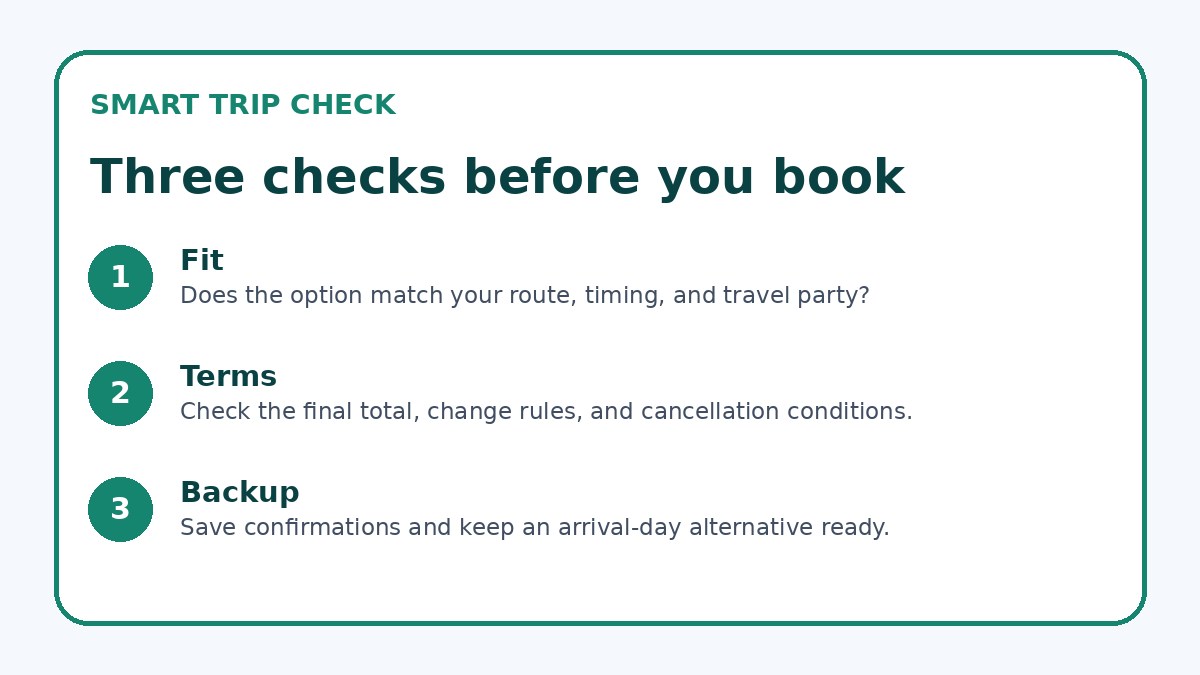
- Confirm the exact change and cancellation fees on the provider’s final booking page before purchase.
- Verify child and infant seat policies and whether adjacent seats can be reserved for the family.
- Check whether connections are on a single ticket or separate bookings and the implications for missed connections.
- Screenshot or save the full terms and conditions shown at checkout, including deadlines for free changes.
- Test the provider’s support channels (chat or phone) to confirm language and response time in case you need urgent changes.
- Compare total door-to-door time and required transfers as part of the flexibility decision, not just ticket cost.
How to evaluate after you find options
Once you’ve shortlisted a few fares and modes, run a quick checklist comparison: what happens if you cancel three days before departure, one day before, or on the day? How much will a change cost and can you change online? Is seat selection included or extra? Do child and infant fares allow lap seating or require a purchased seat? These specific scenarios reveal how family-friendly a ticket really is. Ignore broad marketing terms and look for the exact wording on the booking page that tells you the penalties, permitted changes, and time windows for refunds.
Also test the provider’s customer support process before committing: try the online chat, read recent user feedback for change experiences, and confirm whether language support is available if you need assistance at short notice. If you use an aggregator like Trip.com to compare, always click through to the provider’s final booking page to confirm terms, because the aggregator may not display the full conditions or seat maps. Save a screenshot or PDF of the final booking page after purchase so you have the exact terms if you must request a change or refund.
Frequently asked questions
Can I change only one passenger on a family booking without altering the whole ticket?
Policies differ by operator and fare class. Some systems let you modify individual passenger details or dates on a multi-person booking; others require reissuing the entire booking. Before buying, read the provider’s change policy on the booking page and search for language about partial changes or name-only amendments. If the page is unclear, contact customer service and get a confirmation message outlining how they handle single-passenger changes so you know what to expect.
Is it better for families to book refundable tickets or to buy travel insurance?
Both approaches address different risks. A refundable ticket directly lets you recover the ticket cost under the provider’s terms, while travel insurance can cover a broader set of disruptions (illness, emergencies) but often has exclusions and claim processes. For families, compare refundable fare cost versus the price and coverage of insurance. If a refundable fare is prohibitively expensive, a changeable ticket plus a suitable insurance policy that covers illness or unexpected events can be a practical alternative. Always verify what scenarios the insurance covers and how claims are handled.
How do seat selection and child discounts affect ticket flexibility?
Seat selection and child discounts are separate from core flexibility but affect your travel experience and cost if you must rebook. Some fare classes include free seat reservations and child fare rules; others charge per seat and classify children differently (discounted fare, infant lap seat, or required full seat). If your chosen fare doesn’t include seat selection, you may need to repurchase preferred seats after a change, increasing the effective cost of rebooking. Confirm seat and child fare details on the provider’s checkout page to avoid surprises.
Final planning note
For families traveling Hanoi to Da Nang, ticket flexibility should be evaluated against three practical realities: likelihood of date changes, the importance of adjacent seating, and how many independent legs make up the journey. Fully refundable fares offer the cleanest protection but at higher cost; changeable fares with a fixed fee often balance budget and flexibility. Always verify the exact wording on the provider’s final booking page — fees, deadlines, and child rules are frequently updated — and consider testing customer support responsiveness before you buy. Use comparison tools like Trip.com to surface options, but confirm terms with the carrier or operator to ensure the level of flexibility your family needs.
Continue planning
Check current options and final conditions
Use the provider page to confirm live availability, the final total, cancellation terms, and every condition that matters to your trip.
This evergreen planning guide was created with AI-assisted drafting and a structured quality review. It does not display live prices, schedules, availability, visa guidance, or provider rankings. Verify current details before booking. Some links are affiliate links; we may earn a commission at no additional cost to you.