If your plane lands late in Washington, DC, your first key decision in the first hour after landing is straightforward: get a safe, reliable ride that matches your luggage and comfort needs and goes near your accommodation. For solo travelers this often means choosing between public transit, a rideshare, an airport shuttle, or a pre-booked private transfer. Consider how many bags you have, whether your arrival is delayed or disrupted, how clear the meeting point is at the terminal you arrive in, and whether your drop-off location fits narrow city streets or hotel entrances. The rest of this guide breaks those choices down so you can decide before you land and keep your phone-ready steps efficient, safe, and simple.
Check options for your arrival details
Use your flight, luggage, party size, and accommodation address to compare current choices.
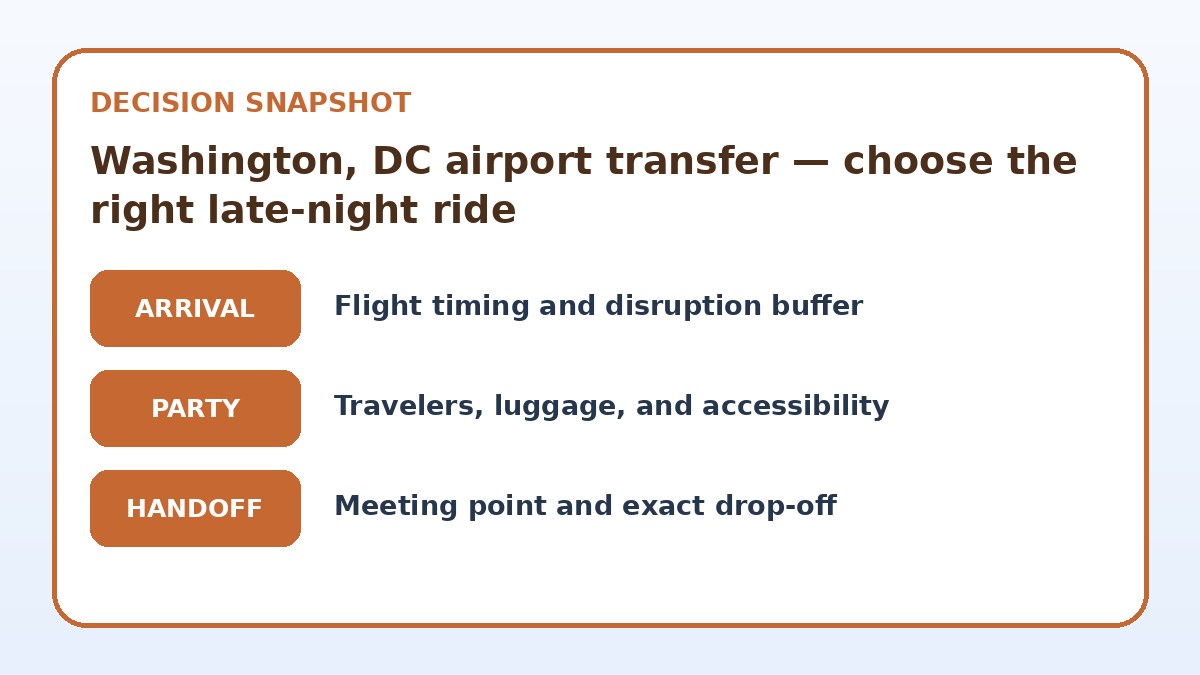
Luggage and party size: pick vehicles that actually fit your load
Before you book anything, inventory your luggage and any extras like a musical instrument, bike bag, or large carry-on. Solo travelers often underestimate cubic space: a single hard-shell checked bag can take as much trunk room as two soft duffels. If you have more than two checked bags or an oversized item, a standard rideshare or shared airport shuttle may be impractical. When evaluating transfer options, ask whether the vehicle has a trunk, roof rack, or cargo van alternative, and whether drivers will help with heavy lifting; those details are typically listed on the booking or provider FAQ page.
Think about party size even when traveling alone — if you expect to meet a friend, bring a pet, or carry bulky work gear, that changes the right choice. For small, straightforward luggage solo trips, public transit or a compact rideshare keeps costs down and is usually faster during overnight hours when traffic is light. For anything bulkier, a private transfer or a rideshare XL ensures trunk space and avoids the stress of juggling bags in the dark. Always confirm on the final booking page what vehicle class you’ll get and the provider’s luggage policy.
Arrival details to have ready
- Count all bags, measure large items, and note whether you need a vehicle with extended cargo space before choosing a transfer.
- Save terminal, gate, and the exact official pickup zone or curbside number from the airport map to show your driver or provider.
- If your flight has a connection or overnight risk, pick a provider with a clear change/cancellation policy and a local contact number.
- Screenshot your booking confirmation, driver name, vehicle description, and the provider’s pickup instructions for quick reference.
- Confirm the exact drop-off address and any access restrictions or preferred hotel entrances so the driver knows where to stop.
- Share your arrival and transfer plan with someone you trust and set a check-in time once you reach your accommodation.
Late or disrupted arrivals: build flexibility into your plan
Late-night flights are more likely to be delayed, cancelled, or to clear immigration slowly; that risk should guide your booking choices. If your arrival window is uncertain, choose providers with flexible cancellation or change policies and live contact options. Many rideshare apps allow you to request a pickup only when you’re actually at the curb; scheduled transfers often require firm arrival times. Balance the value of a scheduled driver waiting for you against the convenience of on-demand pickup. Wherever you book, save the provider’s customer-service number and the reservation reference so you can rebook or update pickup details quickly if your flight status changes.
When disruptions happen, clarity in communication matters: tell drivers terminal, gate area, and a clear meeting point like a specific exit, numbered curb zone, or well-lit landmark. If you use public transit, check late-night schedules and whether night buses or rail replacements operate; these timetables can change and are worth verifying right before travel. If you are uncomfortable with late-night transfers or expect long immigration lines, consider booking the first available hotel night and traveling to your final destination the next morning.
Match the transfer to your arrival
| Arrival approach | Best for | Detail to verify |
|---|---|---|
| Public transit (night bus/rail) | Solo travelers on a tight budget with minimal luggage and familiarity with routes | Lower cost but less privacy, potential walking from stop to accommodation, and limited late-night frequency |
| Rideshare (standard car) | Solo travelers wanting door-to-door convenience without prebooking | Quick and flexible but pickup zones and wait times vary; trunk space may be limited for large bags |
| Shared airport shuttle | Budget-minded solo travelers with moderate luggage who accept multiple stops | Usually cheaper than private transfer but longer journey time and limited ability to control meeting points |
| Pre-booked private transfer | Travelers valuing predictability, assistance with luggage, and direct drop-off late at night | Most convenient and secure, but requires booking in advance and verifying driver wait-time and pickup location |
Make the meeting plan clear
Check the final pickup instructions, waiting conditions, and exact drop-off coverage.
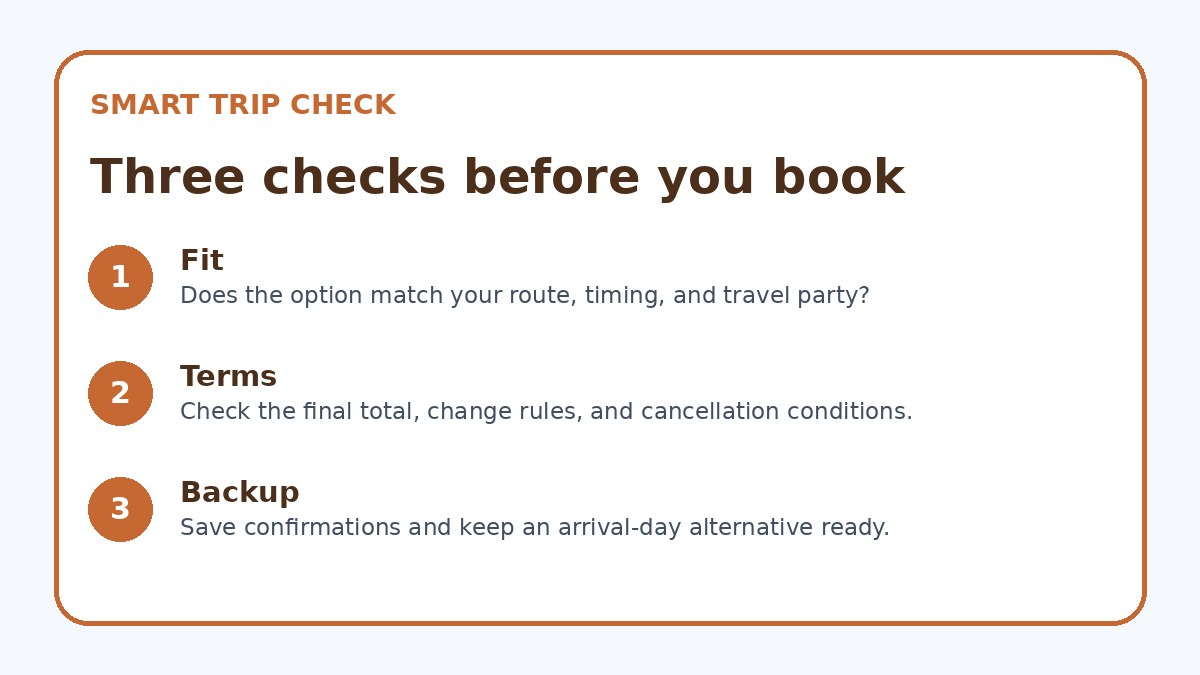
Meeting-point clarity: avoid ambiguous pickup descriptions
Airports and terminals can be confusing after dark. For a smooth handoff, pick a meeting point that’s easy to describe and find: a numbered curb zone, a taxi stand, or a clearly marked ground-transport pavilion. Avoid vague language like “outside arrivals” — specify which terminal, door number, or landmark. If you use a rideshare, confirm whether the app directs drivers to a centralized pickup hub or to terminal curbs; some airports have separate staging lots for different services. Save a photo of the spot or screenshot the airport’s terminal map to show the driver if needed.
When a provider supplies a driver name and vehicle description, save those details in your phone and message them once you’ve cleared security. If the booking includes a meet-and-greet (driver waits at arrivals with a name sign), confirm exactly where the driver will stand and how long they’ll wait. For solo travelers, pick a spot that’s well lit and has other people nearby; that increases safety and makes navigation easier if you’re tired. Always verify the provider’s stated pickup location on the final booking page so you know where to go.
Drop-off fit: match the vehicle to where you’re staying
Not every transfer can pull up directly at small inns, short-term rentals, or certain downtown addresses. Before you commit, check whether your accommodation has a driveway, loading zone, or restricted access; some city streets have limited vehicle access after certain hours. If your accommodation sits on a narrow street or in a traffic-restricted zone, a smaller vehicle or a short walk from a permitted drop-off point may be necessary. Ask the provider whether they can drop you exactly at your door or at a safe, nearby curb — this is usually stated on the provider’s booking page or in their FAQs.
If you’re staying at a large hotel, confirm the preferred guest drop-off point and whether the driver will need a reservation or pass to enter a private driveway. For private rentals, pin the exact address and visible entrance instructions for the driver. Sometimes a short additional walk to a main street is the simplest solution; in other cases, a larger private transfer can negotiate tighter access. Think through safety, lighting, and distance from the drop-off to your room when selecting the vehicle type.
Airport Transfer & Local Mobility questions travelers ask
Is public transit a safe option for a late-night arrival in Washington, DC?
Public transit in Washington, DC—like many major cities—operates later on some lines but may have reduced frequency overnight. Safety depends on the route, time, and station lighting. For solo travelers with minimal luggage who are comfortable navigating buses or rail, it can be economical and efficient. Before you rely on transit, check the latest schedules for your arrival time, station staffing, and whether night buses or rail services run that night. Keep your phone charged, stay in well-lit areas, and consider a short rideshare for the final segment if you feel uncomfortable walking.
How do I choose between booking a rideshare on arrival and pre-booking a private transfer?
Decide based on luggage, predictability, and comfort with waiting. Rideshare apps let you request a ride once you land and are flexible for unforeseen delays, but vehicle size isn’t guaranteed and pickup locations may be centralized. A pre-booked private transfer gives a named driver, a clear waiting protocol, and direct assistance with bags — useful if you arrive very late or have bulky items. Verify the private transfer’s wait time rules and meeting-point instructions on its booking page so you know how long the driver will hold the spot if your flight is delayed.
What should I verify on a provider’s booking page before I confirm an airport transfer?
Check the exact pickup location description, driver wait-time policy, vehicle class, and luggage allowance before booking. Look for a local contact phone number, cancellation or change terms, and any instructions about meeting at a centralized pickup hub versus terminal curb. If accessibility, child seats, or specific entrance access matters, confirm those services explicitly. When in doubt, message or call customer support and save screenshots of the listed instructions so you can show them to your driver or airport staff if the situation changes.
Final decision note
For a late-night solo arrival in Washington, DC, the practical choice is the one that balances luggage needs, certainty around pickup, and personal comfort. If you travel light and know the route, public transit or a rideshare can be smooth and efficient; if you prefer hands-off service and a guaranteed meet-and-greet, a pre-booked private transfer is the safer, more predictable option. Always verify pickup zones, driver wait rules, and luggage policies on the provider’s final booking page before you commit. Keep your phone charged, save key screenshots, and choose a well-lit meeting point so your first hour in the city is calm and controlled.
Continue planning
Check current options and final conditions
Use the provider page to confirm live availability, the final total, cancellation terms, and every condition that matters to your trip.
This evergreen planning guide was created with AI-assisted drafting and a structured quality review. It does not display live prices, schedules, availability, visa guidance, or provider rankings. Verify current details before booking. Some links are affiliate links; we may earn a commission at no additional cost to you.