
Practical answer first: before you click “book” for a Tokyo travel deal, add up flight or train fares, local transport passes, lodging taxes and fees, daily meals, transfers to/from airports, and a realistic daily spending buffer — then compare that total to your budget. Solo travelers especially need to factor single-occupancy surcharges, luggage fees when using budget carriers, and the cost of getting between airports and central Tokyo. This article shows what to include, how to compare direct versus connecting options, and where to verify provider pages for final totals. It focuses on decision points you can control now so your final booking aligns with the money you actually need to travel comfortably in Tokyo.
See current options before you compare the details
Availability and final conditions change. Open Trip.com now or keep reading for the practical comparison.
Build a full-trip cost checklist before you pick a deal
Start with the basics but don’t stop there. List the headline cost shown in the deal—flight or rail fare and room rate—then add taxes, mandatory city or accommodation fees, baggage charges, and any mandatory transfers such as airport express trains or coach shuttles. For solo travelers, single-room supplements and single-use private transfers matter: an economy hotel room for one may still carry the same base fee as a double, and private pickups are rarely cheaper per person. Also allocate a baseline daily expense for food and local travel; Japan’s pricing varies by neighborhood and meal type, so use conservative estimates rather than optimistic splurges.
Next, flag optional extras that can flip a cheap-looking deal into a midrange spend. These include seat selection or preferred cabin upgrades, sightseeing passes that might save or cost more depending on your itinerary, and prepaid SIM or pocket Wi-Fi rentals. If you plan to use convenience stores, vending machines and inexpensive chain restaurants frequently, reduce your food budget; if you aim for restaurants and nightlife, increase it. Finally, write down refundable versus nonrefundable conditions for each significant piece so you can compare true financial exposure if plans change.
Compare direct versus connecting travel options and why it matters
A direct flight or train saves time and reduces missed-connection anxiety for solo travelers, but it can carry a premium. When a direct option is noticeably more expensive, calculate the total cost difference including luggage transfer risk and the value of your time. Connecting itineraries can be cheaper but often add unpredictability: potential delays, longer total travel time, and additional costs like overnight transit hotel stays or last-minute rebooking fees if a connection is missed. Weigh how much time you’re willing to trade for savings, and whether you’re comfortable managing layovers alone.
Also consider the transfer logistics at both ends. Some low-cost carriers use remote terminals or secondary airports that increase transfer time and cost; trains may require multiple station changes or substantial walking between platforms. For each route option, check provider pages for transfer fees, seat selection costs, and the exact arrival and departure terminals. If the search results show both direct and connecting options, run a simple per-hour value calculation: extra travel time converted into a monetary value plus any incremental transfer expenses to see which option is the better overall deal.
| Approach | Best for | Tradeoff to check |
|---|---|---|
| Book cheapest headline fare and add extras later | Travelers confident in flexible schedules and comfortable arranging transfers | Saves immediate cash but risks higher bundled costs and stress if connections need changes |
| Choose a higher upfront fare that includes transfers or baggage | Solo travelers who value convenience and predictable total costs | Pays more initially but reduces the chance of surprise fees and missed connections |
| Stay in central, pricier accommodations | Those prioritizing short commutes and airport/train access | Higher nightly cost offsets savings on local transit and saves time |
| Opt for budget lodging farther out with cheaper headline price | Travelers who prioritize lower nightly cost over transit time | May increase daily transport costs and reduce time available for sightseeing |
Ready to check the option that fits your plan?
Use your exact dates and traveler details so the provider page can show the current total and conditions.
Choose accommodation with a solo traveler lens
Solo travelers often weigh private rooms, business hotels, and capsule or shared options differently than couples or groups. Private rooms provide privacy and secure luggage storage but may carry a single-occupancy cost; business hotels in central neighborhoods can be compact yet efficient, saving transit time and daily commuting costs. Shared hostels or female-only dorms can offer dramatic savings and social opportunities, but factor in privacy tradeoffs and potential noise. When comparing options, calculate the total nights’ cost plus any mandatory facility charges and include the value of your time saved by staying in a more central location.
Use the booking pages to confirm the exact room type, cancellation policy, and any additional fees such as local tourism levies or late check-in charges. Check whether the property includes essentials you’d otherwise buy, like towels, toiletries, or a laundry option—these small conveniences lower incidental costs. If safety or solo traveler amenities matter to you, list specific questions to verify on the provider page: 24-hour reception, secure key access, luggage storage, and proximity to metro lines or stations. Those details affect both cost and how smoothly your trip runs.
Before you book
- Open the final booking page for flights or trains and confirm baggage, seat selection, and airport/terminal details before adding to your cost total.
- Check the accommodation’s full pricing breakdown for taxes, service fees, single-room supplements, and included amenities like breakfast or Wi‑Fi.
- Calculate airport-to-city transfer options and prices (official train, bus, shuttle, taxi) and add the return transfer to your total.
- Estimate a realistic daily budget for meals, local transit, attractions, and an emergency buffer; multiply by trip length and add to fixed costs.
- Compare direct and connecting route totals including time cost, potential overnight needs, and the financial impact of missed connections.
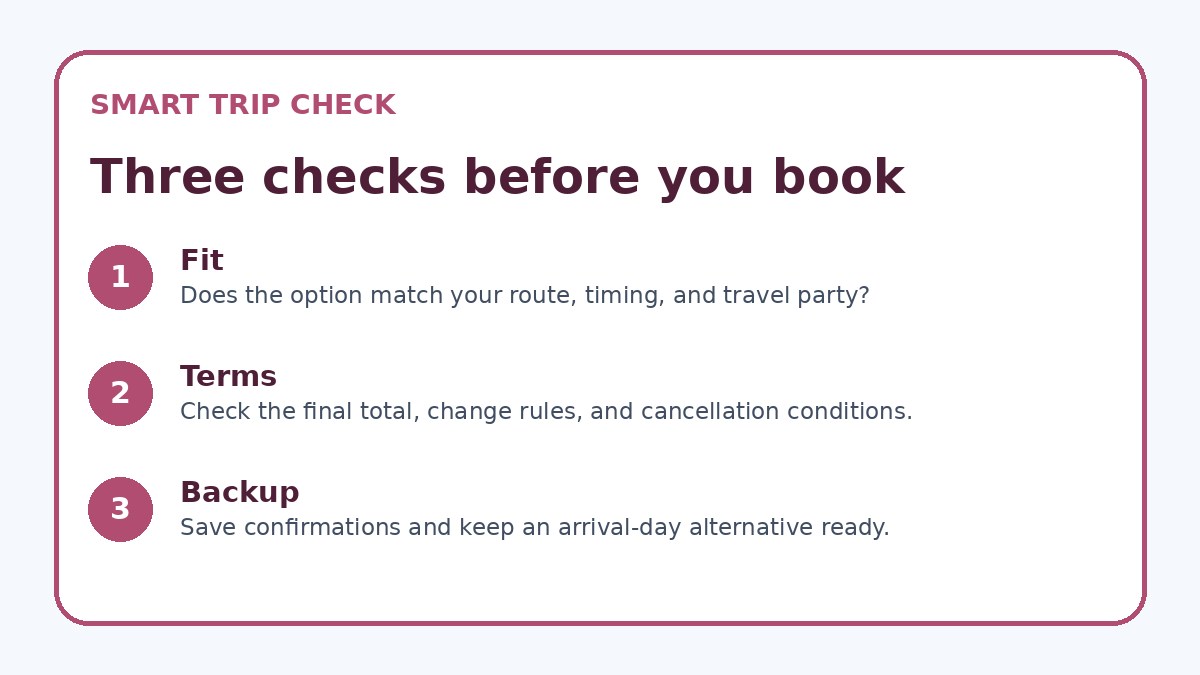
- Verify cancellation and change policies on each provider’s final page and note refund timelines and any change fees that could apply.
Verify the booking pages and prepare a realistic buffer
When you’re ready to book, open each provider’s final booking page and confirm every fee line item. Look for baggage pricing, payment surcharges, local taxes, and whether the rate shown includes or excludes breakfast. If you’re comparing rail passes or metro cards to pay-as-you-go fares, check whether passes cover the lines you need and whether activation, collection, or postage fees apply. If an offer references a promotional or partner rate, verify the eligibility terms and what’s refundable; platform summaries sometimes omit per-passenger surcharges until the final step.
After tallying all known charges, add a contingency buffer—typically a percentage of the subtotal or a fixed daily reserve—to cover unexpected transport changes, a missed connection, or a one-off attraction or evening out. Factor in currency exchange or card foreign transaction fees if you won’t use a fee-free card. Once you’ve got a total with buffer, compare it to alternative dates, different arrival airports, or slightly altered lengths of stay; small timing or location tweaks can produce meaningful savings without sacrificing the experience.
Frequently asked questions
How do I estimate daily expenses in Tokyo as a solo traveler?
Start by choosing a meal style: convenience-store and casual chain meals, mid-range restaurants, or regular dining out. Add average metro trips per day and occasional taxis for late nights or transfers. Include admissions for museums or events you plan, plus small purchases and a contingency. If you’ll dine at a range of places, blend modest and pricier estimates for a realistic daily average. Finally, convert this total to your payment method, and add potential foreign-transaction fees if your card charges them.
Should I buy a prepaid transit pass or pay-as-you-go for Tokyo?
The choice depends on your itinerary density and where you stay. If you plan heavy daily travel across many lines, a prepaid multi-day pass can simplify travel and sometimes lower per-journey cost. For a compact neighborhood-based stay with occasional longer trips, pay-as-you-go loaded on an IC card may be more economical. When comparing, include any activation or deposit requirements shown on provider pages and check which lines or private railways a pass covers to avoid gaps that force extra single fares.
What should I verify on the booking page to avoid surprises?
Confirm every fee line: local taxes, service charges, baggage and seat fees, and any mandatory city levies. Verify exact arrival/departure terminals, pick-up points for transfers, and room type and bed configuration. Check cancellation and change terms, including refund timing and any nonrefundable components. If a promotion or third-party platform is involved, confirm who issues the ticket or voucher and where to get support if plans change.
Final planning note
For solo travelers, a Tokyo travel deal is only a good bargain once you’ve counted every expected cost and a sensible contingency. Prioritize the items that affect your day-to-day comfort—transport time and cost, where you sleep, and cancellation exposure—then compare direct versus connecting options and central versus peripheral accommodations through the lens of total spend and time value. Verify all fee lines and policies on the provider’s final booking pages before committing. If you want a single place to double-check current availability or compare options, Trip.com can be one of several sites you use, but always verify fees and policies on the provider’s own pages before you book.
Continue planning
Check current options and final conditions
Use the provider page to confirm live availability, the final total, cancellation terms, and every condition that matters to your trip.
This evergreen planning guide was created with AI-assisted drafting and a structured quality review. It does not display live prices, schedules, availability, visa guidance, or provider rankings. Verify current details before booking. Some links are affiliate links; we may earn a commission at no additional cost to you.