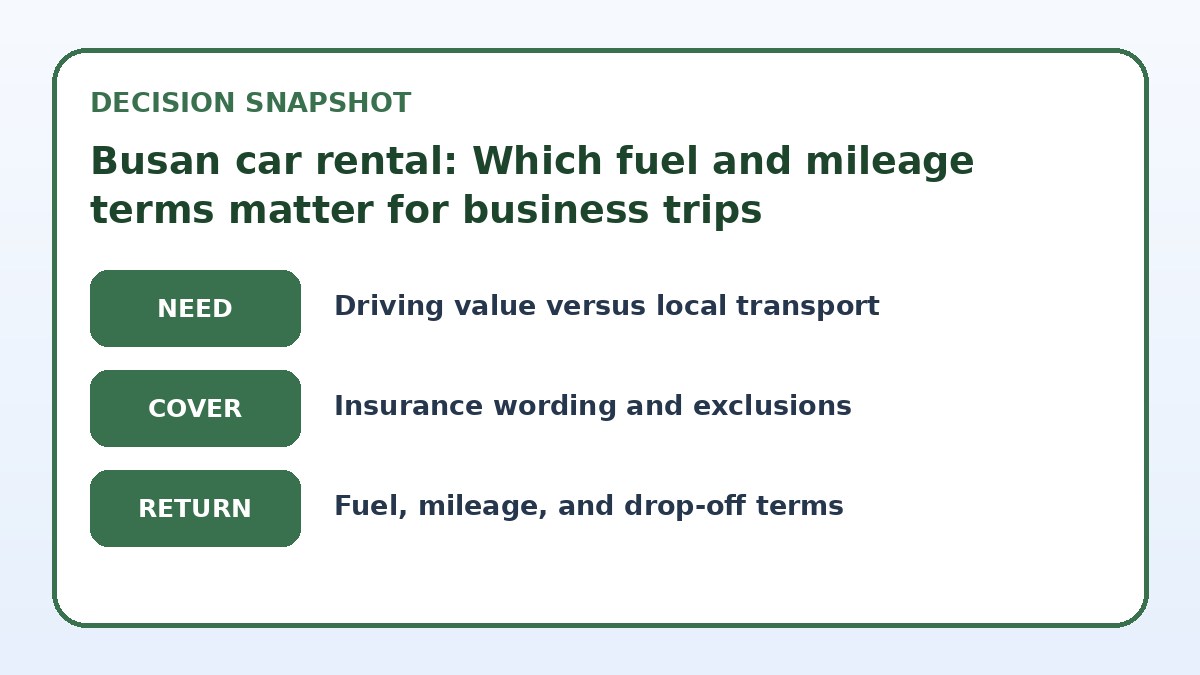
If you’ll be renting a car in Busan for business, the single most useful step before booking is to verify the rental agreement’s fuel and mileage terms—and do it against your company’s reimbursement rules. Fuel policies determine whether you must return the tank full, prepay fuel, or accept a fuel charge; mileage rules affect daily limits, per-kilometer fees, and cross-region travel. These items change how much time you spend refueling, how you document trips for expense reports, and whether a rental fits a multi-stop day of meetings across Busan and Gyeongsang provinces. Read the vehicle page and the rental company’s detailed terms, capture screenshots of the policy, and compare at least two car classes. If you use an intermediary like Trip.com, double-check the provider’s policy on the final booking page—agreements shown by brokers sometimes differ from the rental counter contract.
See current options before you compare the details
Availability and final conditions change. Open Trip.com now or keep reading for the practical comparison.
Understanding common fuel policies and what they mean for business trips
Rental companies in Korea typically use a few standard fuel policies: full-to-full, pre-purchase, and fuel service charge (return empty or not full and pay a fee). For a business traveler, the practical consequence is how much time you’ll spend at service stations and whether you’ll need to process refunds. Full-to-full is easiest for reconciliation—pick up with a full tank and return full, keeping the receipt. Pre-purchase can be convenient for short trips but may leave you paying for fuel you didn’t use, which can complicate expense reports unless your company allows that method.
Before you book, confirm two details: what the pick-up tank level will be and how the provider documents fuel charges on the final invoice. Ask whether the invoice explicitly shows fuel charges and fuel volume—many corporate expense systems require that level of detail. If you expect tight meeting schedules, factor in the time to refill at busy stations near Haeundae or Seomyeon, and plan pick-up or drop-off near a service area if the policy requires a full tank return. Always keep receipts and screenshots of the fuel policy page from the booking site.
Mileage allowances, excess charges, and multi-stop business itineraries
Mileage terms vary: some rentals include unlimited kilometers, others set a daily limit with per-kilometer charges for overage. For a business traveler who might travel widely across Busan’s districts or make day trips to nearby business hubs, excess charges can add up quickly. Calculate likely daily mileage by mapping your meeting locations and estimating distances between them, then compare that total to the rental’s included allowance. If your schedule is uncertain, prioritize options that offer higher or unlimited mileage to avoid repeated fee calculations mid-trip.
If your company reimburses mileage at a per-kilometer rate, check whether the rental’s excess charges exceed that reimbursement. Also verify whether tolls and parking are itemized separately on invoices—tolls are common on express links near the airport and some bridges, and clear documentation simplifies corporate expense reports. When comparing car classes, remember heavier vehicles may be less fuel-efficient; a more economical compact with slightly higher mileage limits might be cheaper overall for city-heavy itineraries.
| Approach | Best for | Tradeoff to check |
|---|---|---|
| Full-to-full fuel policy | Travelers who want clear receipts and predictable expense reconciliation | Requires returning the tank full, which takes time but avoids prepay losses |
| Prepaid fuel option | Short trips or tight schedules where refueling is inconvenient | You may pay for unused fuel; invoice must clearly show prepayment for reimbursement |
| Unlimited mileage | Business itineraries with high daily driving or regional day trips | Often priced higher; confirm actual contract wording and any geographic exclusions |
| Daily mileage allowance with overage fee | Short local trips with predictable, limited distances | Risk of surprise per-kilometer charges if plans change or meetings run long |
Ready to check the option that fits your plan?
Use your exact dates and traveler details so the provider page can show the current total and conditions.
Documentation and receipts: what finance teams will want
Corporate finance teams usually require clear invoices showing rental dates, vehicle type, fuel charges, mileage, and any additional fees. At pick-up, ask the agent to print or email the rental agreement and a meter reading or odometer snapshot; if possible, take your own photos of the odometer at collection and return. For fuel, keep every fuel receipt; the receipt should show date, station, liters and total paid to reconcile with the invoice. If you prepay fuel, request a declaration on the rental invoice so your finance department can track prepaid amounts against final charges.
If you book through a broker or third-party site, verify that the invoice from the actual rental supplier is available at drop-off and will list fuel and mileage details. Some intermediaries issue separate vouchers that don’t include final charges, which complicates reimbursements. For best practice, email yourself the booking confirmation screenshot that includes the supplier name, car class, and policy text. Companies often require the supplier’s name and address; confirm those appear on the final invoice and insist on itemized breakdowns for tolls, fuel, and mileage.
Before you book
- Read and capture a screenshot of the rental supplier’s fuel policy (full-to-full, prepaid, or fuel service charge) from the final booking page.
- Calculate expected daily kilometers from your meeting itinerary and compare to the rental’s included mileage and overage rate.
- Request or photograph the odometer reading at pick-up and drop-off and keep all fuel receipts with date, liters, and station details.
- Confirm whether cross-province driving or airport returns incur extra fees and get any verbal confirmations in writing if the website is unclear.
- Ensure the final supplier invoice will itemize fuel charges, mileage, tolls, and additional fees before accepting a prepaid option.
- Compare at least two car classes for fuel efficiency and mileage allowances, and verify the supplier name on the invoice for expense reporting.
Practical checks before you finalize a Busan car rental
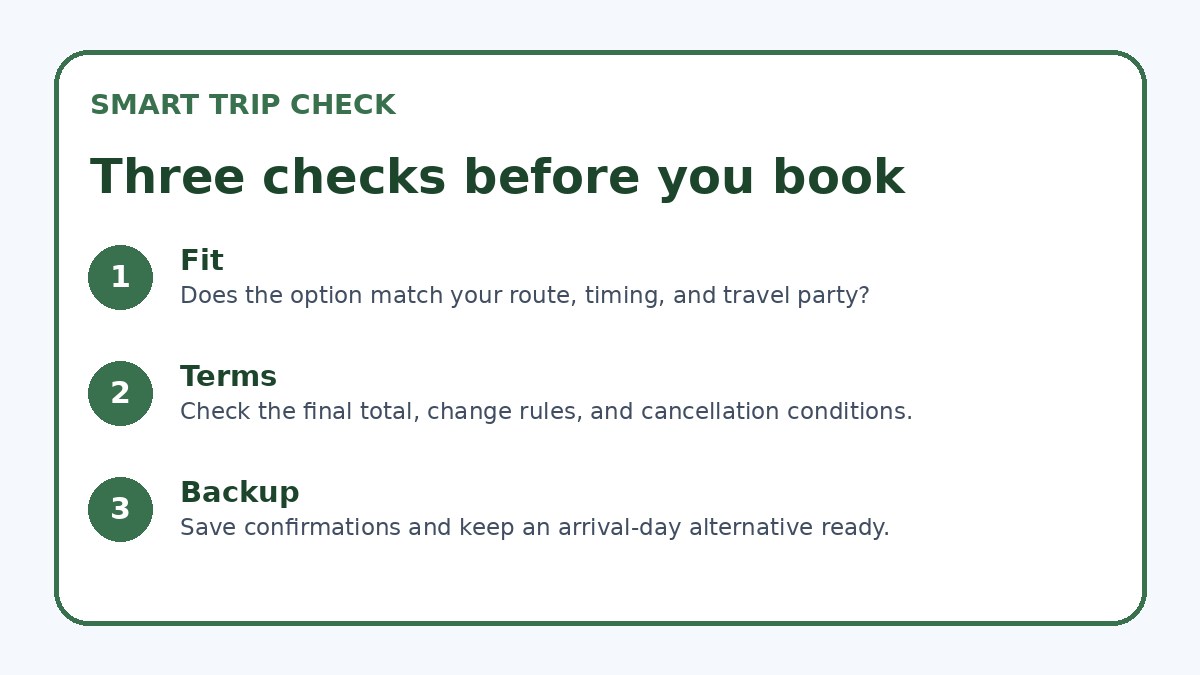
Before you hit book, run a short checklist targeted at fuel and mileage: verify the fuel policy type, check included mileage and overage rates, confirm cross-region driving terms, and ensure the invoice will itemize fuel and mileage. If your schedule includes driving outside Busan—say to Gimhae Airport, industrial parks, or neighboring cities—confirm that the contract allows those journeys without extra geographic fees. When policies are ambiguous on the website, call the rental company directly or capture their chat/email confirmation to avoid surprises at the counter.
Also think practically about fuel logistics in Busan: locate stations near your hotel or common meeting zones and note which accept your preferred payment method. If you prefer to avoid filling the tank at the end of a long day, select a rental with a fuel prepay option only after confirming how refunds are handled. Finally, compare two or three car classes and suppliers, and when using brokers like Trip.com, always follow through to the supplier’s final booking page to verify the exact fuel and mileage terms that will be on your rental contract.
Frequently asked questions
What fuel policy should I pick for back-to-back meetings across Busan?
For tight multi-meeting days, a policy that avoids end-of-trip refueling stress is best. Full-to-full gives clear reconciliation but requires a stop to refill before return; prepaid fuel removes that stop but may leave you paying for unused liters. If you can predict driving distance, calculate whether prepaid loses money compared with a quick full refill. Also consider convenience: choose a pick-up or drop-off location near a reliable service station if you must return full. Keep all receipts and the rental agreement for corporate expense claims.
If I exceed the mileage limit, how will charges typically appear and what should I do?
Excess-kilometer charges are usually calculated per kilometer over the included allowance and added to the final invoice. Before you drive, ask how the provider documents the odometer and whether they include both starting and ending readings on the invoice. If you foresee overage, estimate the extra cost and compare it to options with higher allowances or unlimited mileage. Save all paperwork and take photos of the odometer at both ends—those images are useful if you need to contest a charge with the supplier or your finance department.
How can I make expense reporting easier for fuel and tolls after my Busan rental?
Collect itemized supplier invoices showing fuel, mileage, dates, and tolls; keep every fuel ticket and a photo of the odometer at pick-up and return. If you prepaid fuel, ensure the invoice explicitly states the prepaid amount. Use a single folder or expense app to store digital receipts and booking screenshots. If your company requires supplier details, confirm the rental company’s legal name and address appear on the invoice. When booking through a third party like Trip.com, verify the supplier’s final invoice will be issued by the rental company, not just the broker.
Final planning note
For business travelers in Busan, fuel and mileage policies are small-seeming details that shape costs, schedule flexibility, and expense reconciliation. Prioritize transparency: choose rentals where the supplier provides clear, itemized invoices and unambiguous fuel rules. Map your meeting itinerary to estimate distances, capture odometer photos, and keep every fuel receipt. When in doubt, prefer options with higher mileage allowances or documented fuel prepayment terms that align with your company’s reimbursement rules. Before you confirm a booking—especially if you used a broker—open the supplier’s final booking page, read the contract language on fuel and mileage, and save a copy for finance; that short verification step prevents most billing headaches after the trip.
Continue planning
Check current options and final conditions
Use the provider page to confirm live availability, the final total, cancellation terms, and every condition that matters to your trip.
This evergreen planning guide was created with AI-assisted drafting and a structured quality review. It does not display live prices, schedules, availability, visa guidance, or provider rankings. Verify current details before booking. Some links are affiliate links; we may earn a commission at no additional cost to you.