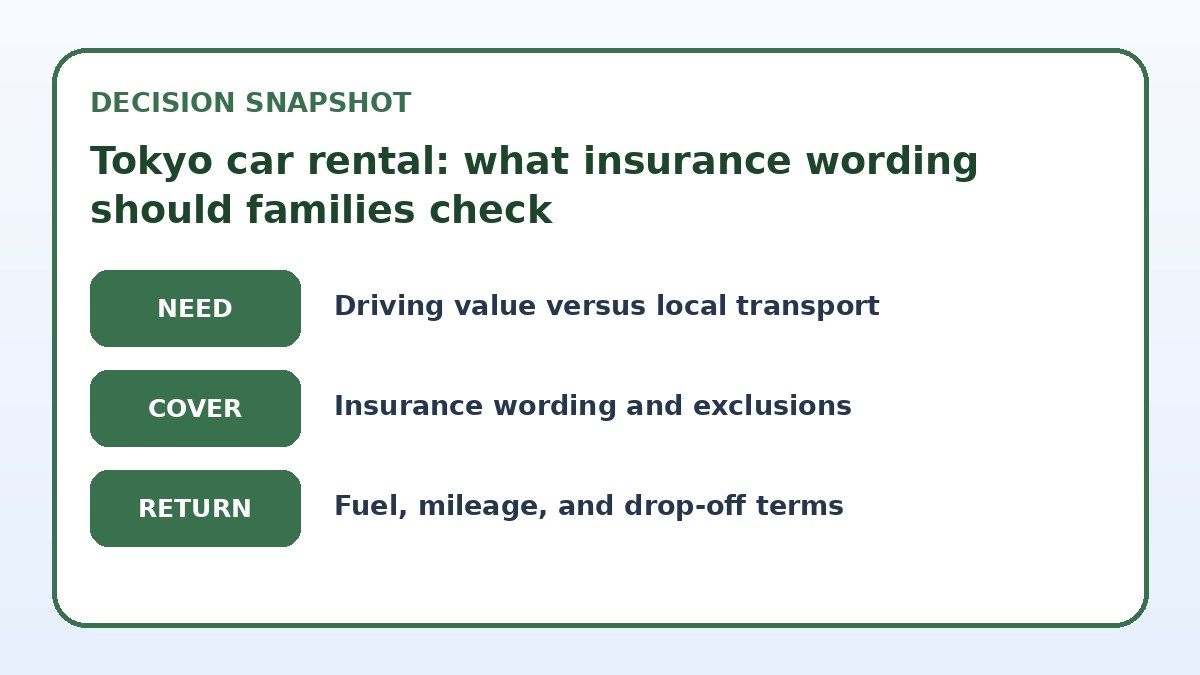
If you're planning to rent a car in Tokyo with your family, the practical first step is to read and confirm three things in the rental contract: who is an authorized driver, what the excess (deductible) is and how it can be reduced, and which damages or incidents are excluded. Japanese rental agreements often use specific legal or insurer language that gets summarized as 'collision damage waiver', 'loss damage waiver', or 'CDW/LDW' and can be confusing when translated. Get clear answers from the supplier’s final booking page or the agent before you commit. Ask for wording rather than sales summaries: policies labeled the same can differ on driver age limits, coverage for tires/windscreens, and whether you need to sign separate insurer forms. Bring a printed policy excerpt or screenshot to avoid surprises at the counter.
Decoding common insurance terms on Tokyo car rental contracts
Rental providers and insurers use shorthand that can hide important limits. 'Collision Damage Waiver' (CDW) or 'Loss Damage Waiver' (LDW) usually means the company will waive its right to recover repair costs from you if certain conditions are met, but a waiver is not identical to full insurance: waivers often leave an excess (deductible) or exclude specific damage types. 'Third-party liability' covers damage you cause to others, while 'supplementary liability' might raise the limit beyond the base legal minimum. Ask for the exact policy name and a one-page summary you can read before signing; headphone-friendly audio or a clear translation helps in busy counters.
Pay attention to wording around 'gross negligence' or 'prohibited use' — phrases that allow the supplier to deny coverage. Many contracts will list behaviors like racing, driving under the influence, or taking the car off-road as voiding protections. Also check whether roadside assistance is included and whether a small administrative fee is charged for accident processing. If the contract references a cooperating insurer, ask how to contact them directly and whether claims are handled in English, as the procedure and required documentation matter more than the advertised coverage limit.
Driver eligibility and named-driver vs. open-driver clauses
For families, understanding who can legally drive the rental car is crucial. Some suppliers require every driver to be registered on the rental agreement; others allow additional drivers if their names are added and the rental fee for extra drivers is paid. Importantly, age limits vary: younger drivers (often under 25) or older drivers (over a threshold) can face restrictions or higher insurance excesses. Check whether spouses, grandparents, or older teenagers with licenses are covered and whether a foreign license with an International Driving Permit is accepted.
Also clarify whether cover transfers between drivers during a multi-day rental. An 'open-driver' clause that implicitly covers anyone in your party is rare and usually carries conditions; more commonly you must present each driver’s license and sign the agreement. Ask the agent to explain how claims are handled if a non-named driver is involved in an incident — sometimes insurers refuse claims if the driver wasn’t listed. For peace of mind, add every likely driver to the agreement, especially if you anticipate swapping frequently during your Tokyo area drives.
| Approach | Best for | Tradeoff to check |
|---|---|---|
| Accept supplier CDW/LDW with excess reduction | Families wanting simple, immediate coverage at the counter | Higher daily cost but easier claims handling; still check exclusions and exact excess amount |
| Decline supplier waivers and use credit-card coverage | Families with eligible cards and willingness to use secondary coverage | May lower upfront cost but often requires paying then claiming back and strict card conditions |
| Buy third-party supplementary insurance | Families seeking broader or cheaper excess protection across rental brands | Often reimbursement-based and needs careful proof and pre-approval from the supplier |
| Buy only mandatory liability and rely on personal insurance | Families with comprehensive personal auto/travel insurance and limited driving plans | Risk of gaps for vehicle damage and potential administrative hassles during claims |
What excess (deductible) and waiver options mean for family budgets
The excess — sometimes called deductible or refundable deposit — is the amount you’re initially liable for if the car is damaged. Wording matters: some waivers reduce the excess to zero, others lower it to a fixed amount, and some apply only to certain kinds of damage. For families, the practical decision is balancing monthly or per-day waiver fees against the financial risk of paying the excess after an incident. Ask for examples: 'If a rear bumper scratch costs X, how much would we actually pay after applying waivers and insurance?' Concrete examples expose gaps in high-level descriptions.
Watch for conditions that invalidate waiver coverage and return the deposit. Typical triggers include using the wrong grade of fuel, failing to report incidents promptly, or parking breaches in restricted areas. Also check how the supplier handles repair authorization — some require that work be done at approved shops, which might mean logistical delays. If you plan to drive out of Tokyo into rural prefectures, confirm whether waivers and roadside assistance apply outside metropolitan limits and what documentation is needed to make a claim from a distance.
Before you book
- Request and save a screenshot or PDF of the exact insurance wording from the supplier’s final booking page before you arrive.
- Confirm and list every authorized driver’s full name, license number, and whether an IDP is required for each family member.
- Ask the supplier for a clear statement of the excess amount and what optional add-on reduces it to zero or a lower figure.
- Verify which damage types are excluded (tires, windscreen, undercarriage, interior) and whether family use scenarios are covered.
- Check how roadside assistance, towing, and accident reporting are handled and what phone numbers and languages are supported.
- If using a credit card or third-party policy, call the issuer, save the confirmation, and confirm the supplier will accept that coverage.
Supplementary cover and coordination with personal or card benefits
Many families rely partially on credit-card rental insurance or separate travel insurance. That coordination is where wording becomes tactical: credit-card benefits often offer secondary coverage, which pays remaining costs after the rental supplier’s insurance is exhausted, and they usually require that you decline the supplier’s optional collision waiver to trigger card benefits. Read the card issuer’s terms and the rental contract carefully: some card policies demand that you use the card to pay the rental and present the cardholder at the counter, while others have age or vehicle-class restrictions.
If you buy supplementary insurance from a third party, verify how claims will be processed. Look for phrases like 'primary' or 'secondary' provider and whether an excess remains. Third-party policies often require you to pay the supplier first and seek reimbursement later; the rental wording should clarify whether the supplier will accept the third-party insurer’s direct settlement. Before you travel, call your card company and the third-party insurer and take screenshots of the relevant policy pages; confirm with the rental supplier which documents they require to accept outside coverage.
Frequently asked questions
Can a family member who isn’t listed still drive the rental car in Tokyo?
Most suppliers require every driver to be listed and present with a valid license at pickup; otherwise, the insurer may deny a claim. If a non-listed family member drives, the contract’s wording often treats that as 'unauthorized use' and voids waivers. To avoid this, add any likely driver before collection. If you expect occasional swaps, ask the supplier about adding drivers mid-rental and whether there’s an administrative fee or additional proof required. Always get confirmation in writing or a screenshot from the booking system.
Will my home-country credit card insurance fully cover damage to a rental in Japan?
Card benefits vary widely and commonly provide secondary coverage—meaning they pay remaining costs after the rental company’s coverage. Some premium cards offer primary coverage, but they typically have exclusions for certain vehicle classes, age limits, or overseas licensing requirements. Before relying on the card, read the issuer’s terms for Japan specifically and confirm whether you must decline the rental company’s optional waivers at the counter. Keep copies of all rental documents and the card’s policy pages to speed any claim.
If we hit a pothole or damage a tire, will the standard waiver cover it?
Tire, wheel, and windshield coverage is frequently excluded from basic waivers, or covered only if you purchased a specific protection. The contract’s wording will state whether 'glass, tires and underbody' are included. Ask the agent for examples and whether roadside assistance handles tire repair or requires a tow to an approved shop. If those items are excluded and you want full protection for family travel, purchase the specific add-on and get confirmation that it applies to the exact incidents you worry about.
Final planning note
Families planning to rent a car in Tokyo gain peace of mind by treating insurance wording as a checklist rather than marketing copy. Focus on named drivers, exact excess amounts, explicit exclusions, and how supplementary or card insurance coordinates with the supplier’s policy. Always save screenshots or PDFs of the final rental terms and ask the counter agent to confirm, in writing, any verbal clarifications. Before you drive away, verify roadside assistance contact details and the claims steps so you’re prepared if an incident happens. When in doubt, compare options side-by-side and prioritize clear, accessible wording over vague assurances; Trip.com can help you compare current availability, but always verify policy specifics on the supplier’s final booking page.
Continue planning
Check current options and final conditions
Use the provider page to confirm live availability, the final total, cancellation terms, and every condition that matters to your trip.
This evergreen planning guide was created with AI-assisted drafting and a structured quality review. It does not display live prices, schedules, availability, visa guidance, or provider rankings. Verify current details before booking. Some links are affiliate links; we may earn a commission at no additional cost to you.