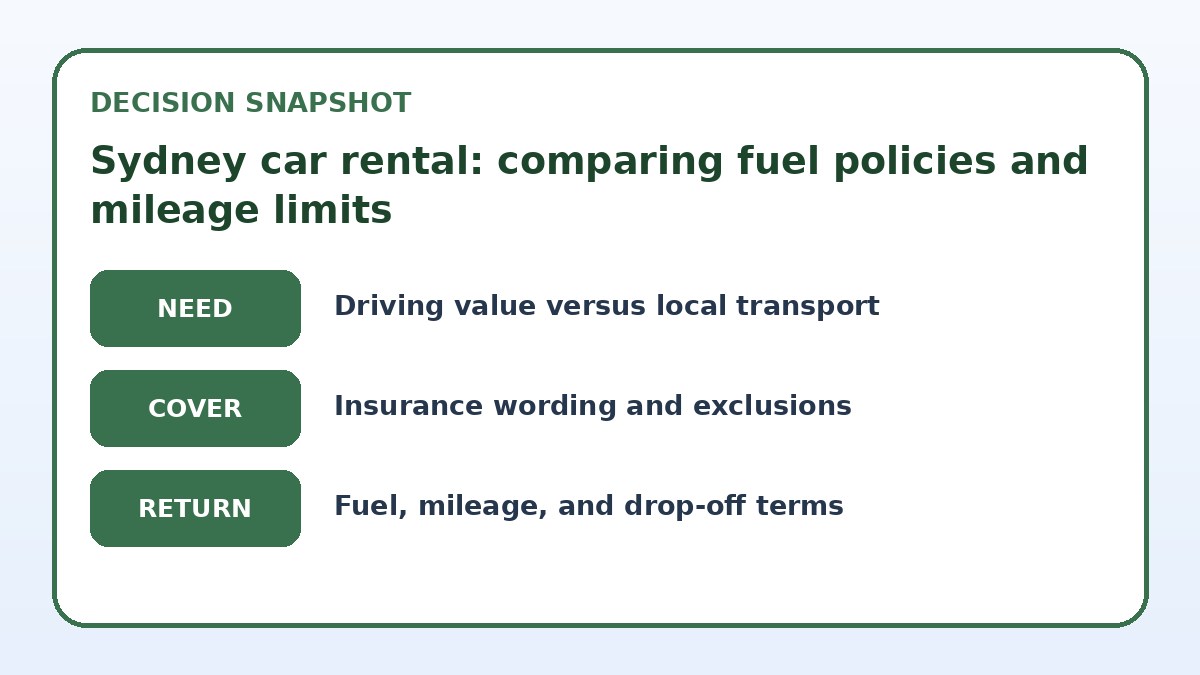
If you’re traveling to Sydney with oversized or extra luggage, check the car rental fuel policy and mileage allowance before you book — these two items often change which car is practical and economical. The practical answer: choose a vehicle with a clear full-to-full fuel policy and an adequate mileage allowance (or an explicitly unlimited option) that also fits your luggage in the available boot and cabin space. Pay close attention to how the provider measures luggage capacity, whether roof-boxes or tow bars are allowed, and how fuel is charged on return. Before you finalize a booking, verify the exact fuel and mileage terms on the provider’s final booking page and confirm any extra-equipment rules, because those details are commonly updated and vary by location and vehicle class.
See current options before you compare the details
Availability and final conditions change. Open Trip.com now or keep reading for the practical comparison.
How fuel policies work and why the wording matters
Fuel policy descriptions often use shorthand that sounds similar but leads to different outcomes. Full-to-full means you pick the car up with a full tank and must return it full; if you fail to, the company refuels and charges you a potentially high refuelling fee plus the fuel cost. Pre-purchase or prepaid fuel lets you buy a full tank up front and return empty, but you rarely get refunded for unused fuel. Same-to-same or return-as-collected can be ambiguous unless the pickup condition is clearly logged. When extra luggage affects range planning, the convenience of dropping off empty versus the financial risk of pre-buying fuel becomes particularly relevant.
Before you sign, ask for the precise steps the company uses to document fuel level at pickup and drop-off — photographic proof or an inspection sheet can prevent disputes. Verify whether fuel is measured in litres or percentage and how rounding is applied: companies sometimes round down the tank level when calculating refuel charges. Also check if airport or city-centre locations have different fuel rules; branches in different parts of Sydney or nearby airports may operate separate policies. Confirm these specifics on the provider’s final booking page and, if possible, request them in writing as part of your rental confirmation.
Mileage limits: how they affect trips with heavy luggage
Mileage rules vary from unlimited kilometres to strict per-day or per-rental caps. Heavy luggage usually doesn’t change the raw mileage allowance, but it can slow you down, increase fuel consumption, and push you over a daily cap if you plan longer drives out of Sydney. Some providers calculate distance from the vehicle odometer at pickup and drop-off and charge a fixed per-kilometre rate for excess travel. If you’re planning a coastal drive, Blue Mountains day trips, or regional detours where public transport is limited, an unlimited or high-cap allowance will remove a costly uncertainty.
Compare the per-kilometre excess fee to the cost difference between vehicle classes: sometimes paying a little more for a higher class with unlimited mileage is cheaper than incurring excess-kilometre penalties. Remember, a heavier load can reduce fuel efficiency and potentially shorten the range, which interacts with fuel policy choices. On the booking page, look for exact wording about daily versus total caps, how partial days are handled, and whether distance tracking is based on kilometres or miles.
| Approach | Best for | Tradeoff to check |
|---|---|---|
| Choose full-to-full with unlimited mileage | Drivers who want transparency and plan long regional drives without mileage anxiety | You must refill before return and handle refuelling yourself; risk of small logistical hassle |
| Pre-purchase fuel with limited mileage | Short city stays where you prefer time savings over exact fuel costs | You may pay for unused fuel and face tight mileage caps that add excess charges |
| Lower-class car with supplemental roof box | Groups aiming to save on base rate while expanding luggage capacity | Roof boxes affect fuel consumption and may alter fuel policy or add equipment fees |
| Higher-class SUV or people-mover with unlimited miles | Travellers with bulky or many suitcases who want interior space and freedom to roam | Higher base rate and possibly higher fuel use, though often cheaper than excess-km fees |
Ready to check the option that fits your plan?
Use your exact dates and traveler details so the provider page can show the current total and conditions.
Choosing a vehicle when you have oversized bags
Boot and cabin capacity is frequently presented as ‘suitcases’ or litres — neither is standardized across providers. If you travel with bulky items like surfboards, golf clubs, or multiple large suitcases, a standard sedan might look fine on paper but be impractical in reality. Consider estate/wagon, SUV, or people-mover classes that advertise larger cargo volumes, and check whether the spare wheel is inside the boot, which reduces usable space. If interior space still doesn’t suffice, ask about roof racks, roof boxes, or tow-hitch options and whether they are available at the pick-up location.
When extra equipment is required—roof boxes, bike racks, trailers—confirm installation, insurance coverage, and any additional fuel or mileage rules that apply. Some suppliers restrict roof or trailer use on specific licences or vehicle classes; others levy a surcharge or alter the fuel policy for vehicles carrying external loads. Always check load limits for roof boxes and how the supplier records such accessories at pickup; require those items to be documented in your rental agreement so you don’t face penalties on return.
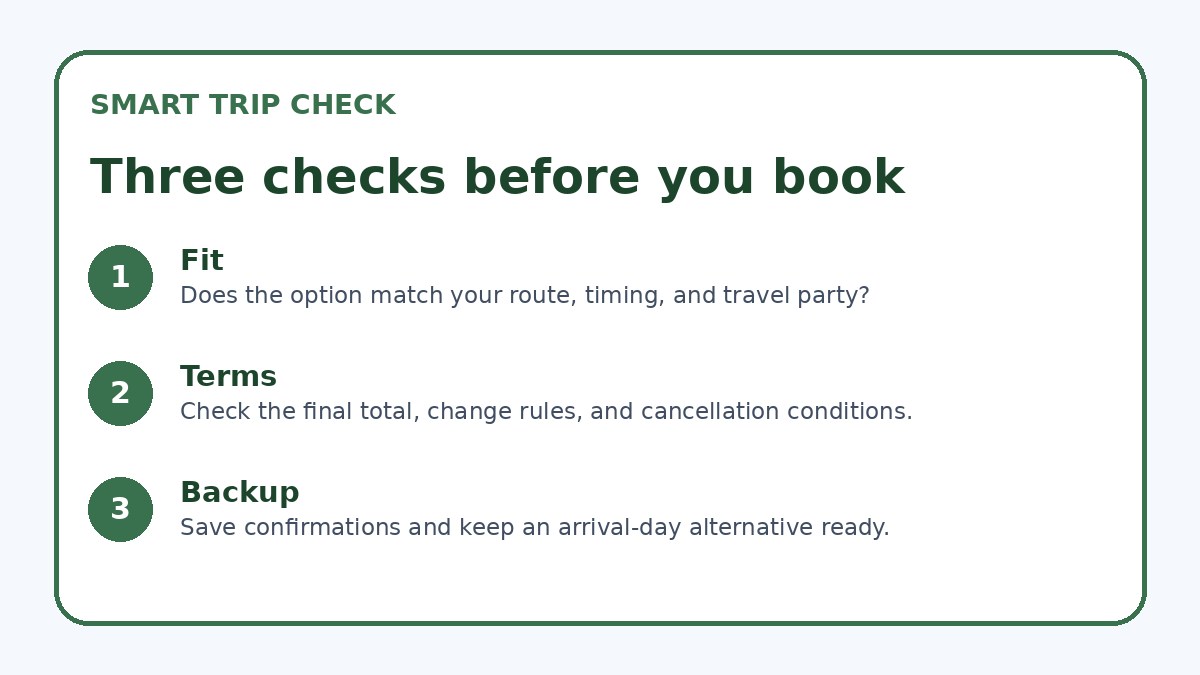
Before you book
- Confirm the fuel policy label (full-to-full, pre-purchase, same-to-same) and read the provider’s exact pickup/drop-off fuel measurement method.
- Verify whether mileage is unlimited or capped, note the per-kilometre excess fee, and see if daily or total caps apply.
- Measure your luggage and compare to the vehicle’s stated boot volume or suitcase count; photograph items to estimate fit if unsure.
- Ask whether roof boxes, tow bars, or trailers are permitted, the additional fees, and whether installation is included or must be arranged.
- Request documentation of fuel level and odometer reading at pickup (photos or signed sheet) and retain booking confirmation emails.
- If any term is unclear, contact the rental branch listed on the booking page and get written confirmation before you pay.
Booking steps and what to verify on the final page
Work through booking filters but don’t treat the displayed summary as the final word—open the full terms section on the provider’s booking page. Verify the exact fuel policy label and read the descriptive paragraph that follows. Confirm whether mileage is unlimited or capped, the excess-kilometre rate, and whether mileage is measured in kilometres. Check whether airport and city branches have different terms. If you see optional extras for roof boxes or trailers, click through their terms too and note whether installation or pick-up times are restricted.
Before payment, screenshot the fuel and mileage terms and save the confirmation email. If anything is unclear, message or call the rental branch listed on the booking page and request a written clarification. When comparing offers, consider Trip.com or similar aggregation sites for availability but always reconcile the aggregator’s summary with the provider’s own final booking page and contract language. That final page is where you’ll find charge examples, damage waivers, insurance boundaries, and the explicit list of permitted accessories.
Frequently asked questions
Will a roof box change the rental’s fuel or mileage charges?
A roof box itself doesn’t automatically change the mileage allowance, but it can increase fuel consumption which affects range and refuelling needs. Some providers charge extra for roof boxes, list them as optional equipment with separate fees, or restrict their use on certain vehicle or licence types. They may also require the accessory to be documented on pickup and could alter terms related to damage or aerodynamics. Always confirm on the provider’s final booking page whether adding a roof box triggers additional charges or changes to fuel and insurance coverage.
How do I avoid disputes over fuel levels at drop-off?
Document the fuel level and odometer at pickup with time-stamped photos showing the gauge and dashboard, and ask the rental agent to sign an inspection sheet. On return, repeat the same photo process and request a copy of the drop-off inspection or receipt that records the fuel level. Keep your booking confirmation and any written communication about the fuel policy. If the provider charges a refuelling fee, ask for an itemised invoice showing fuel litres and the rate; you can challenge inconsistent charges by referencing your documented evidence and the terms on the final booking page.
If I expect to exceed the baggage capacity, what’s the easiest rental approach?
The simplest route is to book a larger vehicle class that clearly lists sufficient boot volume or suitcase capacity, or to add a factory-fitted trailer or roof box through the rental company. Booking a higher class with unlimited mileage reduces the risk of costly excess-km charges if you plan longer drives. If you opt for external equipment, ensure it’s permitted at the rental location, request installation and documentation at pickup, and verify how it affects insurance and fuel policy. Always confirm these specifics on the provider’s final booking page and get the branch to note accessories on the rental agreement.
Final planning note
When travelling in Sydney with extra luggage, fuel policy and mileage rules shape which car is practical, the total cost, and how much pre-trip planning you need. Prioritise a clear full-to-full or unlimited-mileage option if you value straightforward accounting and plan regional drives; consider pre-purchase fuel or a smaller car plus a roof box for short city stays where time beats tight fuel accounting. In every case, read the provider’s full terms on the final booking page, document pickup fuel and odometer readings, and confirm accessory permissions and installation. Doing these checks before you pay prevents surprises at drop-off and keeps your Sydney trip running smoothly.
Continue planning
Check current options and final conditions
Use the provider page to confirm live availability, the final total, cancellation terms, and every condition that matters to your trip.
This evergreen planning guide was created with AI-assisted drafting and a structured quality review. It does not display live prices, schedules, availability, visa guidance, or provider rankings. Verify current details before booking. Some links are affiliate links; we may earn a commission at no additional cost to you.