If you’re a solo traveler booking Singapore to Bangkok flights, your top decision isn’t just price — it’s how flexible the ticket is when plans shift. Practical choices come down to routing, connection risk, baggage rules, and the fare’s change/cancellation terms. Start by knowing exact travel dates, passport name, contact details, and whether you want refundable or restricted fares. That lets you compare rules on the airline or booking page rather than guessing. This guide gives a compact checklist and a clear tradeoff view so you can pick the flight-selection strategy that matches your risk tolerance and schedule. Before finalizing any purchase, verify the carrier’s full fare conditions, fees, and the refund timeline on the final booking page; Trip.com can be one place to compare live availability and terms, but always confirm directly with the airline or your chosen seller.
See live routes for your exact travel day
Compare direct and connecting choices with the same baggage and traveler details.
Routing: direct versus connecting and how it affects flexibility
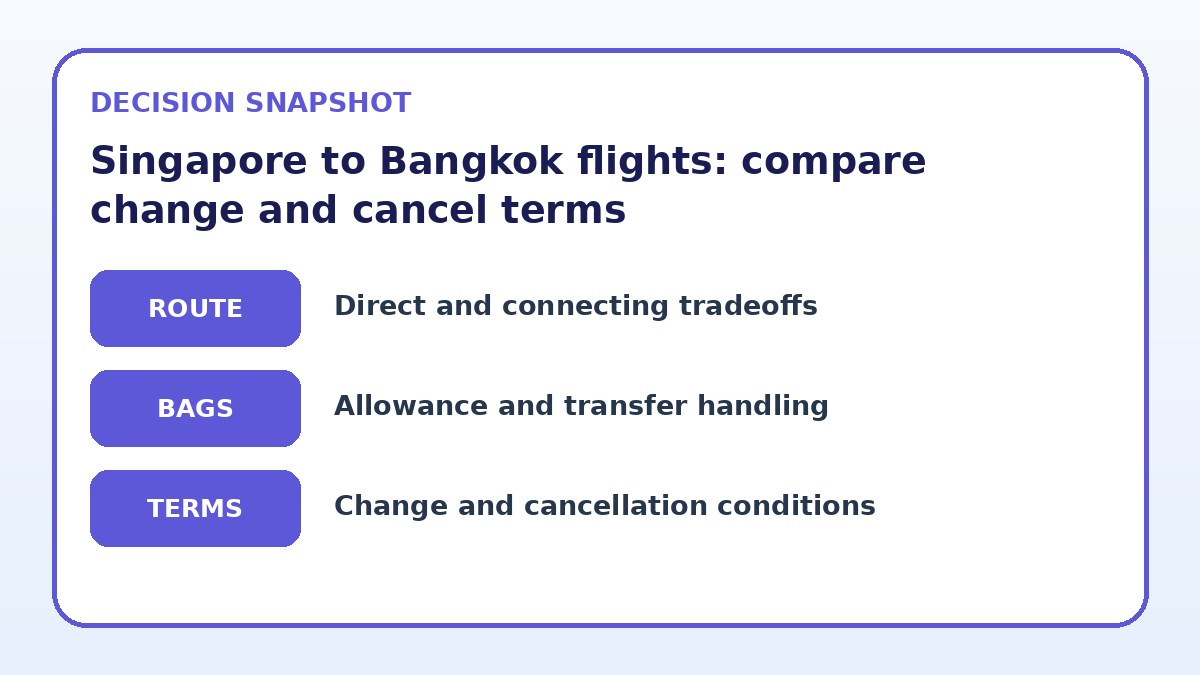
When choosing between direct and connecting flights from Singapore to Bangkok, routing directly affects the change and cancellation experience. Direct flights typically simplify disruptions: fewer moving parts, single carrier rules, and easier baggage handling. Connecting itineraries often mix carriers or require airport transfers, which can multiply change fees and complicate refunds if the segments are booked separately. For solo travelers who need predictable flexibility, a single-ticket connection operated by one alliance member may be preferable because the carrier assumes responsibility across segments and usually lists a single set of fare conditions on the booking page.
However, connections can be attractive when they reduce the base fare or open better departure times. If you consider a connection, inspect the minimum connection time, the airport’s transfer layout, and whether you must reclaim and recheck luggage—these factors affect the practical cost of changing plans. On the booking or airline page, confirm whether all segments are on the same ticket and under the same fare class; that clarity dictates whether you’ll pay one change fee or multiple separate fees in case of alterations.
Baggage and connection risk: how policies change the math
Baggage rules are part of the flexibility equation. Low-fare tickets often exclude checked bags or charge for each piece; when you change or cancel, how that baggage payment is handled varies by carrier. If your itinerary includes an airline that treats baggage as an add-on, verify whether the add-on is transferable, refundable, or forfeited on change or cancellation. For solo travelers who prefer to travel light, avoiding checked baggage can reduce the complexity of changes and the number of items at risk during a missed connection.
Beyond fees, connection risk matters: if a missed connection forces a rebooking, baggage may arrive separate from you or require manual retrieval. On the airline’s final booking page, check the policy for delayed or misconnected bags and whether the carrier offers protection or vouchers for rebooking. If you have tight timing or important items in checked luggage, a slightly more expensive ticket with included checked baggage and clearer rebooking protections could save money and stress when plans shift.
Compare flight-selection strategies
| Flight strategy | Best for | Risk to check |
|---|---|---|
| Book a refundable or flexible fare | Solo travelers who prioritize cancellation flexibility and pay a premium to avoid stress. | Higher upfront cost but straightforward refunds or free changes under the fare rules. |
| Buy a low-cost nonrefundable fare and add optional extras | Price-sensitive travelers who can lock plans and refuse last-minute changes. | Lower fare initially, but change fees or forfeited tickets can make changes expensive. |
| Choose a connecting itinerary on a single ticket | Travelers seeking balance between cost savings and protection under one carrier. | Potentially lower fares with single-ticket protection, but longer travel time and connection risk. |
| Mix-and-match separate bookings for outbound and return | Flexible planners wanting targeted lower fares or varied carriers by leg. | Saves money on one leg but creates independent change rules and higher risk if one leg is disrupted. |
Recheck the complete itinerary
Confirm airports, connection handling, baggage, and change conditions before deciding.
Schedule fit: why departure times and change windows matter
A ticket’s schedule is more than departure and arrival times; it comes with deadlines for free or low-cost changes. Many carriers allow free changes only within a specific window (for example, before check-in opens) or impose higher fees close to departure. For solo travelers, evening flights may feel safer in case of day-of delays, but that can also mean different change fee schedules. When assessing schedule fit, read the fare conditions to see if changes are permitted up to a certain time before departure and whether same-day changes are allowed at lower cost.
Also consider time-of-day tradeoffs: earlier departures can free up same-day onward plans but may be harder to modify without a fee, while later departures sometimes offer more flexibility if airlines provide complimentary standby options or reduced fees. Always confirm on the carrier’s or seller’s final booking page the exact timeline for fee-free changes, the process for requesting a change, and any administrative deadlines. That confirmation will determine whether the ticket truly matches your tolerance for last-minute adjustments.
Flight details to verify
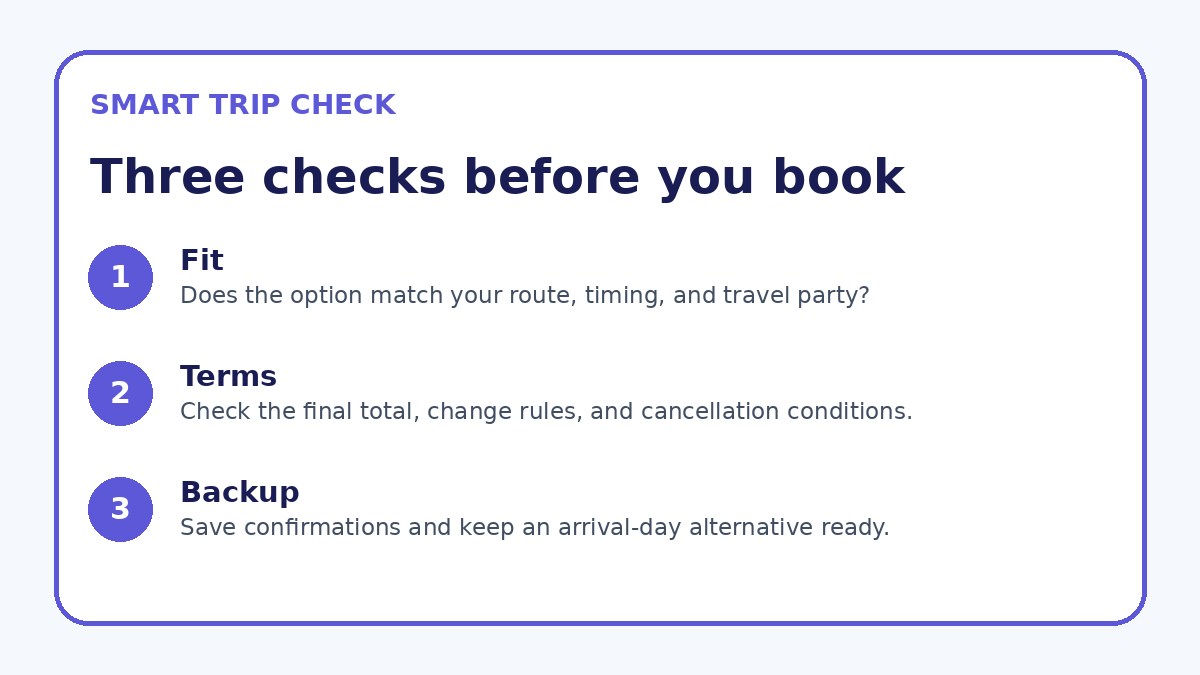
- Confirm exact travel dates, full traveler name as on passport, and a contact email and phone before searching fares.
- Open the fare rules on the final booking page and note the change fee, refundability, and whether credits have an expiry.
- Verify baggage inclusion and whether purchased add-ons (checked bag, seat) are refundable or transferable on change.
- Check whether connecting flights are on one ticket or separate tickets and confirm minimum connection times on the carrier page.
- If booking through an agent or third party, note any additional agent service fees and their change/refund process.
- Save or screenshot the final checkout page and fare rules PDF; keep those documents for any future change or refund request.
Fare conditions: reading the fine print for refunds and credits
Fare rules determine your real options if you need to cancel or change. Look beyond labels like “flex” or “basic” and open the published fare conditions on the booking page. Key elements to verify include whether the fare is refundable or credit-only, the size and timing of any change or cancellation fee, and how price differences are handled when rebooking. Some carriers issue a travel credit rather than a monetary refund, with expiration terms and limited routing restrictions — know those details before you book.
In addition, check whether taxes and airport fees are refundable on a cancelled ticket; some carriers refund taxes even when the fare portion is nonrefundable. If you’re booking through an online agency, confirm if the agent’s own change fee applies on top of the airline’s fee. Always save screenshots or PDFs of the fare rules and the final checkout page that lists fees — these are the documents you’ll reference if you need to request a refund, change, or credit later.
Flight Guide questions travelers ask
How do I compare change fees across airlines for the Singapore to Bangkok route?
Compare fees by looking at the airline’s published fare rules on the exact fare class shown in your search results. Open the detailed fare conditions on the final booking page — that document lists how much the airline charges for a change, whether a change is allowed, and when fees increase as departure approaches. Do the same for booking sites or travel agents to see if they add extra administrative fees. Keep travel dates and traveler details entered so the page shows conditions for the precise ticket you intend to buy.
If my flight is cancelled, how do I know whether I’ll get a refund or a travel credit?
The outcome depends on the carrier’s cancellation policy and the fare purchased. On the airline’s or seller’s final booking page, check the section that describes refunds for cancelled flights; this will specify whether money is returned to your original payment method or issued as a credit with an expiry. If the carrier initiates the cancellation versus voluntary changes, different rules may apply — verify which scenario the policy covers. Save confirmation emails and the fare rules as proof when you request the refund or credit.
What steps should a solo traveler take if they need to change dates close to departure?
First, review the fare’s deadline for free or reduced-fee changes on the booking page. Contact the airline directly if the online system is unclear; airlines sometimes allow the same-day change at a different cost or offer standby options. If you booked through an agency, contact them promptly and clarify any additional service fees. Be ready with your new preferred dates, flexibility windows, and payment method to cover fare differences or fees. Document phone or chat confirmations and request email confirmation of any agreed change.
Final decision note
Choosing the right Singapore to Bangkok flights as a solo traveler means trading off immediate ticket cost against the real-world cost of changing plans. Start by deciding whether you need a refundable ticket or can accept the restrictions of a cheaper fare; then check routing, baggage transfer rules, and exact fare conditions on the final booking page. Keep traveler details ready so pages return accurate rules, save screenshots of fare rules and confirmations, and contact the carrier directly for any ambiguity. With these steps you’ll be able to judge which option — refundable fare, single-ticket connection, or low-cost basic fare with add-ons — fits your comfort level and the unpredictability of solo travel.
Continue planning
Check current options and final conditions
Use the provider page to confirm live availability, the final total, cancellation terms, and every condition that matters to your trip.
This evergreen planning guide was created with AI-assisted drafting and a structured quality review. It does not display live prices, schedules, availability, visa guidance, or provider rankings. Verify current details before booking. Some links are affiliate links; we may earn a commission at no additional cost to you.