
If this is your first time planning Seoul to Jeju flights, start with a short, actionable checklist: choose direct versus connecting service, confirm which Seoul airport the flight uses, check baggage and change/refund rules, and compare arrival airports on Jeju. Those first checks usually solve the biggest surprises at booking and at the airport. After you have those basics settled, weigh tradeoffs like earlier departures versus higher fares, or a later arrival to match ferry schedules and local transfers. This article gives that practical pre-booking checklist first, then explains how to compare options and what details to verify on the airline or booking page before you commit.
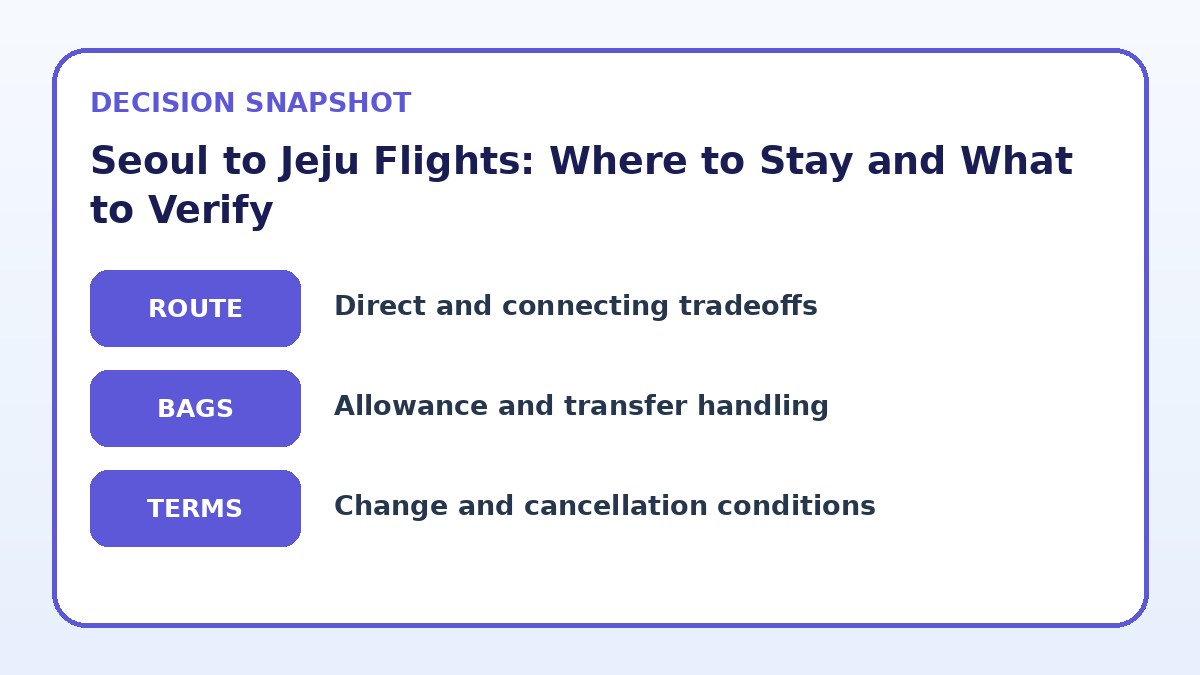
See current options before you compare the details
Availability and final conditions change. Open Trip.com now or keep reading for the practical comparison.
Pick your departure and arrival preferences
Start by deciding which Seoul airport is most convenient for you. Gimpo is closer to central Seoul and commonly serves short domestic flights, while Incheon handles more international services; both can have flights to Jeju depending on operators. When comparing options, note the ground transfer time and transport cost to each airport from your accommodation. For first-time visitors, minimizing transfers often reduces stress, so a Gimpo departure might be preferable if you’re staying in central Seoul. If you must use Incheon because of a connecting international flight, factor an extra buffer for inter-airport transfers.
On Jeju side, verify whether your flight arrives at Jeju International Airport and consider where you’ll go from there. The airport sits relatively close to many northern and central island attractions, but if your plans focus on the southern coast or remote areas you’ll need to plan local transfer time. Think door-to-door: combine flight schedules with bus, taxi, or rental-car availability before you book. Some travelers prioritize an early arrival to maximize sightseeing time, while others prefer mid-day flights to avoid early-morning rush and ensure easier baggage handling.
Compare direct versus connecting options
Direct flights are the simplest choice for Seoul to Jeju routes: fewer points of failure and shorter total travel time if a direct option exists. But connecting itineraries can sometimes be cheaper or necessary depending on your departure city or loyalty program constraints. When evaluating a connecting option, add realistic transfer buffers and factor that delays on the first leg will affect the rest of your journey. Also check whether the connection requires you to recheck baggage or collect it and pass security again; that can turn a perceived savings into a logistical headache.
If both direct and connecting flights are available, compare them using the same measures: total door-to-door time, number of changes, minimum connection time at each airport, and how baggage is handled. Don’t only compare scheduled airtime; consider the likelihood of delays at the connecting airport and how comfortable you are with tight layovers. For families or travelers with tight onward plans, a slightly more expensive direct flight may be worth the reduced risk and stress.
| Approach | Best for | Tradeoff to check |
|---|---|---|
| Direct flight | Travelers prioritizing shortest travel time and fewer transfer risks. | May cost more and have limited schedule choices at peak times. |
| Connecting flight | Those seeking lower fares or who must link from international arrivals. | Longer total travel time and higher risk of missed connections. |
| Flexible fare | Uncertain itineraries or travelers who need change/refund protection. | Higher upfront cost compared with restricted fare classes. |
| Basic/budget fare | Solo travelers or light packers trying to minimize ticket price. | Often excludes checked bags, seat selection, and has strict change rules. |
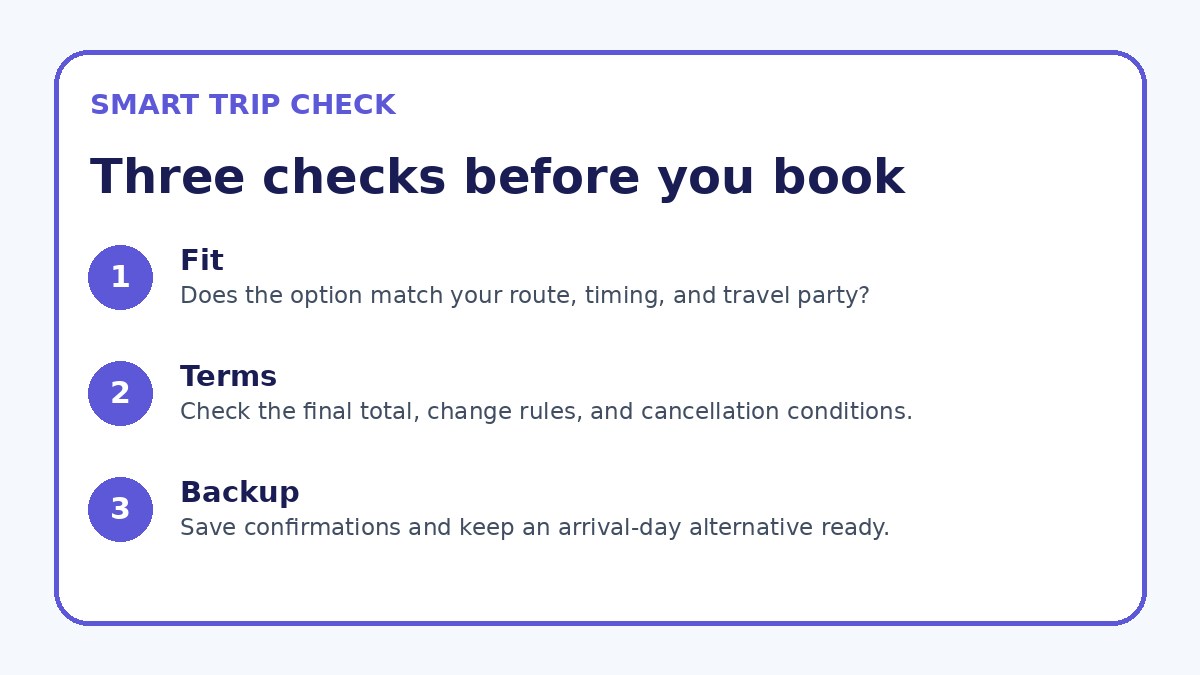
Ready to check the option that fits your plan?
Use your exact dates and traveler details so the provider page can show the current total and conditions.
Understand fares, baggage, and seat policies
Fare classes on the same route can vary substantially in what they include. Budget fares sometimes exclude checked baggage, advance seat assignment, or even in-flight snacks, while higher fare classes bundle these extras. Before clicking buy, open the fare rules and check exactly what’s included: number and weight of checked bags, maximum dimensions for carry-on, seat selection fees, and boarding priority. If you’re traveling with sports gear or oversized luggage, confirm special equipment policies. Be precise: some operators treat infant seats, surfboards, or skis differently and require advance notice or additional fees.
Also review change and refund conditions for the exact fare you’re considering. Flexible fares cost more but can save money if plans shift; stricter fares might restrict changes or impose high penalties. On the airline or booking page, verify the full change policy: how long before departure changes are allowed, whether a fare difference will apply, and how refunds are processed in case of cancellations. If you’re booking through a third-party site, confirm whether the site or the airline is the contract issuer and where you must go to request a change or refund.
Before you book
- Confirm which Seoul airport the flight uses (Gimpo or Incheon) and plan ground transfer time from your accommodation.
- Decide if you need a direct flight or are willing to accept connections; add realistic transfer buffers if connecting.
- Open the exact fare rules and verify checked baggage allowance, carry-on dimensions, and any special-equipment policies.
- Check change and refund conditions for the specific fare class, and note how to request changes on the airline or booking site.
- Match arrival time in Jeju to your next step—rental-car pickup, ferry, tour, or hotel—and note local operating hours.
- Verify whether you must show ID, residency documentation, or other papers at booking or check-in, and prepare those documents.
Timing, connections, and local ground transport
Match your flight schedule to your planned activities on Jeju and your onward transport. If you need to catch a ferry, guided tour, or rental-car company, check opening hours and reservation requirements so your flight arrival lines up with them. Peak travel periods may mean longer waits for rental cars or taxi queues at Jeju airport, so build a buffer for busy days. Night arrivals may limit public-transport options and could require a pre-arranged transfer or hotel pickup, so verify local options for late arrivals before you book.
Also plan for contingencies. If your trip includes tight connections at Seoul between international and domestic legs, leave several hours to clear immigration, collect bags, and transfer between terminals or airports. For arrivals in Jeju, note how long it will take to reach your first stop—city center, accommodation, or attraction—and whether you’ll need to pre-book a shuttle or taxi. Planning ground logistics along with flight times reduces the chance of wasted time and stress on arrival.
Frequently asked questions
Should I book a direct flight from Seoul to Jeju or accept a cheaper connecting option?
If minimizing travel time and reducing transfer risk are your priorities, a direct flight is usually better because it eliminates the need to re-clear security or move between terminals or airports. If cost is the main constraint and you have flexible time, a connecting option can save money but requires careful planning: verify minimum connection times, whether you must collect and recheck luggage, and how tight the layover is. For travelers with tight onward plans or young children, the reduced uncertainty of a direct flight often justifies the extra cost.
What baggage rules should I check before booking my Seoul to Jeju ticket?
Look at the exact fare rules to see what’s included: number of checked bags, allowed weight per bag, and carry-on size limits. Budget fare classes commonly exclude checked luggage and may charge extra for seat selection or priority boarding. If you travel with oversized or specialty equipment like surfboards or strollers, confirm the carrier’s policies and whether advance notice or fees apply. If booking through a third party, verify whether baggage allowances are enforced by the airline and confirm final details on the airline’s official booking page.
How much time should I allow between an international arrival and a domestic flight to Jeju?
Allow several hours between an international arrival and a domestic Seoul–Jeju flight to clear immigration, collect checked baggage, and transfer between terminals or to a different airport if required. Typical buffers people use range from two to four hours or more depending on whether you switch airports (Incheon to Gimpo) and how familiar you are with transfers. Check if your international and domestic segments are on a single ticket because that affects baggage transfers and protection for missed connections. Always verify transfer time recommendations on the airline or airport websites before booking.
Final planning note
Booking Seoul to Jeju flights for the first time becomes straightforward when you follow a short pre-booking checklist: pick the right Seoul airport, choose between direct and connecting options, confirm baggage and fare rules, and align your arrival time with onward ground transport. After those practical checks, compare flexible versus basic fares based on how likely your plans are to change. Before confirming, open the airline’s fare rules and the provider’s final booking page to verify baggage allowances, change and refund policies, and any special-equipment requirements. If you want a convenient site to compare current availability and conditions, you can check Trip.com as one of several places to view options, but always confirm crucial terms on the airline’s official page.
Continue planning
Check current options and final conditions
Use the provider page to confirm live availability, the final total, cancellation terms, and every condition that matters to your trip.
This evergreen planning guide was created with AI-assisted drafting and a structured quality review. It does not display live prices, schedules, availability, visa guidance, or provider rankings. Verify current details before booking. Some links are affiliate links; we may earn a commission at no additional cost to you.