If your priority is getting from Seoul to Jeju quickly and with the least hassle, a direct flight is usually the simplest choice; if you’re looking to save money, add flexibility, or turn the journey into a stopover, a connecting itinerary can make sense. This guide gives the short answer up front: favor direct for speed and predictability, and choose connecting when the schedule, price gap, or a desired stop en route outweigh the extra complexity. I’ll walk through the typical tradeoffs solo travelers face—time, cost, baggage handling, missed-connection risk, and airport transfers—and show what to verify on booking pages and at check-in. You’ll get practical decision rules, a comparison of approaches (not specific carriers), an actionable 6-point checklist, and answers to common solo-traveler concerns so you can pick the option that fits your comfort level and itinerary goals.
See current options before you compare the details
Availability and final conditions change. Open Trip.com now or keep reading for the practical comparison.
Speed, convenience and predictability: the case for direct flights
Direct flights between Seoul and Jeju cut out extra airports and connections, simplifying the journey for a solo traveler who values predictability. With fewer legs to manage, there’s less chance of delays cascading, fewer opportunities to miss a connection, and only one check-in and security routine to navigate. That simplicity matters when you’re traveling alone and don’t want to juggle complex transfers, language barriers, or tight layovers while handling luggage and navigation by yourself.
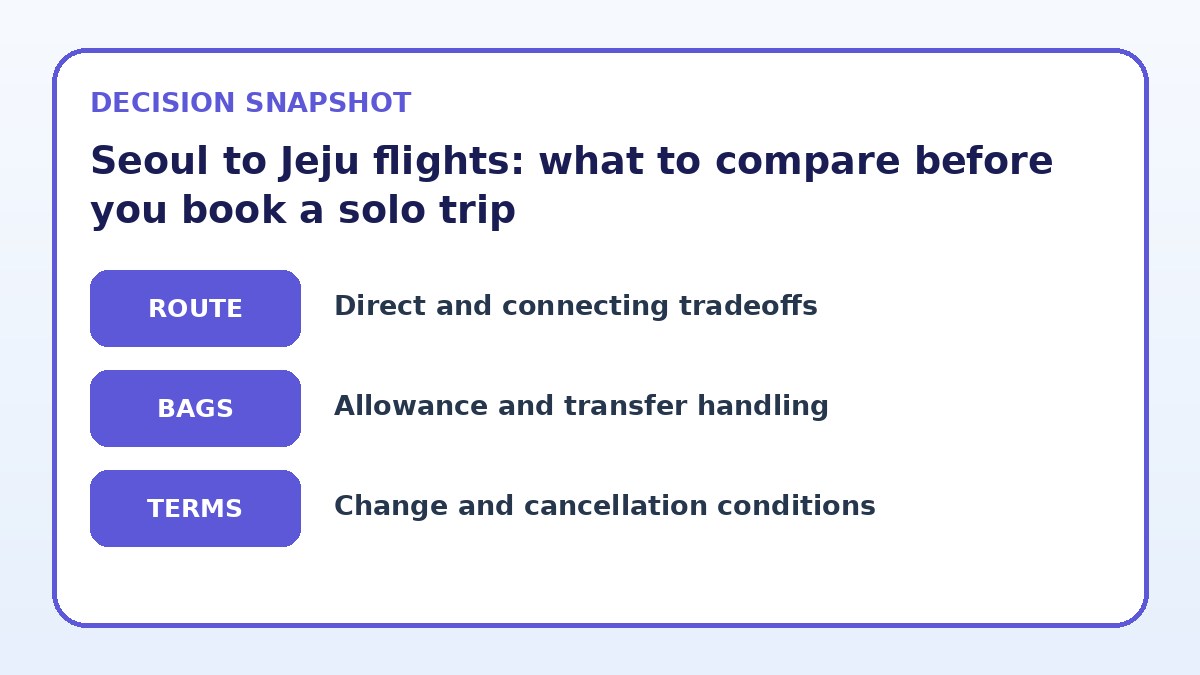
Choose direct when your time is limited, your tolerance for travel hassle is low, or you have a tight itinerary on arrival in Jeju. Before booking, verify the departure and arrival airports, exact baggage allowance, and change/cancellation policies shown on the provider’s final booking page. If you’re sensitive to seat comfort or need extra assistance, confirm seat selection rules and available support services in advance—especially important for solo travelers who prefer to control every step of the trip.
When connecting options make sense for solo travelers
Connecting itineraries can be attractive if they lower your out-of-pocket cost, open up different departure times, or let you break the journey with a planned stopover. For solo travelers with flexible schedules, a longer total travel time may be an acceptable tradeoff in exchange for a lower fare or the chance to visit another city briefly. Connections also sometimes provide more flight frequency, which can be helpful when direct flights are limited or don’t fit your preferred departure window.
If you consider a connection, pay special attention to the layover length and the airport transfer logistics at the connection point. Longer layovers reduce stress but increase total travel time. Confirm whether your baggage will be checked through to Jeju or if you must collect and re-check it—this detail is crucial and should be verified on the provider’s final booking page. Also check whether separate tickets require separate check-ins; solo travelers should plan time, transport, and contingency funds in case of disruptions.
| Approach | Best for | Tradeoff to check |
|---|---|---|
| Direct flight | Travelers who prioritize speed, simplicity, and minimal transfer risk. | Usually fewer scheduling options and sometimes higher fares compared with connections. |
| Connecting on single-ticket itinerary | Those seeking lower fares or specific timing while retaining protection for missed connections. | Longer total travel time and more time spent in airports, but with rebooking assistance if delays occur. |
| Connecting on separate tickets | Flexible travelers comfortable managing transfers who want to mix carriers or fares. | Higher personal risk for missed connections; you’ll likely handle rebooking and baggage recheck yourself. |
| Planned stopover connection | Solo travelers wanting to visit an intermediate city or split the journey intentionally. | Adds planned time and logistics but can turn travel into part of the trip experience. |
Ready to check the option that fits your plan?
Use your exact dates and traveler details so the provider page can show the current total and conditions.
Risk management: missed connections, delays, and what you can control
The main practical risk with connecting itineraries is missing a tight connection due to delay or long queues. As a solo traveler, you don’t have a partner to coordinate rebooking with, so build buffer time into any connection you consider. Look for itineraries that explicitly list minimum connection times and, when possible, choose connections within the same terminal or airport complex to reduce the chance of requiring an additional transfer.
On multi-ticket trips, you’re often responsible for rebooking if an earlier leg is delayed and causes you to miss a later flight. Verify through the carrier or booking site whether the itinerary is protected (single-ticket) or unprotected (separate tickets). Carry essential items—medications, a change of clothes, chargers—in your carry-on, and know how to contact customer service for each carrier on your ticket. These small steps make a missed-connection headache easier to manage when traveling solo.
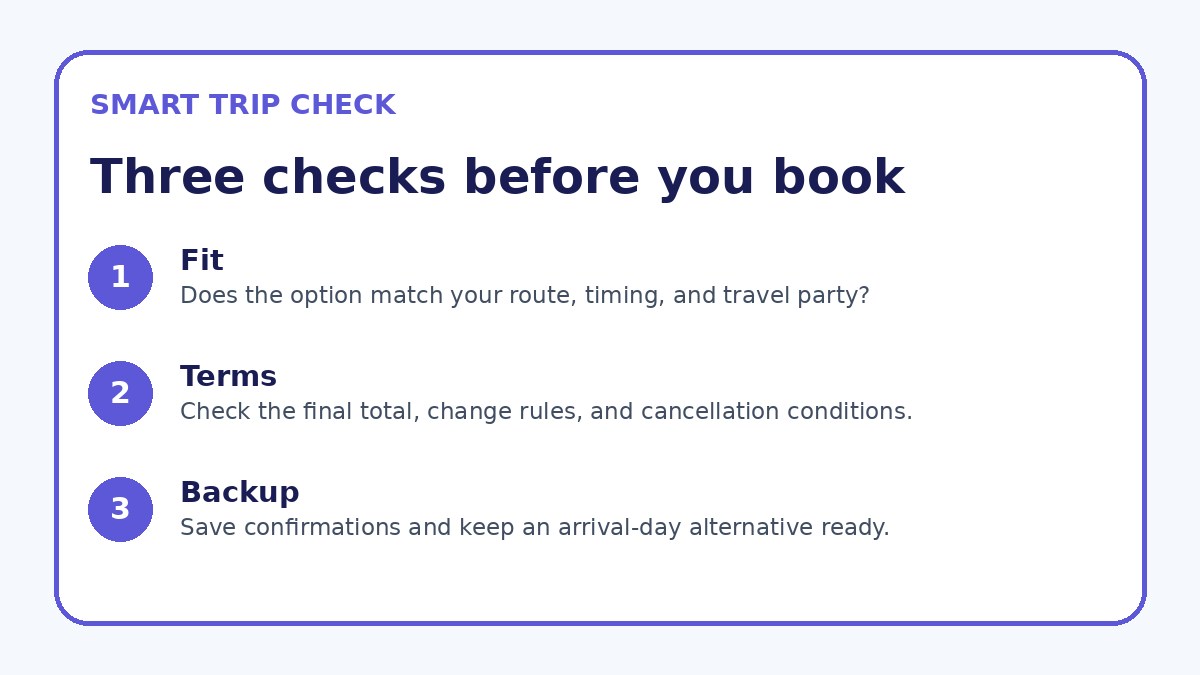
Before you book
- Confirm whether your itinerary is a single ticket (protected) or multiple tickets before you book.
- Verify baggage transfer rules and allowances on the final booking page for every carrier on your itinerary.
- Add at least 60–90 minutes of buffer for domestic connections or more if terminals require transfers.
- Keep essential items—medication, chargers, documents—in your carry-on in case checked luggage is delayed.
- Save carrier customer-service contacts and airport maps offline in case you need to rebook en route.
- Compare door-to-door travel time, not just airborne time, including transfers to Seoul departure airport.
Practical booking criteria and solo-traveler considerations
When comparing direct and connecting options, use a checklist: total door-to-door time, number of transfers, baggage rules, whether the itinerary is single-ticket, and how comfortable you are with layover logistics. Also consider airport transfer times to and from terminals in Seoul and Jeju—ground transport or taxi times can change the real travel-time advantage of a direct flight. If you value fewer decisions during travel, weight convenience higher; if you want to optimize cost or add a stop, prioritize price and schedule flexibility.
Verify final details before you commit: exact baggage allowance, change and cancellation fee structure, whether seats are confirmed, and whether assistance services are available if needed. If you use third-party sites to compare options, cross-check the carrier’s own site before paying. Trip.com can be a helpful comparison tool for current availability, but always confirm final booking conditions and any small-print exceptions directly on the provider’s checkout page.
Frequently asked questions
How much longer will a connecting route typically take compared with a direct flight?
Connecting routes add layover time to the airborne portion of your journey, so total door-to-door time is usually longer. The difference depends on layover length and transfer logistics: a short 45–90 minute domestic connection can add under two hours, while longer planned stopovers or airport changes can add several hours. When evaluating options, add transfer time to your ground travel estimates and decide whether the time saved by a direct flight is worth any price premium or schedule constraints.
Can I trust my checked luggage to be transferred automatically on a connecting itinerary?
That depends on whether your legs are booked on a single ticket and whether carriers have interline agreements. On a protected single-ticket itinerary, checked baggage is usually tagged through to the final destination; on separate tickets you may need to collect and re-check luggage. Always check the final booking page for baggage routing confirmation and pull up your baggage receipt at check-in. If the information is unclear, contact the carrier before travel so you know whether you must handle your luggage during the connection.
What should a solo traveler do if they miss a connection?
First, stay calm and head to the airline or booking-agent service desk as soon as possible to discuss rebooking. If your itinerary was booked on a single ticket, the carrier typically helps rebook you on the next available flight; on separate tickets you are usually responsible for catching the next flight and any rebooking costs. Keep digital and printed copies of booking confirmations, have a credit card ready for emergency purchases, and understand each carrier’s rebooking and delay policies on the final booking page so you can advocate for yourself efficiently.
Final planning note
For most solo travelers on the Seoul to Jeju route, a direct flight is the simplest and least stressful choice: fewer steps, fewer things that can go wrong, and a shorter door-to-door time. Use connecting options when the schedule, price, or a desired stopover clearly outweighs the added complexity; if you do, prioritize single-ticket connections, buffer time, and verified baggage transfer to reduce your personal risk. Whatever you choose, check carrier and booking-page details for baggage rules, ticket protection, and rebooking policies—those specifics determine how easily you can manage delays or missed connections when traveling alone.
Continue planning
Check current options and final conditions
Use the provider page to confirm live availability, the final total, cancellation terms, and every condition that matters to your trip.
This evergreen planning guide was created with AI-assisted drafting and a structured quality review. It does not display live prices, schedules, availability, visa guidance, or provider rankings. Verify current details before booking. Some links are affiliate links; we may earn a commission at no additional cost to you.