For families booking Seoul to Hong Kong flights, the practical choice of departure airport often matters more than finding the lowest headline fare. Incheon International (ICN) and Gimpo (GMP) both serve outbound routes, but they differ in how they handle connections, luggage, transit time to the airport, and flight schedules that match children’s rhythms. The most useful single rule: choose the airport that minimizes complexity for your specific group—shorter door-to-gate transfers, fewer tight connections, and baggage handling that matches how many checked bags or strollers you’ll bring. That usually points families toward the departure that reduces transfer steps and connection risk even if the ticket costs a little more. Below you’ll find the decision tradeoffs, the flight and fare factors to compare, a simple comparison of four selection strategies, and a checklist to use before you open any booking site.
See live routes for your exact travel day
Compare direct and connecting choices with the same baggage and traveler details.
Routing: direct vs connecting and terminal considerations
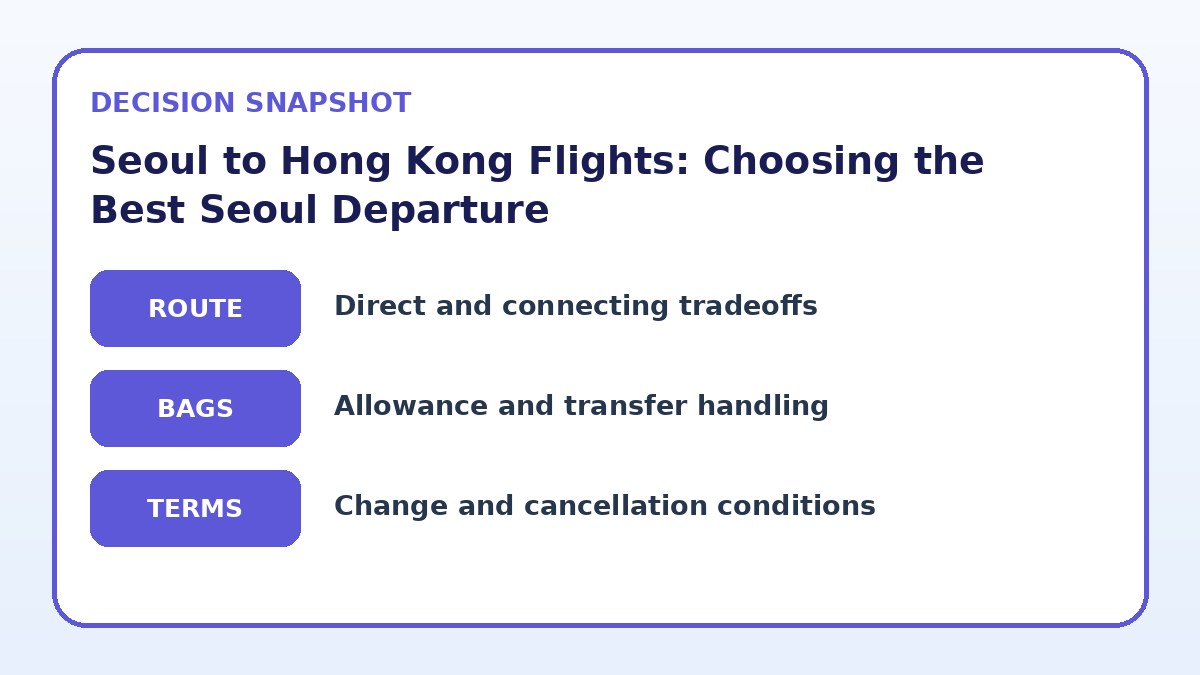
When comparing Seoul to Hong Kong flights, first identify whether a direct nonstop is available for your travel dates. A nonstop (if offered) removes connection uncertainty and baggage recheck steps that add stress with children. If a nonstop isn’t an option on your dates, look closely at the connecting airport and whether the itinerary requires changing terminals or passing immigration—those steps add time and complexity. Make a list of acceptable maximum connection times for your family; a longer, simple connection is often better than a tight one that forces rushing with kids and luggage.
Also verify whether the connection is on the same ticket and whether the airline has protected transfer procedures. Same-ticket connections generally mean the carrier accepts responsibility for missed connections and will transfer checked baggage, while separate tickets can require collecting and rechecking bags and buying a new boarding pass. If a connection requires immigration and re-entry into the country of transit, factor in extra time for passport control, potentially extra transit visas, and the logistics of getting back to a departure terminal with children and gear.
Baggage and connection risk for families
Families frequently travel with more luggage: checked bags, a stroller, a car seat, and carry-on essentials. Confirm the fare conditions for checked allowance and measured items like car seats; low-fare tickets can have restrictive baggage rules that make a seemingly cheap fare far less convenient. If an itinerary includes a connection, confirm whether checked baggage is through-checked to Hong Kong or must be collected and rechecked—this makes a big difference in time and effort during a layover and impacts which Seoul departure is more practical.
If you’ll bring bulky gear, ask the airline precisely what they count as checked versus gate-checked and whether strollers or car seats need to be boxed or tagged. When booking, verify these details on the airline’s official booking page and review the carrier’s policy for families and unaccompanied minors if applicable. Where possible, choose tickets with clear through-checked baggage handling to avoid carrying heavy items through transit and immigration lines.
Compare flight-selection strategies
| Flight strategy | Best for | Risk to check |
|---|---|---|
| Prioritize shortest airport transfer (choose nearest airport) | Families wanting minimal pre-flight commuting and fewer timing variables | May limit nonstop options or have higher connection complexity en route |
| Prioritize nonstop or single-carrier itinerary | Families who value simplicity and minimizing checked-bag handling | Could mean longer commute to a larger airport or higher ticket cost |
| Choose lowest headline fare regardless of airport | Budget-focused families on short trips comfortable with more logistics | Potentially more connections, separate tickets, and baggage recheck risks |
| Prioritize flexible fare and family-friendly services | Families needing changeability, seat selection, and special assistance | Higher upfront cost but reduced stress and simpler recovery if plans change |
Recheck the complete itinerary
Confirm airports, connection handling, baggage, and change conditions before deciding.
Schedule fit: family routines, departure windows and airport transit
Match flight times to your family’s daily rhythm. Early morning departures may be easier for children who sleep on planes, but they require earlier travel to the airport and may mean waking everyone before dawn. Evening departures can align with bedtime, but late arrivals in Hong Kong can unsettle little ones. Consider travel time from your accommodation to either Seoul airport and the reliability of that transfer at your chosen departure hour—larger airports may have more predictable shuttle or taxi services, while a nearer airport could cut pre-flight stress.
Also weigh the total door-to-door time, not just flight duration. A shorter flight from a closer airport can be better for families even if the scheduled airtime is slightly longer via the bigger international airport because it reduces time spent in transit to the departure airport. Look for flights with buffer time for security lines, family check-in counters, and stroller handling at your chosen terminal; these operational details affect how well the schedule works for children and caregivers.
Flight details to verify
- Confirm exact travel dates, number of adults and children, and ages before searching fares.
- List all bags and equipment (checked bags, stroller, car seat) and verify each airline’s handling policy on the carrier’s final booking page.
- Decide acceptable maximum connection time and whether terminal changes are workable for your group.
- Check departure and arrival times against your children’s nap and meal schedules to avoid transfers during peak fussiness.
- Compare total door-to-door time (home to Hong Kong accommodation) for each airport option, not just airborne time.
- Read change and cancellation rules on the airline’s confirmation screen and purchase seat selections that reduce stress for caregivers.
Fare conditions and what to verify on booking pages
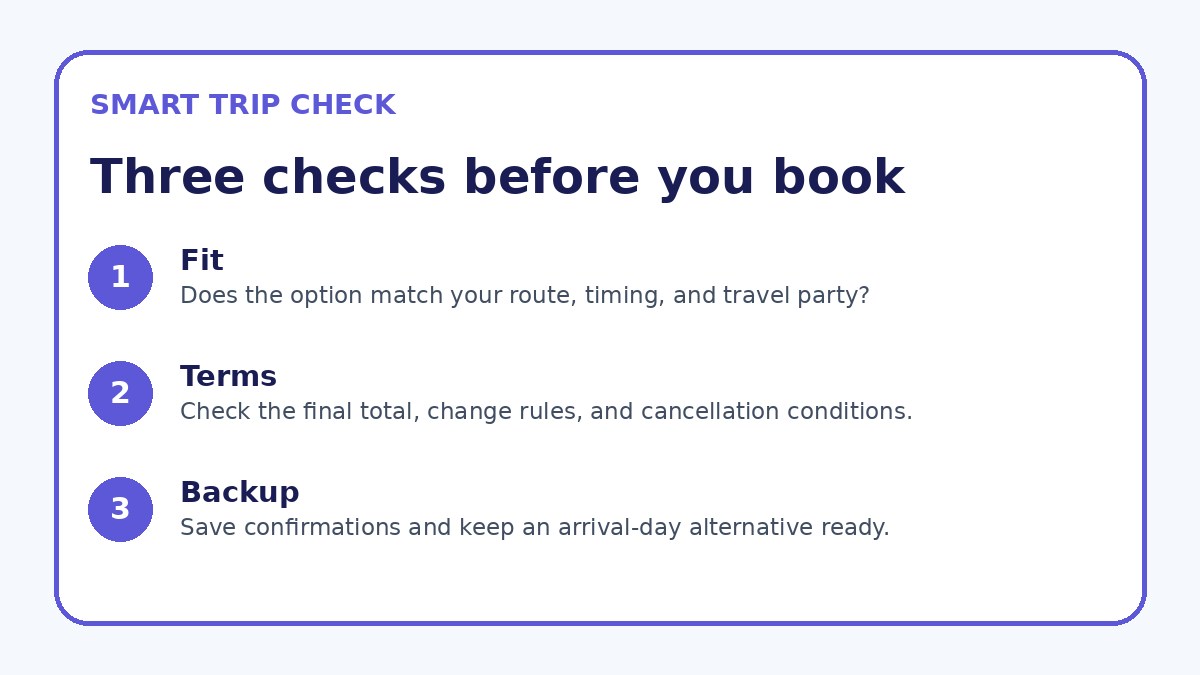
Ticket price is only part of the decision. When considering Seoul to Hong Kong flights, read the fare rules before you buy: change penalties, refundability, baggage allowance, seat assignment fees, and specific family services like priority boarding for travelers with children. These conditions are often different for the same flight when sold by different channels, so verify them on the airline’s booking confirmation page—don’t rely solely on aggregator summaries. If you need flexibility, pick a fare that allows reasonable free or low-cost changes because family plans can change suddenly.
Also check seat maps and the airline’s policy for child restraints or bassinets if you’re traveling with infants. If a lower fare means uncomfortably tight seats or no blocked middle seat options, the small price saving may not be worth the additional stress. Finally, when using any third-party site such as Trip.com to compare options, always follow through to the carrier’s final booking screen to confirm baggage rules, fees, and boarding conditions before completing payment.
Flight Guide questions travelers ask
Should families always pick the airport with direct flights to Hong Kong?
Not always. Direct flights reduce the number of handoffs and the chance of missed connections, which is appealing for families. However, the nearest airport might offer a shorter overall travel day when you factor in transit time from your accommodation. If a direct flight requires a much longer commute or an extremely early departure, a slightly longer airborne route from a closer airport that avoids complicated transfers may be the better family-friendly choice. Compare total door-to-door time, baggage handling, and departure windows before choosing.
How can I reduce baggage risk when traveling with children from Seoul to Hong Kong?
Aim for itineraries with through-checked baggage on a single ticket to avoid collecting and rechecking bags during connections. If using separate tickets or different carriers, build generous connection buffers and consider shipping large items or using gate-check services. Always verify the airline’s rules for strollers and car seats on the carrier’s booking page, and tag important items with contact details. Packing a carry-on kit with essentials for delays—diapers, snacks, change of clothes—reduces the impact of a delayed or lost checked bag.
What details should I verify on the airline or booking page before final purchase?
Check the fare conditions for change and cancellation fees, the exact checked baggage allowance, seat selection fees, and family services like priority boarding. Confirm whether the ticket is on a single carrier and whether baggage is through-checked for any connections. If assistance or seating for infants is required, verify availability and any required documentation or requests. Finally, review boarding times, terminal information, and airline instructions for strollers or car seats on the airline’s own confirmation screen—these operational details can differ from aggregator summaries.
Final decision note
Choosing the most practical Seoul departure for Hong Kong flights means weighing airport access, connection complexity, baggage handling, and schedule fit against fare differences. Families often benefit from prioritizing simplicity: shorter transfers to the airport, itineraries that minimize connections and baggage rechecks, and fare conditions that allow flexibility. Collect exact travel dates, passenger counts and gear list before searching, then verify baggage and change rules on the airline’s final booking page. Use the comparison approaches above to match your family’s tolerance for logistics versus upfront cost, and remember that a slightly higher fare can be worthwhile if it saves time and stress on travel day.
Continue planning
Check current options and final conditions
Use the provider page to confirm live availability, the final total, cancellation terms, and every condition that matters to your trip.
This evergreen planning guide was created with AI-assisted drafting and a structured quality review. It does not display live prices, schedules, availability, visa guidance, or provider rankings. Verify current details before booking. Some links are affiliate links; we may earn a commission at no additional cost to you.