Practical answer up front: for most first-time visitors traveling Seoul to Gyeongju, choose the mode that minimizes door-to-door transfers. If you prioritize comfort with fewer transfers and straightforward connections, go rail (KTX/high-speed + local transfer). If your priority is lowest transfer friction from a downtown hotel and flexibility with luggage, a direct express coach or a combined coach + local taxi works well. To pick between options, compare where each service leaves from and arrives, how many times you’ll change vehicles, and the complexity of moving bulky bags. Consider whether you need a fixed arrival time or can tolerate flexible schedules. Read provider booking pages to confirm platform numbers, departure terminals, and luggage rules before you buy. Keep a simple backup plan—an alternate train or coach and an app for local taxis—so delays or sold-out departures don’t strand you mid-journey.
Terminal fit: where you start and finish matters
Start by mapping exact departure and arrival points. Seoul’s long-distance rail departs from major city stations; coaches use intercity bus terminals that may be closer to subways and direct taxi routes. Gyeongju’s arrival points vary: some long-distance coaches stop at the city bus terminal while trains typically drop you at the closest major rail station. For door-to-door practicality, measure the time and hassle of the transfer between each terminal and your hotel. A shorter on-paper transit time can evaporate once you factor in an extra taxi ride, a subway line with stairs, or heavy luggage on foot.
If you have mobility concerns or large suitcases, prioritize services that minimize last-mile walking and vehicle changes. Look for options with luggage allowance that covers large bags, or ask at booking what assistance is available at arrival stations. Also consider how late or early you'll arrive — some terminals have limited late-night taxi availability or fewer onward connections. Choosing the departure point that aligns with your accommodation side of Seoul can save an additional transfer and reduce stress on arrival in Gyeongju.
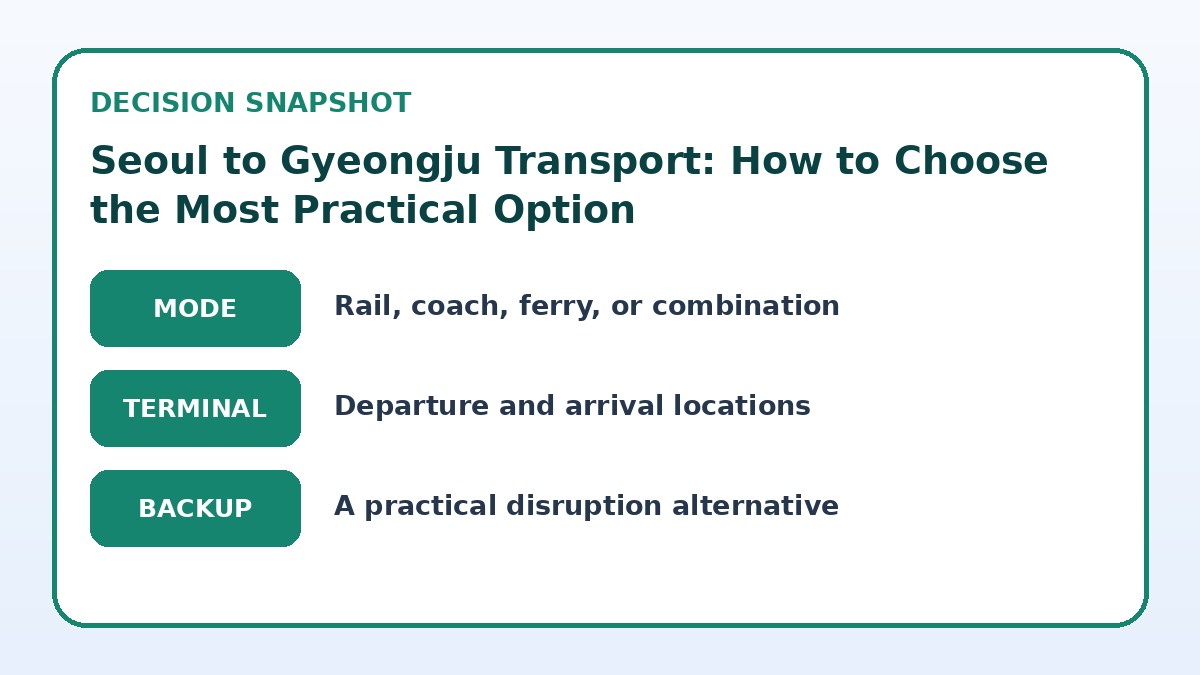
Choose the end-to-end journey plan
| Journey approach | Best for | Friction to check |
|---|---|---|
| Direct coach from central Seoul to Gyeongju | Travelers wanting fewer transfers and straightforward luggage handling from bus terminal to destination | Longer on-road travel times and sensitivity to traffic and holiday congestion |
| High-speed rail + short taxi or regional bus | Those prioritizing faster overland travel time and reliable schedules with a single convenient transfer | May require platform or station transfers and handling luggage between train and taxi/bus |
| Train to a regional hub (Busan/Daegu) then taxi to Gyeongju | Travelers who want many departure options and shorter final taxi rides into Gyeongju | Extra complexity planning two tickets and coordinating arrival times between services |
| Mixed approach: coach for part, train for part | Flexible travelers balancing cost, convenience and arrival location—useful if schedules don’t align | More transfers and potential luggage handling; better suited to experienced planners |
Check live intercity options
Look beyond the ride itself and compare terminals, transfers, luggage, and arrival fit.
Luggage and transfer friction: make getting off the vehicle easy
Assess how many times you will move your luggage. A single-seat rail ride with one final taxi often means less handling than a coach that requires a short walk from the drop-off point to your hotel. Coaches may store luggage under the bus, which is convenient, but you’ll still collect and move it at the terminal. Trains tend to have luggage racks and simpler boarding when platforms are level with station concourses; still, check whether you must carry bags up and down station stairs to change platforms or transfer to a local bus.
If you want minimal physical effort, a direct coach that drops you near your accommodation or a train that terminates at a station with taxi ranks nearby can be best. Families and travelers with mobility needs should confirm elevator/escalator availability at terminals in both Seoul and Gyeongju. When booking, verify luggage size rules and whether an additional fee applies for oversized items on the provider’s final booking page. Plan a small buffer for collecting bags and moving between vehicles when estimating total travel time.
Timing flexibility: schedules, peak days and arrival windows
Decide whether you need a fixed arrival time. High-speed rail services offer predictable journey times and frequent departures during the day, which helps when you have a tight schedule or onward reservations. Coaches can be more flexible on off-peak days and sometimes have multiple routes that stop closer to different parts of Gyeongju. If your itinerary is tied to an evening event or a late checkout in Seoul, prefer a mode with frequent alternatives so you can shift to the next departure without a long wait.
When comparing options, check frequency and typical variability rather than absolute journey time. Road travel is more sensitive to traffic and weather; allow extra time for coach trips during holiday peaks or heavy rain. Trains are generally less affected by road congestion but may require transferring to a regional line or a local bus for the final leg. Build a buffer for each segment: a short taxi or bus after arrival can absorb small delays without jeopardizing plans.
Compare the practical alternatives
Use the final page to confirm what is actually offered on your dates and save a workable fallback.
Intercity travel checklist
- Confirm the exact departure terminal and platform at both Seoul and Gyeongju on the provider’s final booking page before leaving your hotel.
- Measure door-to-door time from your accommodation to each terminal using local transit apps and include time to collect luggage.
- Check luggage rules and size limits on the carrier’s booking confirmation, and arrange assistance if you have oversized items.
- Identify at least one later departure on the same day as a contingency and note how to change or cancel your ticket on the booking site.
- Save contact details for the carrier and a local taxi app or dispatch number in case you need a private ride from the arrival point.
- Plan an arrival buffer of 30–90 minutes before any onward booking (museum opening, hotel check-in, or guided tour).
Disruption backup: three simple contingency plans
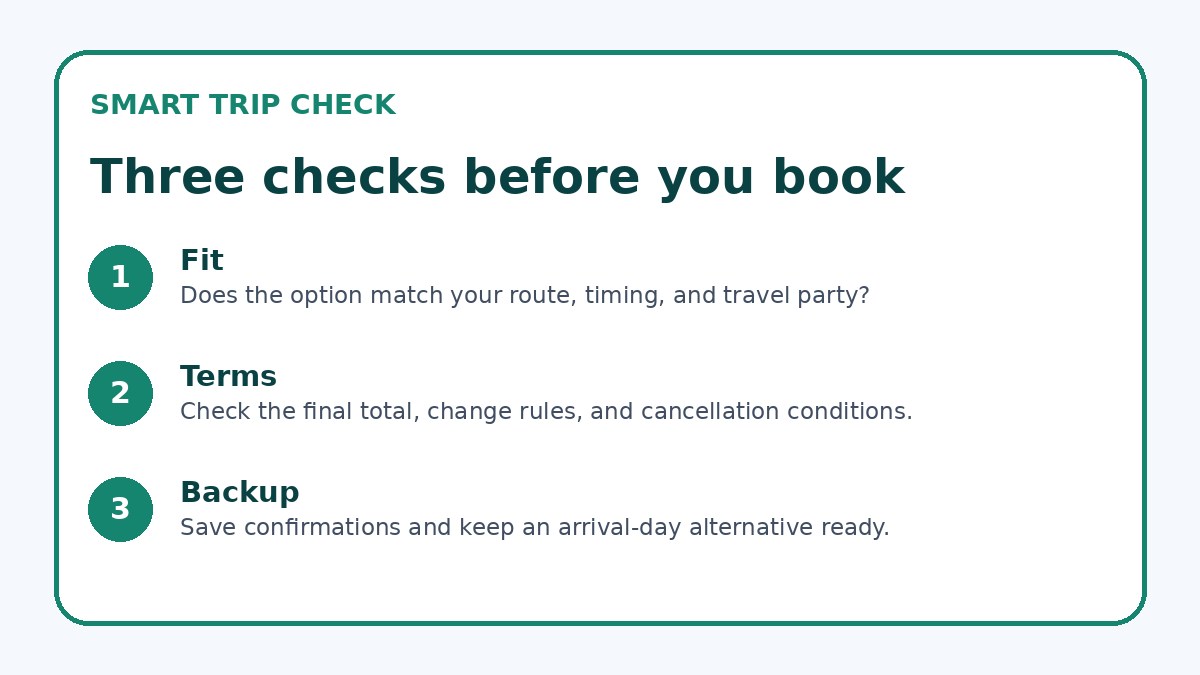
Every traveler should have a backup. First, identify an alternative departure a couple of hours later on the same mode—another train or coach—that you can transfer to if your original is full or delayed. Second, note the nearest major hub (Busan or Daegu) where trains and coaches are more frequent; reaching that hub gives more onward options and taxis to Gyeongju. Third, have a local taxi app or phone number ready so you can complete the last mile if public connections fail.
Before you leave, screenshot or save tickets, seat numbers and the operator’s contact information from the booking page. This is especially important for rail-to-local-bus transfers where timing matters. If you’re traveling during busy seasons, consider booking a flexible ticket that allows changes on the provider’s site — confirm change and cancellation rules at checkout. Finally, keep an eye on national rail or road alerts on the day of travel and be ready to switch to the nearest viable connection to avoid long waits.
Rail & Intercity Transport questions travelers ask
Is taking the high-speed train from Seoul to Gyeongju the simplest option for first-time visitors?
High-speed trains cut the long-distance portion of the journey and are generally punctual, which simplifies scheduling. However, most high-speed services will require a final transfer—either a regional train, bus, or taxi—because Gyeongju’s main historical sites are not always within short walking distance of the nearest major station. For a first-time visitor, simplicity depends on your tolerance for a short last mile: if you prefer fewer total transfers and less on-road time, pair a train with a short taxi; if you dislike transfers altogether, compare direct coaches that might arrive closer to central Gyeongju.
What should I check on the booking page before I finalize a Seoul to Gyeongju trip?
On the provider’s final booking page, verify the physical departure and arrival locations (station name, terminal and platform if shown), luggage allowances and any special assistance options. Also check change and cancellation policies, and whether seats are assigned. If your trip includes a connection, confirm the scheduled arrival and departure times allow a realistic transfer margin, and look for notes on station facilities such as elevators or taxi ranks that affect door-to-door ease. Trip.com can be used to compare current availability but always verify details with the carrier at checkout.
How much extra time should I allow for transfers and unexpected delays?
Allow at least 30 minutes for straightforward transfers, such as a short taxi after a train, and 60–90 minutes when you must change stations, collect luggage, or travel during peak holiday periods. Road-based journeys are more variable, so if you choose a coach, build extra time for traffic-related delays, especially if you have time-sensitive bookings at your destination. If your itinerary is tight, prefer the option with more frequent departures so you can move to the next service with minimal waiting.
Final decision note
Choosing the most practical Seoul to Gyeongju transport depends on how you weigh door-to-door ease, luggage handling and schedule certainty. If you want predictable journey times and a fast long-haul leg, a rail-based option with a single taxi or local bus at the end usually works best. If minimizing transfers and door-to-door simplicity matters most, a direct coach that arrives near the city center can be simpler despite longer road time. Whatever you pick, verify exact terminals, luggage rules and transfer details on the booking page, save contingency options, and give yourself a realistic buffer so the journey enhances rather than complicates your visit to Gyeongju.
Continue planning
Check current options and final conditions
Use the provider page to confirm live availability, the final total, cancellation terms, and every condition that matters to your trip.
This evergreen planning guide was created with AI-assisted drafting and a structured quality review. It does not display live prices, schedules, availability, visa guidance, or provider rankings. Verify current details before booking. Some links are affiliate links; we may earn a commission at no additional cost to you.