If you’re planning a solo trip from Seoul to Gyeongju, start by matching your priorities: speed and simplicity (usually rail), lowest number of transfers (direct coach or train), or scenic variety (combined ferry plus land legs). The practical choice often depends less on the ride itself and more on door-to-door factors: which terminal is closest to your accommodation, how easy luggage handling will be for one person, and how much schedule flexibility you need. This guide explains the everyday tradeoffs among trains, coaches, ferries, and mixed options, and gives concrete steps for choosing and validating your plan. Where specifics matter—timetables, station access, luggage limits—check the operator’s booking page or a current aggregator like Trip.com before you buy. Read on to compare terminal fit, transfer friction, timing flexibility, and what to do if your preferred leg is disrupted.
Terminal fit: start and end where it’s actually convenient
Terminal choice is often the single biggest practical factor for solo travellers. Seoul has multiple long-distance departure points with very different local transport links; which one you use alters how early you must leave your accommodation and how easily you can handle luggage on public transport or taxis. In Gyeongju the drop-off point influences whether you need another bus or taxi to reach historic sites or your guesthouse. Compare walking times, subway or bus transfers, and taxi costs from your hotel to each possible terminal before committing to a particular carrier or departure time.
When assessing terminals, look beyond the departure floor: check where luggage check-in is handled, how many stairs or escalators you will face, and whether stations have left-luggage facilities if you plan to sightsee before checking in. For ferries, verify the port’s distance from the nearest bus or train connection. If you have mobility concerns or bulky bags, prioritize options with minimal walking, level transfers, or an easy taxi hop — a slightly longer journey time can be worth significant personal convenience.
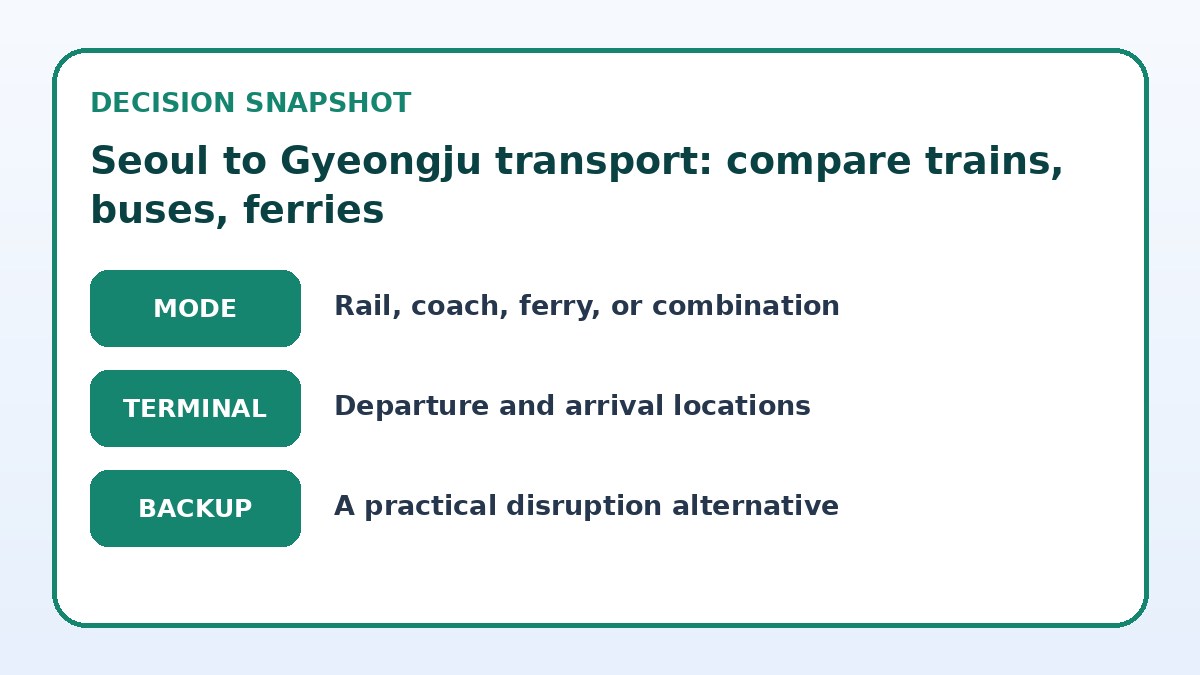
Choose the end-to-end journey plan
| Journey approach | Best for | Friction to check |
|---|---|---|
| Rail-first (direct or high-speed trains) | Solo travellers who prioritize low transfer friction and faster door-to-door journey | May require traveling to a specific Seoul station that’s less convenient from your accommodation |
| Coach-first (direct intercity buses) | Those wanting simpler station-to-station logistics with centralized coach terminals | Fewer departure times and variable terminal locations can reduce timing flexibility in some neighborhoods |
| Ferry-plus-land (scenic combination routes) | Travellers valuing the experience and views, not pure speed or simplicity | Adds extra transfers and schedule vulnerability to weather; requires careful buffer planning |
| Mixed-route (train+coach or train+ferry) | People balancing convenience and scenery or seeking access to specific local stops | More transfer points increase luggage handling and the need for reliable disruption backups |
Check live intercity options
Look beyond the ride itself and compare terminals, transfers, luggage, and arrival fit.
Luggage and transfer friction for solo travellers
Traveling alone means every transfer adds friction. Trains generally let you keep personal bags nearby and often provide storage for larger suitcases on board, reducing handling. Coaches may load luggage into a hold and reunite you at the stop, which is convenient but requires confidence about loading/unloading procedures and whether the stop is central in Gyeongju. Ferries add more handling: you’ll carry or wheel bags between station and terminal, and between port and onward transport. Factor in the number and difficulty of staircases, platform gaps, and whether a single person can manage a suitcase plus carry-on comfortably.
If you expect to change modes mid-route—say a ferry plus bus—build explicit transfer time in your plan and favor terminals with staff who can advise or luggage storage. Consider luggage that’s easy to move solo (wheeled, compact) and keep essentials in a daypack. Verify luggage policies on the operator’s final booking page: allowances, oversize fees, and any required check-in deadlines. That avoids surprises and reduces stress when you’re the only person responsible for your bags.
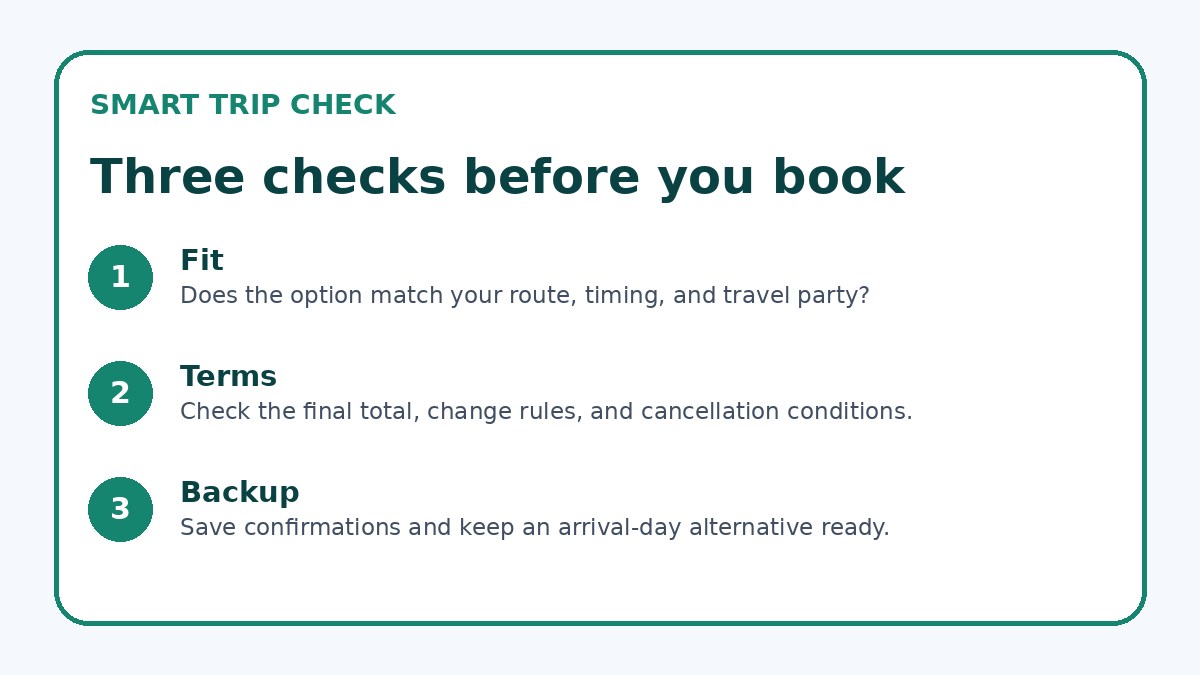
Timing flexibility and day planning
How flexible you need to be depends on whether you prefer fixed schedules or want wiggle room. Trains often run frequently on main intercity routes, allowing same-day returns or late departures without dramatic schedule gaps, which suits solo travelers who prefer spontaneous day plans. Coaches can have fewer departures but sometimes run at convenient times from neighborhoods underserved by train stations. Ferries are usually less frequent and more weather-influenced, so treat them as fixed commitments rather than flexible options unless you have multiple sailings a day.
When building an itinerary for Gyeongju’s sites, align arrival time with check-in and daylight hours for walking tours. If using mixed modes, prioritize a slightly earlier arrival in Gyeongju to absorb potential delays. Always check the operator’s live timetable and allow buffer time for local taxis or buses from the terminal to your accommodation. If your day includes a timed activity—museum entry, guided tour—work backwards from that time to choose a departure that won’t leave you rushing after a single late transfer.
Compare the practical alternatives
Use the final page to confirm what is actually offered on your dates and save a workable fallback.
Intercity travel checklist
- Confirm which Seoul departure terminal is closest to your accommodation and map public transport or taxi time to that terminal.
- Check luggage allowances, carry-on rules, and any check-in deadline on the operator’s final booking page before purchasing.
- Build minimum 45–90 minute transfer buffers for intermodal moves; increase buffers if you have heavy luggage or travel during peak hours.
- Save station and port names in Korean on your phone and take offline maps or screenshots for quick directions and taxi drivers.
- Identify two practical disruption backups: an alternative same-day service and a nearby overnight option with easy return access.
- If using a ferry or scenic leg, verify weather-dependent policies and whether refunds or rebookings are straightforward on the provider’s site.
Disruption backups: practical plans that solo travellers can actually use
Travel disruptions happen. A practical backup for solo travellers is a ranked list of alternatives you can execute without assistance: the next train or coach departure, a reliable taxi route with estimated fare range, or an overnight option with easy access to the station. Avoid complex multi-step backups that require unfamiliar local knowledge; pick options with clear booking pages or reachable counters at the terminal. Keep phone numbers, the station name in Korean, and a map screenshot so you can quickly re-route if needed.
For mixed-mode trips where one missed connection could strand you, have two realistic backups: one that keeps you moving that day and one that includes an inexpensive overnight stay near the terminal. When time is tight, check whether trains or coaches accept walk-up tickets that day or if booking ahead is mandatory. For ferries, confirm the refund or rebooking policy and look for nearby rail or coach alternatives that operate even in poor weather. Always verify the provider’s current rules on the final booking page.
Rail & Intercity Transport questions travelers ask
Which mode is usually fastest door-to-door from Seoul to Gyeongju for a solo traveller?
Typically, high-speed or intercity trains reduce total door-to-door time because they cut ride time and tend to use stations with good public transport links. However, the fastest true option depends on where in Seoul you start and where in Gyeongju you need to finish; a fast train from a far-side station can be slower overall than a coach leaving from a closer terminal. Before booking, compare total travel time from your accommodation to final destination — include transfer walks, taxi rides, and luggage handling — and verify train frequency and seat availability on the operator’s booking page.
Is taking a ferry practical for most solo travellers on this route?
Ferries can be practical if you want a scenic break and you accept extra transfers at each end. For many solo travellers they are less convenient than a continuous rail or coach ride because you must manage additional luggage movements and connect with land transport to reach Gyeongju. If you consider a ferry, check the port’s location relative to your start and end points, the schedule reliability, and refund or rebooking policies on the ferry operator’s site. Treat ferry legs as optional enrichments rather than default time-saving choices unless schedules align well with your plan.
How should I plan for disruptions when I’m travelling alone?
Plan two simple backups you can execute solo: a later direct service on the same route, and an overnight option near the departure or arrival terminal that has easy return access. Keep critical information handy — operator contact details, station names in Korean, printed or offline maps — and pre-check refund/rebooking rules on the provider’s booking page. If you rely on a specific connection, aim to arrive earlier than strictly necessary or choose a later origin departure so you have breathing room; solo travellers should favour solutions that minimize complex multi-step reroutes.
Final decision note
Choosing between train, coach, ferry, or mixed travel from Seoul to Gyeongju comes down to three practical questions: which terminal is easiest from your accommodation, how much luggage and transfer handling you’re willing to manage alone, and how much schedule flexibility you need. Trains generally reduce transfer friction; coaches can be handy if they depart near where you are; ferries add scenic value but increase handling and weather risk. For mixed routes, treat schedules as linked: add buffers and plan straightforward backups you can carry out by yourself. Verify timetables, luggage rules, and rebooking or refund policies on each provider’s booking page (or a current aggregator such as Trip.com) before you book, and you’ll travel more confidently and with fewer surprises.
Continue planning
Check current options and final conditions
Use the provider page to confirm live availability, the final total, cancellation terms, and every condition that matters to your trip.
This evergreen planning guide was created with AI-assisted drafting and a structured quality review. It does not display live prices, schedules, availability, visa guidance, or provider rankings. Verify current details before booking. Some links are affiliate links; we may earn a commission at no additional cost to you.