If you’re traveling from Seoul to Da Nang with extra luggage, the practical decisions you make before booking will determine whether departure is calm or chaotic. Start by deciding how many pieces you truly need to check, then match that count to route and fare options so you don’t overpay or get stuck at check-in. The key tradeoff is route versus fare: indirect flights or carriers with generous weight allowances often cost more or add travel time, but can save money on overweight charges and reduce connection stress. This guide focuses on organizing baggage and airport time—what to compare in fares, how to plan connections and buffer time, and which operational details to confirm on the airline’s final booking page. Have your travel dates, number of travelers, exact luggage dimensions and weights, and passport details ready before checking live options.
See live routes for your exact travel day
Compare direct and connecting choices with the same baggage and traveler details.
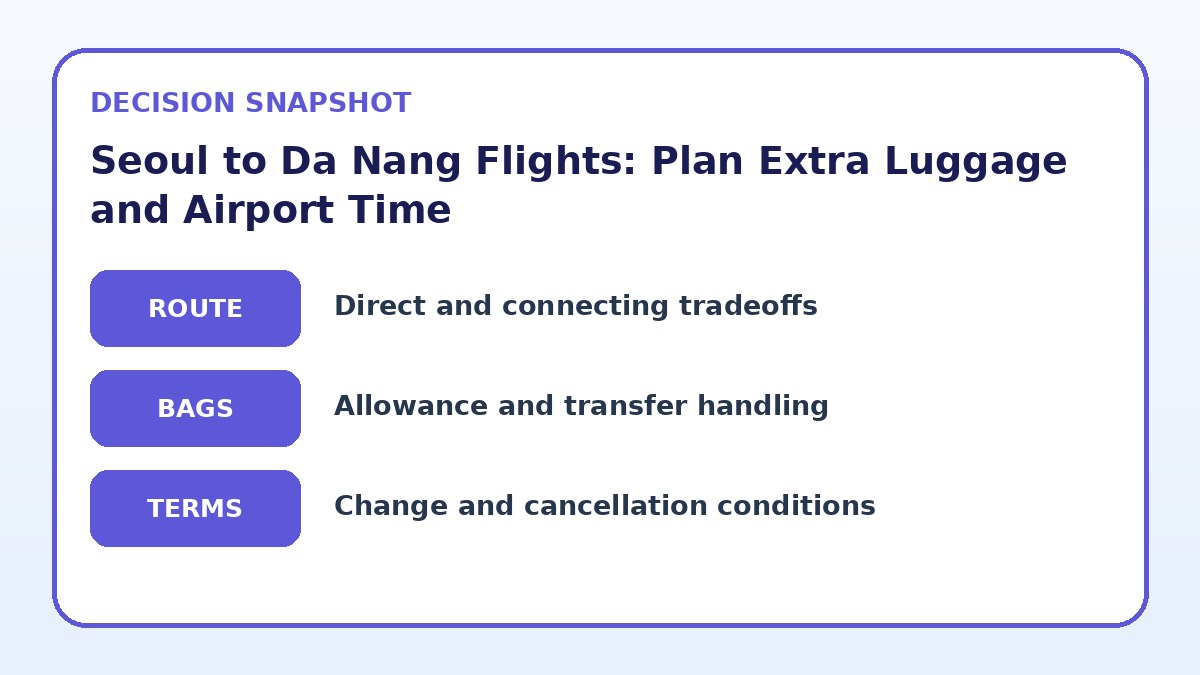
Routing: direct versus connecting with extra luggage
When traveling Seoul to Da Nang, the simplest routing tradeoff is direct versus connecting flights. Direct flights reduce the number of times baggage must be handled, lower the chance of misrouted luggage, and simplify arrival logistics in Da Nang. If you can find a direct option with a baggage allowance that suits your needs, you’ll reduce handling fees and the need to re-check bags during connections. However, direct options may have stricter piece or weight limits, so a direct flight is only better if the fare and baggage rules align with your actual luggage plan.
Connecting flights often let you mix a lower base fare with a more generous baggage policy on one of the legs, but each change introduces risk and time requirements. If a connection requires you to clear immigration and pick up bags in a transit city, you’ll need extra time and must factor in local terminal layouts and re-check procedures. Compare total door-to-door time and the number of manual baggage handoffs when deciding; sometimes a longer single-connection itinerary with more generous allowance is more practical than a tight direct flight with costly overweight fees.
Baggage and connection risk: what to verify before booking
Before committing to a fare, read the airline’s baggage rules on the final booking page: allowed pieces, weight per piece, size limits, and fees for overweight or oversized items. If you’re booking separate tickets for connecting legs, verify whether the airline will interline your bags or if you must collect and re-check them. Also check whether special luggage—sports gear, musical instruments, or large boxes—requires advance notice or a dedicated handling process. When rules are ambiguous, contact the airline’s baggage or reservations team and save any confirmation in writing.
Consider connection airports’ terminal logistics and whether you’ll need to change terminals, clear security again, or pass immigration to re-check luggage. Tight connections amplify baggage risk: delayed arrival, long transfer distances, or separate-ticket itineraries increase the chance an item won’t make the next leg. Build buffer time for manual baggage processes—label checks, screening for oversized items, and physically moving large pieces—and plan for contingencies like delayed check-in counters or special-luggage queues at your Seoul departure airport.
Compare flight-selection strategies
| Flight strategy | Best for | Risk to check |
|---|---|---|
| Book a direct flight with standard baggage included | Travelers who want fewer handoffs and simpler arrival logistics | May have strict weight/piece limits and higher base fare |
| Choose a connecting itinerary with generous baggage on one leg | Those who can accept longer travel time to avoid overweight fees | Increases transfer complexity and risk of missed or delayed luggage |
| Buy a low-fare ticket then pre-purchase extra baggage online | Price-sensitive travelers who can plan baggage needs in advance | Requires careful confirmation; some add-ons are non-refundable or limited |
| Book higher-tier fare or add premium baggage allowance | Travelers prioritizing certainty and minimal airport stress | Higher upfront cost but reduces handling and connection worries |
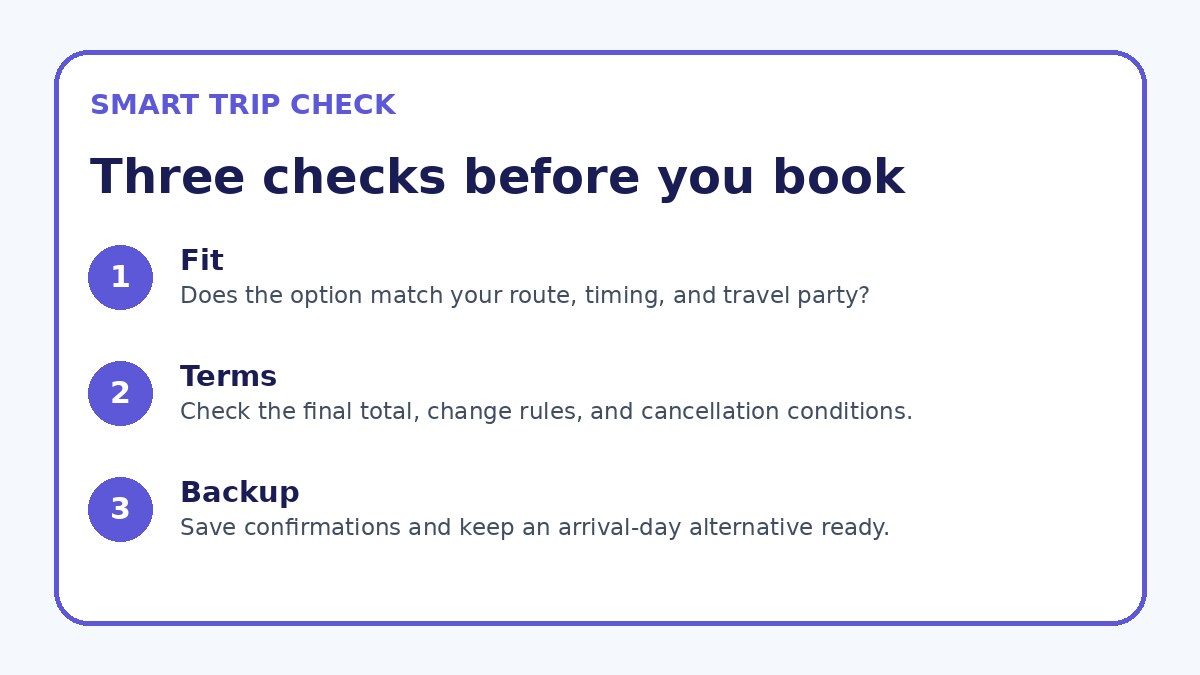
Recheck the complete itinerary
Confirm airports, connection handling, baggage, and change conditions before deciding.
Schedule fit and airport time: building reliable buffers
For Seoul departures, pick your arrival time at the airport with extra luggage in mind. Standard arrival guidance (two hours for international flights) is a minimum; add 30–90 minutes when you expect oversized drop-off, special handling, or busy counters. If you’re checking heavy or multiple pieces, early morning departures may offer faster handling and less crowded counters, while late-night flights can bring reduced staffing at special-luggage desks. Factor in local transport variability to the airport, any luggage-wrapping needs, and time for identity checks and security screening.
For itineraries with a connection, calculate minimum connection times based on whether you need to re-check bags and whether you must clear immigration. When in doubt, choose a longer connection to avoid missed flights or rushed baggage transfers. Use that extra time to confirm onward boarding passes at the transfer desk and to physically verify bags have been tagged to the final destination. Keep essentials—medication, documents, a change of clothes—in carry-on to reduce disruption if checked luggage is delayed.
Flight details to verify
- Record exact travel dates, number of travelers, passport details, and final destination address before searching fares.
- Weigh and measure every checked bag at home; note dimensions, weight per piece, and any oversized measurements.
- Check the airline’s official baggage allowance and extra-fee rules on the final booking page before payment.
- If connecting, confirm whether baggage will be through-checked or must be reclaimed and re-checked during transit.
- Plan airport arrival time with an extra 30–90 minutes for oversized or manually handled luggage.
- Purchase and save written confirmation for any pre-paid extra baggage, specialty handling, or oversized-item service.
Fare conditions and what to confirm on booking pages
Fares can be structured around piece-based or weight-based baggage systems; some carriers include one checked bag in a ticket type, while others apply per-kilogram limits. On the airline’s final booking page, confirm the fare’s exact baggage allowance, the cost and rules for extra pieces, and how overweight or oversized items are billed. Also verify whether your fare allows flight changes or refunds and what penalties apply if you must reschedule. If baggage allowances differ by leg in a connecting itinerary, the least generous leg often dictates what you must prepay or carry.
If you rely on third-party booking platforms, confirm the baggage policy on the carrier’s official page before finalizing. Trip.com can be used as one place to compare live availability and conditions, but always cross-check the airline’s terms for baggage and change/refund rules. Finally, when purchasing add-on baggage online, save the receipt and a confirmation number; airport staff will sometimes require the prepayment record when processing oversized items or refunds for unused pre-purchased allowance.
Flight Guide questions travelers ask
How early should I arrive at the Seoul airport if I have oversized or heavy luggage?
Arrive earlier than the usual international suggestion because oversized and heavy luggage require additional processing. Add 30 to 90 minutes depending on how many pieces you have and whether the airline provides a special-luggage drop. For items needing manual inspection, wrapping, or special equipment, choose the higher end of that window. Also factor in transport variability to the airport, holiday crowds, and whether you need to purchase pre-paid baggage at the counter. Confirm recommended check-in times on the airline’s booking page and follow any carrier-specific guidance.
What should I do if my connecting itinerary requires me to reclaim and re-check bags?
If you must reclaim and re-check bags during a connection, build a generous buffer when booking—allow enough time to clear immigration if required, move between terminals, and stand in re-check queues. Keep necessary documents and a small carry-on with essentials in case checked items are delayed. Before departure from Seoul, verify with the airline whether your bags will be tagged to the final destination; if not, plan for the extra step and possible inspection. If you booked separate tickets, contact both carriers to understand their handover practices and allow extra transfer time accordingly.
Can I pre-purchase extra baggage online and does that eliminate airport delays?
Pre-purchasing extra baggage can reduce the risk of expensive overweight charges at the counter and often speeds up check-in, but it does not eliminate all airport handling tasks. Some oversized or irregular items still require manual handling, special labeling, or transfer to a special-luggage desk. Always save the confirmation of any pre-purchased allowance and verify the exact permitted dimensions, weight, and any carrier instructions on the final booking page. If you’re traveling on separate tickets or through a carrier with complex interline rules, pre-purchase helps but doesn’t remove the need for additional transfer time.
Final decision note
Travelers flying Seoul to Da Nang with extra luggage should make choices that align baggage needs with routing and time buffers rather than picking a flight on price alone. Start by documenting exact luggage dimensions and weights, then compare total costs including pre-paid baggage and overweight fees while checking whether baggage will be through-checked on connections. Build conservative airport arrival and transfer buffers when you expect manual handling or terminal changes. Confirm everything on the airline’s final booking page—allowances, fees, and change penalties—and save written proof for any pre-purchased services. With planning, you can reduce airport stress, avoid surprise fees, and arrive in Da Nang prepared to move on quickly.
Continue planning
Check current options and final conditions
Use the provider page to confirm live availability, the final total, cancellation terms, and every condition that matters to your trip.
This evergreen planning guide was created with AI-assisted drafting and a structured quality review. It does not display live prices, schedules, availability, visa guidance, or provider rankings. Verify current details before booking. Some links are affiliate links; we may earn a commission at no additional cost to you.