Pick the neighborhood first, then match booking flexibility to the trip’s risk profile. For short business trips to Taipei, a central area that minimizes commute friction usually matters more than a cheaper property across town. Decide whether you need fully refundable rates, limited-change options, or prepaid discounts after mapping your must-attend meetings, airport transfer, and evening plans. This article helps you choose an area, evaluate how daily routing affects punctuality, size up room needs for work and rest, and compare the practical tradeoffs of refundable, semi-flexible, and prepaid bookings. By the end you should be able to shortlist one or two neighborhoods and identify which booking terms to request or avoid when you open live availability on a booking site or the hotel’s own page. Remember to verify cancellation windows, change fees, and payment timing directly on the provider’s final booking page before committing.

Check live stays in the areas that fit
Use your dates and party size to compare current rooms after you narrow the neighborhood fit.
Neighborhood fit: where to base yourself in Taipei
For business travelers the single most important decision is the neighborhood since meetings, dinners, and airport transfers usually define the day. Zhongshan and Xinyi are the typical choices for central access: Xinyi suits corporate offices and conference centers, while Zhongshan offers good dining and direct MRT links across the city. Taipei Main Station is ideal when you need maximum rail connectivity and quick access to trains or buses to outlying districts. Choose an area that keeps your primary destinations within 15–30 minutes by MRT or taxi during peak hours to avoid unpredictable delays.
When you map neighborhoods against your calendar, factor in evening commitments too—networking events can run later and late-night transport options vary. If your itinerary includes morning inspections or multiple site visits, staying closer to industrial or university districts makes sense even if it means fewer dinner options. Also consider airport transfer logistics: the Taoyuan Airport MRT and express buses run from specific hubs, so a slightly longer paycheck-friendly commute might add time if you frequently fly in and out during the same trip.
Choose an area-selection strategy
| Area approach | Best for | Tradeoff to check |
|---|---|---|
| Central business district (Xinyi) | Short meetings, proximity to conference centers and corporate offices. | Higher room rates and busier evenings; refundable rates may cost more here. |
| Transit hub (Taipei Main Station) | Maximum rail connectivity and easy airport transfers. | More crowding during peak times and longer walks between platforms and hotels. |
| Mixed commercial neighborhoods (Zhongshan, Daan) | Balanced dining, nightlife, and steady MRT access for varied schedules. | May add 10–20 minutes to some commutes compared with a district-center hotel. |
| Near industrial parks or universities | Site visits, daytime inspections, and lower-cost options with direct local access. | Fewer evening services and longer transfers to central conference venues. |
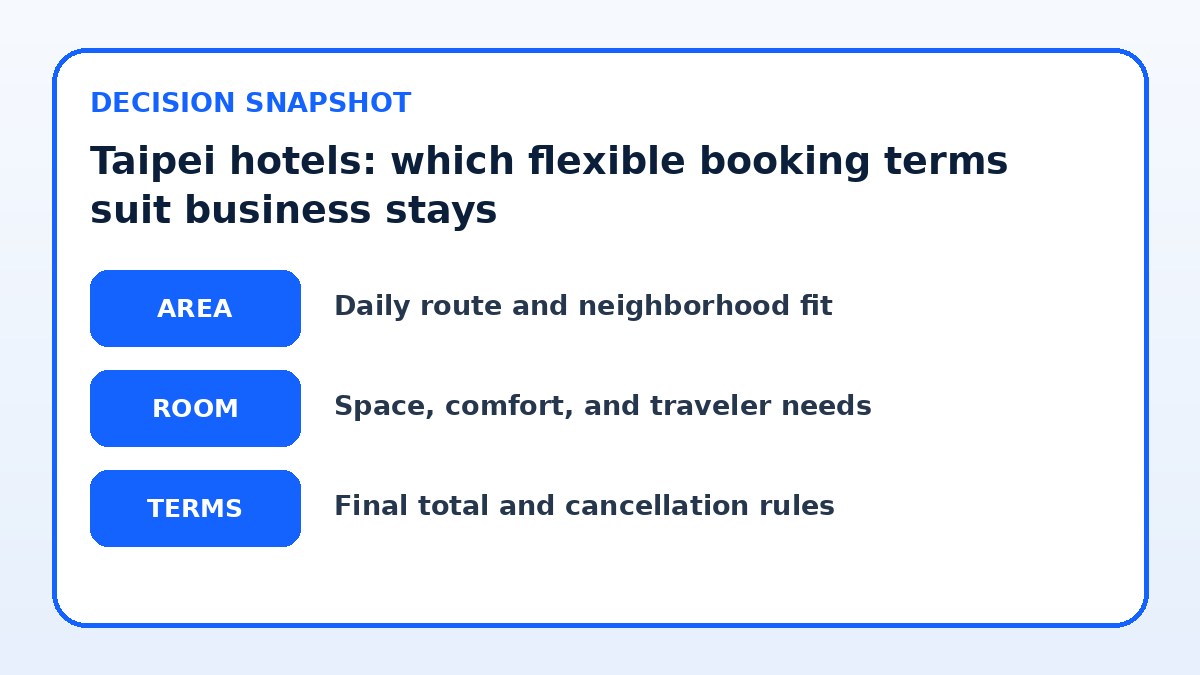
Daily-route friction: time, reliability and peak travel
Daily-route friction arises from transfer time, time-of-day congestion, and how much buffer you need for meetings. Taipei’s MRT is reliable and extensive but can be crowded at weekday peak times; a 20-minute scheduled trip can take longer if you must walk between stations or wait for a taxi. When choosing a hotel, measure door-to-door time between your hotel and meeting venues at the times you’ll travel—morning rush and late-evening return can differ substantially. If punctuality is critical, favor neighborhoods with stations on the same MRT line as your meeting locations or those with fast taxi access.
Also account for the hotel’s check-in and check-out policies when mapping your daily plan. Late arrivals or early departures are common in business travel; flexible booking terms that allow late check-out or early check-in (subject to availability) reduce logistical stress. Where the hotel is close to a reliable airport shuttle or express MRT, you can accept slightly longer commutes inside Taipei itself while cutting transfer uncertainty for flights.
Now compare like with like
Keep the same dates, guests, room needs, and cancellation preferences while you compare the final choices.
Room and party needs: size, workspace and practical amenities
A room that doubles as a workspace and a quiet place for calls is essential. Look for clear descriptions of desk size, in-room lighting, and a stable wired or high-quality Wi-Fi option before booking since these features are not always obvious in photos. If you expect to host one or two short in-room meetings or need privacy for calls, book a larger room category or a business-room package that explicitly lists workspace amenities. For multi-person travel, verify whether connecting rooms or suites are available and whether those configurations can be held with refundable or semi-flexible terms.
Hotel facilities like an on-site business center, meeting rooms you can reserve hourly, and 24-hour reception matter for last-minute printing or courier needs. If presentations are part of the trip, ask whether the hotel provides HDMI adapters, a projector, or dedicated AV support and confirm any extra fees on the booking page. When comparing flexible bookings, check whether upgrades, room-type changes, or late check-out are permitted without full cancellation—these are common negotiated benefits for corporate reservations.

Hotel booking check before payment
- Map each meeting and event location and estimate door-to-door travel times from shortlisted neighborhoods at the actual times you will travel.
- Open the full rate rules on the hotel’s booking page and note the exact cancellation cutoff time, change fees, and whether taxes or service charges are refundable.
- Confirm payment timing: does the rate require immediate prepayment, a partial deposit, or only a credit card guarantee at booking?
- Ask the hotel (or check the rate terms) about late check-out, early check-in, room upgrades, and whether those options can be held without canceling the reservation.
- Verify whether corporate invoicing, VAT receipts, or specific billing names are supported by the hotel and if any extra documents are required at check-in.
- Compare refundable and nonrefundable rates for the same room type and then calculate the break-even point where flexibility is worth the extra cost for your itinerary risk.
Final booking terms: how to compare refundable, semi-flexible and prepaid
When you’re ready to book, compare specific contractual points rather than general labels. Fully refundable rates typically allow free cancellation up to a specified cutoff time—verify the exact local date and time the hotel uses (hotel time zone) and whether third-party taxes or service charges are refundable. Semi-flexible or modified rates often permit date changes with a fee or partial refund; read the change policy for how many days in advance changes are allowed and how fees are calculated. Prepaid and nonrefundable rates can offer savings but make sure your corporate card or expense policy allows nonrefundable bookings.
Also check what triggers a fee: no-shows, early departures, or changes to occupancy can carry penalties. Verify whether the reservation requires immediate payment or a credit card guarantee and whether the property will place an authorization on the card at check-in. If the booking site shows multiple rate rules, open each rate’s full terms on the provider’s booking page to confirm inclusion of taxes, breakfast, corporate invoicing options, and whether rewards points or third-party benefits still apply. For live inventory and current conditions consider checking Trip.com as one place to compare offers, then confirm directly with the hotel for final contractual details.
Hotel Guide questions travelers ask
Should I always book a fully refundable rate for brief Taipei business trips?
Not always. Fully refundable rates minimize financial risk when meeting times or attendee lists are uncertain, but they can cost significantly more. If your schedule is locked and cancellations are unlikely, a semi-flexible rate that allows changes for a fee or a prepaid nonrefundable rate may be more economical. Weigh the cost difference against the likelihood of change: for last-minute itinerary shifts, the peace of mind from refundable terms can outweigh the premium. Always confirm the provider’s exact refund window and any administrative fees on the final booking page before paying.
How do corporate booking policies affect flexible booking choices in Taipei?
Corporate policies often dictate allowable rate types, preferred neighborhoods, and reimbursement procedures. If your company requires use of a corporate travel portal or mandates refundable bookings for certain trip types, follow those rules first. If policy allows flexibility, choose a rate that balances cost and risk while meeting invoicing and receipt requirements. When in doubt, ask your travel manager whether prepaid bookings require pre-approval or if the company will reimburse nonrefundable costs in the event of a schedule change.
What should I verify on the hotel’s booking page before finalizing a reservation?
Check the precise cancellation and change policy including time-zone specifics, payment timing and whether taxes or service fees are included, any deposit or no-show penalties, and special clauses about group or multi-room bookings. Confirm whether breakfast or other amenities are included and whether they are refundable. If you need corporate invoicing, ensure the hotel lists invoicing options and any documentation requirements. Finally, look for explicit statements on early check-in or late check-out policies and whether the rate allows free changes or charges an administrative fee.
Final decision note
For Taipei business travel, pick your neighborhood first to minimize daily routing friction and then choose booking flexibility that matches the trip’s risk. Central areas and transit hubs reduce commute unpredictability but can come at a premium; industrial or university areas suit site visits but may lengthen transfers. Once you have a neighborhood and room type in mind, read the full rate rules on the provider’s booking page: confirm deadlines for free cancellation, fees for changes or no-shows, and exact payment timing. Use semi-flexible rates as a middle path when some schedule certainty exists, reserve fully refundable rates if changes are likely, and accept prepaid options only when your itinerary is fixed and corporate policy permits. Shortlist one or two neighborhoods, compare the applicable rate rules, then verify contractual details with the hotel before you book.
Continue planning
Check current options and final conditions
Use the provider page to confirm live availability, the final total, cancellation terms, and every condition that matters to your trip.
This evergreen planning guide was created with AI-assisted drafting and a structured quality review. It does not display live prices, schedules, availability, visa guidance, or provider rankings. Verify current details before booking. Some links are affiliate links; we may earn a commission at no additional cost to you.