Practical answer up front: for most first-time visitors to Da Nang, choose the Seoul airport that gives you the best balance of fewer connections and a convenient schedule for your exact travel dates — often that means favoring the airport with a direct route or the shortest same-day connection, even if the fare looks slightly higher. The route-versus-fare tradeoff is the core decision: a cheap multi-leg itinerary can be tempting, but extra connections raise baggage and missed-connection risk and add travel fatigue. Before you search, get your exact travel dates, the number of checked bags, and any mobility or timing constraints ready. With those details you can judge which departure airport keeps connections smooth and arrival times practical for reaching Da Nang’s city center or your first hotel.

See live routes for your exact travel day
Compare direct and connecting choices with the same baggage and traveler details.
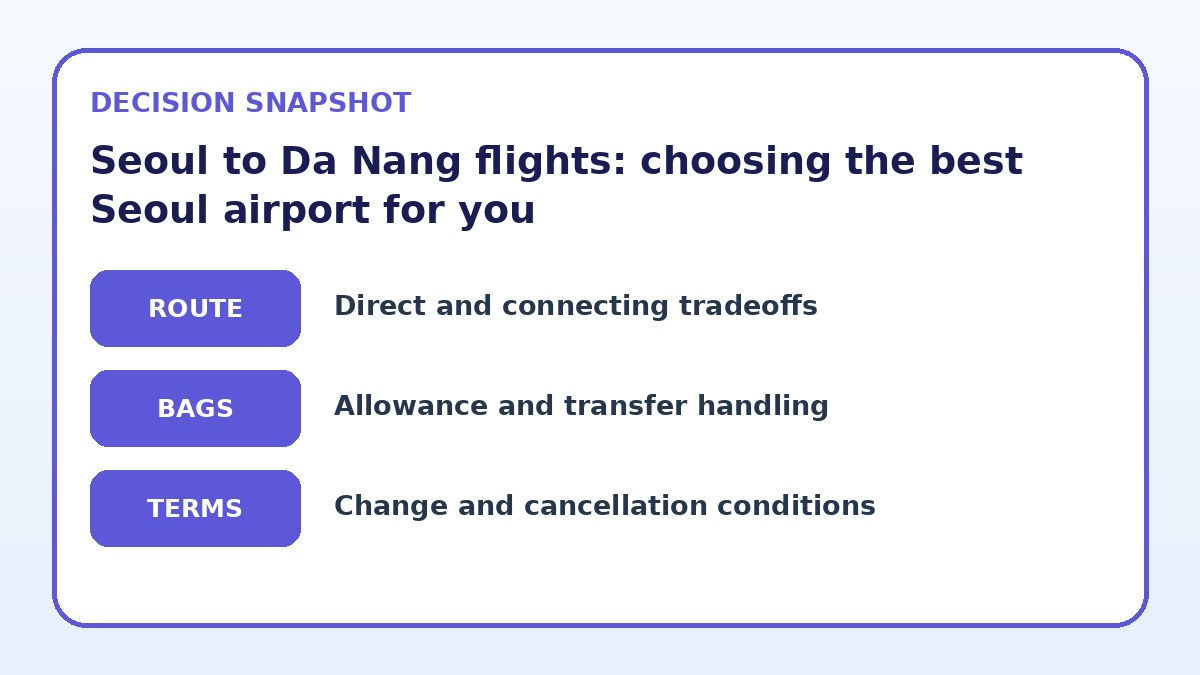
Routing: direct vs connecting and which Seoul airport offers what
Start by mapping the routings available on your intended dates. Some travelers find direct flights from Seoul to Da Nang on certain carriers and days; others must accept a connection. Which Seoul airport you prefer should depend on where those most convenient routings originate. If a direct flight is available from the airport closer to your home or central Seoul, that can save time and stress compared with transferring through a third city. If only connecting options exist, check whether the connection is scheduled within the same terminal complex or requires a transfer between airports — transfers between Seoul airports add significant ground-time and uncertainty.
When comparing routings, ask whether a connection is within a single carrier or involves separate tickets. Single-ticket itineraries typically protect you if an earlier flight is delayed, but are still subject to airline connection times and minimums. For first-time visitors, prioritize routings that limit the number of takeoffs and landings and reduce overnight layovers unless you plan to stop intentionally. Always confirm on the carrier or booking page whether a listed connection is airport-to-airport within Seoul or between different Seoul-area airports, since that matters for transfer logistics.
Baggage and connection risk: how airport choice changes what you should expect
Baggage handling differs with itinerary type. On a single-ticket itinerary that routes through Seoul and onward to Da Nang, checked bags are often tagged through, meaning you won’t reclaim them in Seoul. But if you book separate tickets or transfer between airports, you will likely need to collect and recheck baggage, which consumes time and increases the chance of missing the next flight. For first-time visitors who rely on checked luggage, choosing the Seoul departure that reduces transfers cuts the number of times your bags must be unloaded and reloaded.
Tight connection windows increase stress regardless of airport. Even if both departure airports are efficient, consider travel time to the airport, expected peak traffic, and the minimum recommended check-in time for international departures. If the more convenient departure airport requires a longer ground transfer from where you are staying, recalibrate the assumed connection buffer. For travellers carrying fragile items, medical equipment, or needing mobility assistance, prefer routings with longer scheduled connection times and single-ticket protection when possible.
Compare flight-selection strategies
| Flight strategy | Best for | Risk to check |
|---|---|---|
| Choose the airport with a direct flight even if the fare is higher | Travelers who prioritize simplicity, minimal transfers, and lower missed-connection risk | May pay more up front and have fewer schedule options on some dates |
| Pick the cheapest multi-leg itinerary regardless of airport | Budget-focused travelers with flexible schedules and minimal checked luggage | Higher chance of tight connections, baggage rechecks, and schedule fragility |
| Use the airport closest to your accommodation for convenience | Those who want to minimize ground travel time before departure | Might reduce flight options or require a connection that increases total travel time |
| Prioritize single-ticket connections through Seoul’s major hub | Travelers who want connection protection and easier rebooking if delays occur | Could limit carriers and increase cost compared with self-managed separate tickets |
Recheck the complete itinerary
Confirm airports, connection handling, baggage, and change conditions before deciding.

Schedule fit: arrival time in Da Nang and ground transport considerations
Schedule fit means matching arrival and departure times to how you’ll actually move once you land. Da Nang’s airport hours, local transport options, and hotel check-in policies can make an afternoon arrival much easier than a late-night touchdown. Pick the Seoul departure airport and specific flight that puts you in Da Nang at a time when taxis, buses, or transfers are operating reliably and when you can get into your accommodation without extra hassle. If you have onward domestic plans in Vietnam, ensure your arrival leaves enough time for immigration, baggage claim, and transfer to a connecting domestic flight or ground transport.
Also think about your outbound flight from Seoul: an early-morning departure favors an airport with reliable early-morning public transport or easy taxi access; an evening flight may tolerate a slightly longer commute. If your itinerary includes early check-ins or late arrivals, check logistics like hotel early check-in policies or airport lounges. Before booking, verify the carrier's stated check-in and boarding cut-off times on the final booking page, since they vary by airline and fare class and will determine how early you must arrive at your chosen Seoul airport.
Flight details to verify
- Write down exact travel dates, full traveler names as in passports, and the number and sizes of checked bags before searching fares.
- Search for itineraries that keep connections on one ticket; if connections require changing airports in Seoul, add at least three hours of transfer buffer.
- On the carrier or booking page confirm baggage allowance, change/cancellation rules, and check-in deadlines for both outbound and connecting flights.
- If you need airport transfer services, check availability and operating hours for taxis, shuttle buses, or private transfers at your chosen Seoul airport.
- If you have mobility needs or special assistance, request it directly with the airline after booking and confirm airport procedure for both departure and arrival.
- Before final payment, verify total travel time from your home or hotel to the Seoul departure airport and from Da Nang Airport to your first destination.
Fare conditions: ticket flexibility, baggage allowances, and what to confirm
Fares can look cheaper on the surface but carry restrictive conditions. When you compare options from different Seoul airports, read the fare rules: change and cancellation fees, refundability, and included checked-bag allowance. A lower headline fare that excludes checked luggage or charges high change fees may cost more in the event of a schedule change or travel disruption. For first-time visitors, a moderately more expensive flexible fare can provide peace of mind against unforeseen delays or necessary rebookings.
On the carrier’s final booking page confirm exactly what your fare includes. Check the number and weight allowance for checked bags, fees for carry-on oversize items, and the time windows for free changes or refunds. If you’re connecting on separate tickets, verify whether the later carrier will accept your arrival if the first leg is delayed; typically only single-ticket itineraries carry formal connection protection. You can use Trip.com or the airline’s site to compare current availability and conditions, but always verify final rules on the carrier or booking-agent checkout page before committing.
Flight Guide questions travelers ask
If a cheaper connection requires changing between Seoul airports, is it ever worth it?
Changing between Seoul airports can be worth it if the price savings are large and you have plenty of time and reliable ground transport. However, it adds complexity: you must collect and recheck baggage in most cases, allow for traffic variability between airports, and possibly incur extra transport costs. For first-time visitors or those traveling with checked luggage, tight schedules, or after a long international leg, the safer option is an itinerary that stays within one airport or uses a single-ticket connection. Always calculate door-to-door transfer time and total cost before deciding.
How should I weigh an earlier departure time versus a later one when choosing my Seoul airport?
Weighing departure time depends on your tolerance for early travel and local transport reliability. An earlier flight might come from the airport closest to your accommodation, reducing pre-flight stress, but it may require early-morning transit when public transport is limited. A later flight from a different Seoul airport could be more convenient if it offers a direct routing to Da Nang, reducing connections. Consider how airport access, expected traffic, and your sleep preferences interact; then choose the airport that offers the best practical timing for your full door-to-door schedule.
What exact provider details should I verify on the final booking page?
On the final booking page verify the fare conditions (change and cancellation rules), baggage allowances for each traveler, the exact scheduled departure and arrival times, and whether the itinerary is on one ticket. Also confirm any seat assignment policies, the carrier responsible for each flight segment, and contact details for customer service. If using a third-party agent, check whether their support covers missed connections. These specifics determine your real options if plans change, so don’t finalize payment until you’ve reviewed and accepted them.
Final decision note
Choosing the most practical Seoul departure airport for flights to Da Nang is fundamentally a routing-versus-fare decision shaped by your dates, baggage needs, and tolerance for connections. For many first-time visitors, reducing the number of transfers and keeping the itinerary on a single ticket outweighs a modest fare saving. Prepare exact dates and traveler details before comparing live options, read fare conditions carefully, and verify baggage and connection protection on the final booking page. If you want a single search source for availability, you can check Trip.com alongside airline sites, but always confirm the carrier’s official terms at checkout. A deliberate choice now can save time and stress on arrival in Da Nang.
Continue planning
Check current options and final conditions
Use the provider page to confirm live availability, the final total, cancellation terms, and every condition that matters to your trip.
This evergreen planning guide was created with AI-assisted drafting and a structured quality review. It does not display live prices, schedules, availability, visa guidance, or provider rankings. Verify current details before booking. Some links are affiliate links; we may earn a commission at no additional cost to you.