
Practical answer first: for most business travelers who need a predictable schedule, minimal transfer hassle, and the ability to work en route, a direct high-speed or express rail service between Seoul and Busan is the most practical option. If your priority is absolute door-to-door speed from a downtown office to downtown meeting, a flight may beat rail on paper, but factor in airport transfers, security, and possible delays. Driving or long-distance bus options can be useful for flexible multi-stop itineraries or groups with bulky equipment, but they rarely outcompete train or plane for reliability on a single business round trip. Below I’ll explain the tradeoffs, the key questions to ask when comparing options, and a checklist to use before you book—plus how to verify the final details on carrier pages or comparison sites such as Trip.com.
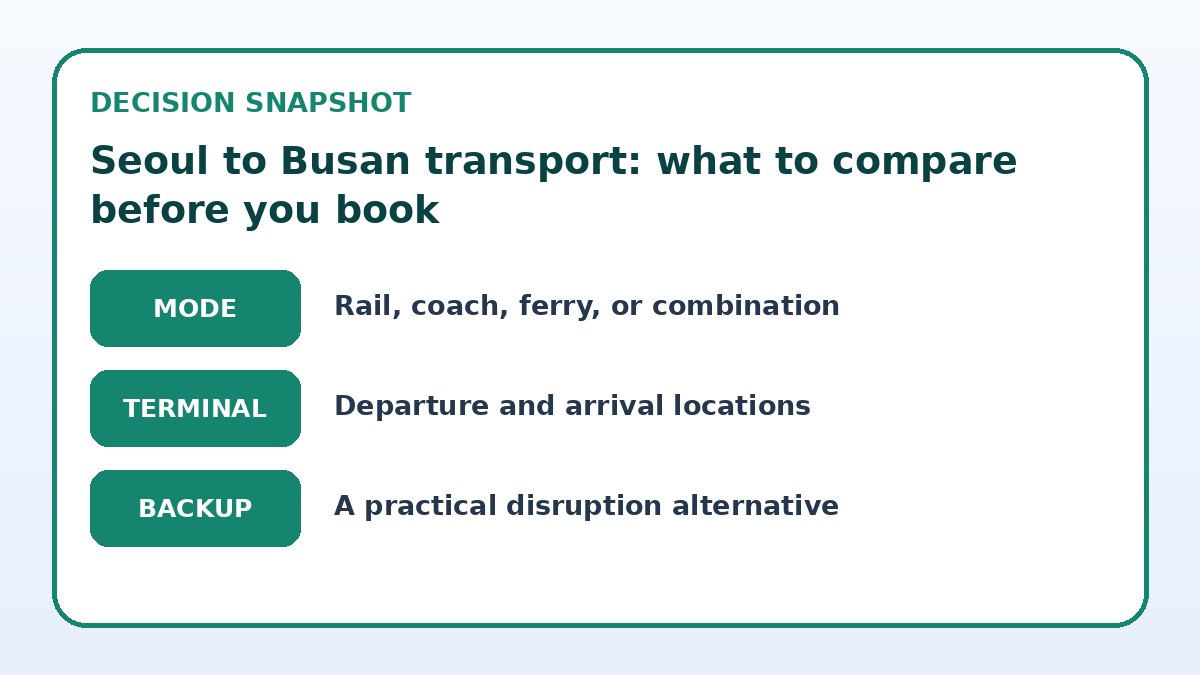
See current options before you compare the details
Availability and final conditions change. Open Trip.com now or keep reading for the practical comparison.
Why high-speed or express rail is usually best for business
High-speed or express rail services typically offer the strongest combination of consistent runtime, frequent departures, and city-center terminals—making them convenient for meetings in either Seoul or Busan. Trains usually provide a reasonably quiet workspace, power outlets in many cabins, and no lengthy security queues. For a single-day round trip, the ability to leave from a central station, work en route, and arrive at a central station reduces total hassle and uncertainty that can impact a tight business schedule.
That said, not every train option is identical. When comparing train services, check seat class, onboard amenities, luggage allowance, and the frequency of departures at the time you need to travel. Verify whether the specific service you’re considering is direct or requires transfers—if a transfer is needed, account for connection time and the risk of missed connections. Always confirm final schedules and seat-type details on the operator’s booking page before selecting seats for a time-sensitive trip.
When flying makes sense—and what to check before booking
Flying can be the right choice when your meeting location is closer to an airport than to the train station, when you need many departure windows, or when a late-night or early-morning flight fits your schedule better than overnight train options. For some itineraries, the airborne segment is short but it can still be useful if the flight times line up with meetings or if ticket flexibility is important for last-minute changes. For multi-city business travel that connects onward by air, staying in the air can simplify logistics.
Before booking a flight, compare door-to-door time rather than airborne time alone: include transit to and from airports, recommended check-in or security time, and the typical reliability of the chosen airports. Confirm the baggage rules for the fare class you select, and look at change or cancellation policies—business trips often need flexible options. When provider-specific facts matter, check the airline’s official booking page for seat pitch, Wi-Fi availability, and exact rules rather than relying solely on third-party summaries.
| Approach | Best for | Tradeoff to check |
|---|---|---|
| Direct high-speed/express train | Reliable downtown-to-downtown travel and productive onboard work | Less useful if your meeting is near an airport or you need many late-night departures |
| Commercial flight | Shortest airborne time and plentiful departure times | Additional airport transfers and security add uncertainty to door-to-door time |
| Private car or hire | Flexible schedules, multi-stop itineraries, and group equipment transport | Exposure to traffic delays and variable parking or toll logistics |
| Long-distance coach | Budget-conscious group travel with direct door-to-door pickup options | Limited onboard workspace and longer journey times than rail or air |
Ready to check the option that fits your plan?
Use your exact dates and traveler details so the provider page can show the current total and conditions.
Driving or coach travel: flexibility versus predictability
Driving or hiring a private car offers unmatched flexibility for multi-stop meetings, carrying equipment, or synchronizing arrival times for teams spread across locations. Road travel allows you to control departure times and to detour if meetings change, which is valuable for larger teams or site visits outside city centers. Coaches and express bus services can be economical for groups and sometimes offer direct routes between terminals, though comfort and onboard working conditions vary widely.
The key tradeoff is predictability: road travel is exposed to traffic, weather, and toll or parking considerations that can disrupt a tight schedule. If you choose to drive or take a coach, plan buffer time into your agenda, identify reliable routes, and have contingency options such as a nearby train or flight you could switch to in case of delays. Always verify the operator’s on-the-day service notices on the booking site and confirm meeting locations relative to pickup and drop-off points.
Before you book
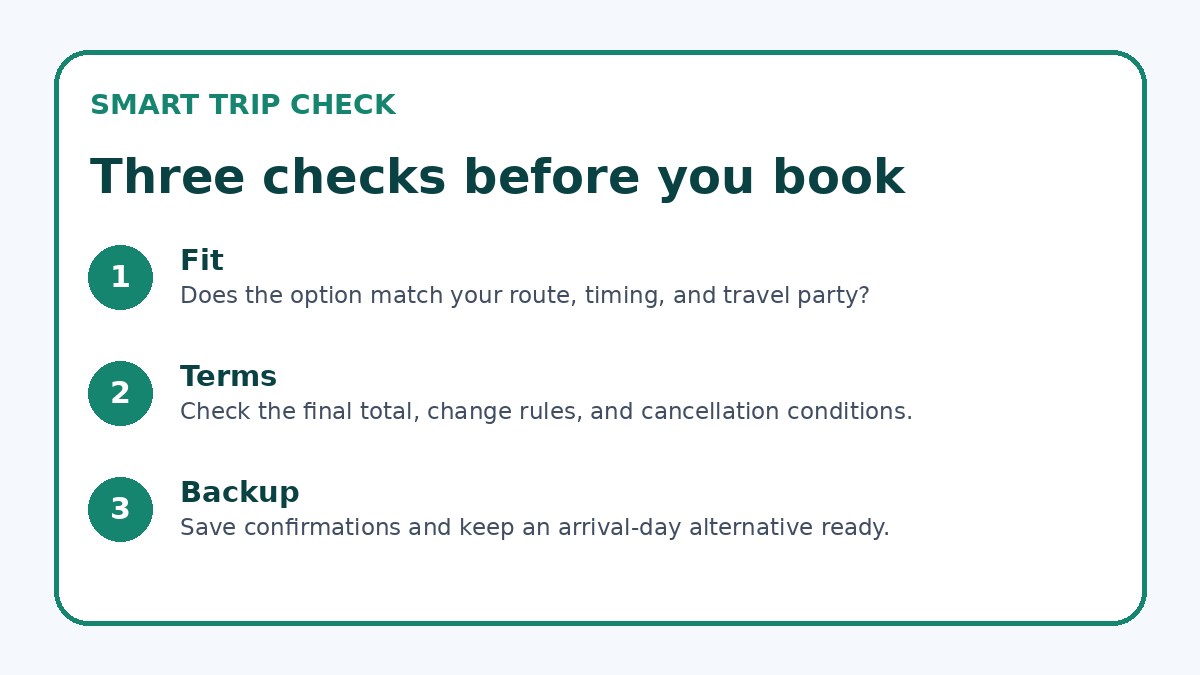
- Compare door-to-door travel times for train, flight, and road options including transfers and security buffers.
- Confirm whether the service is direct or requires a transfer and verify minimum connection times on the carrier page.
- Check seat class amenities, onboard power or Wi-Fi availability, and whether those features are guaranteed for your ticket.
- Review luggage allowances and any size/weight restrictions that could affect business equipment or samples.
- Examine change and cancellation policies for the exact fare class before you finalize payment.
- Identify and save alternative departures or carriers to use if your first-choice service is canceled or delayed.
How to decide quickly: a simple decision framework
Start by ranking your priorities: minimize total door-to-door time, minimize unpredictability, maximize onboard workability, or keep costs predictable. For each option—train, plane, or road—estimate total door-to-door time including transfers and security, then score each option by your priorities. If minimizing disruption is top, prioritize rail or non-peak flights with good on-time records; if flexibility is top, consider driving or a private hire.
Next, check scheduling and policy details on the provider’s booking pages: direct versus connecting service, luggage rules, refundability, and onboard connectivity or power. Use a comparison site like Trip.com to surface current schedules and fares, but always finalize on the carrier’s official page to confirm seat availability, precise restrictions, and any operational notices that could affect a business trip. Build a short contingency plan—what you will do if a train is canceled or a flight is delayed—and share it with coworkers or assistants before travel.
Frequently asked questions
Is the fastest option always the best for a business day trip between Seoul and Busan?
Not necessarily. The fastest airborne time might still come with long airport transfers and security time that erode any speed advantage. For many business day trips, reliability and predictable door-to-door time are more valuable than a slightly shorter airborne or track time. Evaluate the total journey from office to meeting venue, the number and timing of departures, and how comfortable you need to be working en route. If a meeting is downtown, a direct train can often deliver the most consistent result even if a flight has a shorter airborne segment.
How should I factor onboard workability into my choice?
Decide whether uninterrupted focus, laptop power, and stable internet are essential. Trains typically offer more space to spread documents and a steadier environment for calls; certain seat classes have dedicated power outlets. Flights can be workable but are constrained by tray size, seat space, and restrictions during taxi, takeoff, and landing. If you absolutely must conduct video calls, confirm Wi-Fi availability and any device restrictions on the operator’s site. For critical tasks, pick the option that guarantees a quiet space and a power source when booking.
What immediate checks should I make on the booking page before I pay?
On the provider’s official booking page, verify that the specific departure is direct or note any transfers, confirm exact baggage allowances for your fare class, and read change or refund terms. Check seat or cabin class features—power outlets, Wi-Fi, and legroom—because these can vary by service and fare. Look for operational advisories, like maintenance or scheduled changes, and confirm the final arrival/departure terminal or station so you can plan ground transfers accordingly. Use a comparison site such as Trip.com to see options, then validate the final facts with the carrier.
Final planning note
For business travelers between Seoul and Busan, choose the option that best aligns with your top priorities: trains for consistent, productive downtown-to-downtown travel; flights when airport proximity or multiple departure windows matters; and road options when flexibility or group logistics rule. Always evaluate total door-to-door time rather than a single segment, verify directness and seat amenities on the provider’s booking page, and keep alternatives handy in case of delays or disruptions. A short pre-trip contingency plan and confirmation of fare conditions will reduce stress and help you arrive prepared for the meeting ahead.
Continue planning
Check current options and final conditions
Use the provider page to confirm live availability, the final total, cancellation terms, and every condition that matters to your trip.
This evergreen planning guide was created with AI-assisted drafting and a structured quality review. It does not display live prices, schedules, availability, visa guidance, or provider rankings. Verify current details before booking. Some links are affiliate links; we may earn a commission at no additional cost to you.