If you’re traveling from Seoul to Busan with more or larger bags than usual, the most practical answer is to choose a plan that minimizes handling: pick a single through-transport (a train or direct bus) that allows checked baggage in the carriage or book a dedicated luggage transfer/parcels service to meet you in Busan. That keeps you mobile at stations and reduces the risk of missed connections, but it won’t suit everyone. Your choice depends on how many bags you have, whether you need them at arrival immediately, how much lifting you can do, and whether you want to avoid stairs, long station walks, or frequent transfers. Below you’ll find how to compare options, what to verify on booking pages, and a luggage-focused checklist so you can select the fastest, easiest, or cheapest approach for your priorities.
See current options before you compare the details
Availability and final conditions change. Open Trip.com now or keep reading for the practical comparison.
Compare the core transport approaches
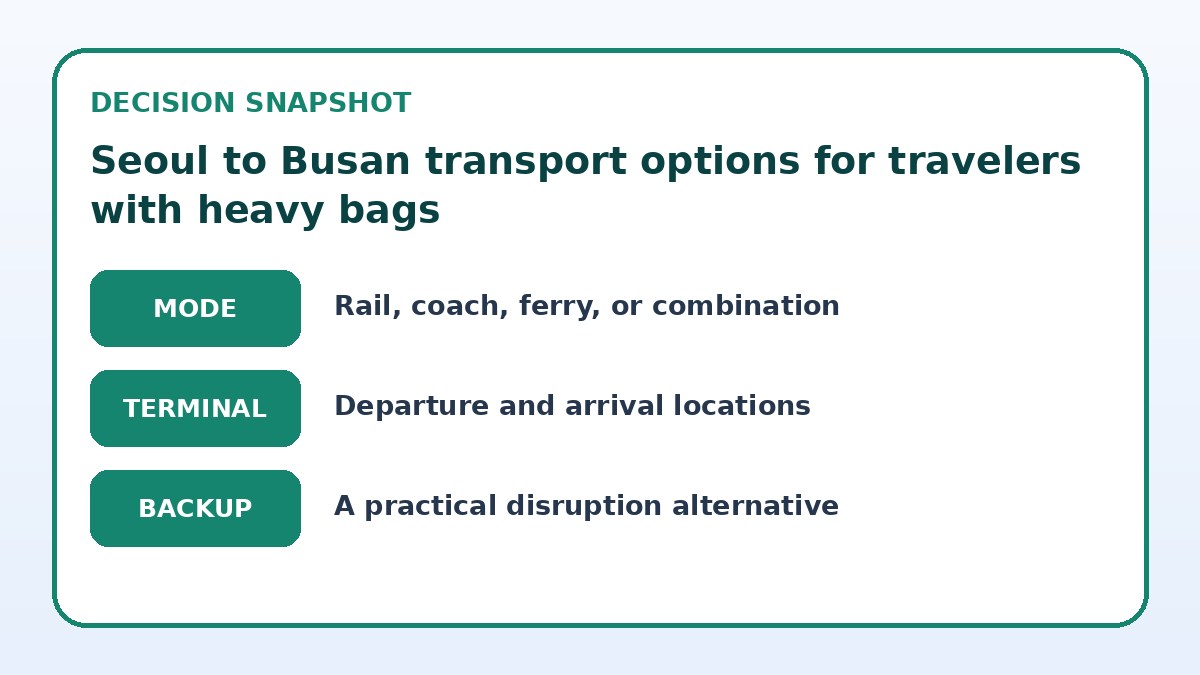
Four practical approaches cover most needs: intercity train, express bus, private car transfer (or rental), and a luggage delivery/parcel service. Trains minimize transfers because you board once and generally disembark at a main station in Busan; buses follow similar logic but stop more often. Car transfers or rentals remove public-transfer constraints but shift responsibility for driving, traffic, and parking to you. Luggage delivery services let you travel light on public transport and pick up bags later, which is useful if you plan activities before checking into accommodation.
Decide by stacking three factors: how heavy and many your bags are, how much walking or stairs you can manage, and whether you need your bags immediately on arrival. If you have mobility limits or children, prioritize door-to-door car or delivery. If you value time on the move and minimal logistical steps, find a direct rail or bus option. For flexible schedules with lots of touring before check-in, parcel services can be ideal—just confirm delivery windows and insurance limits on the provider’s site.
What to check on booking pages and station details
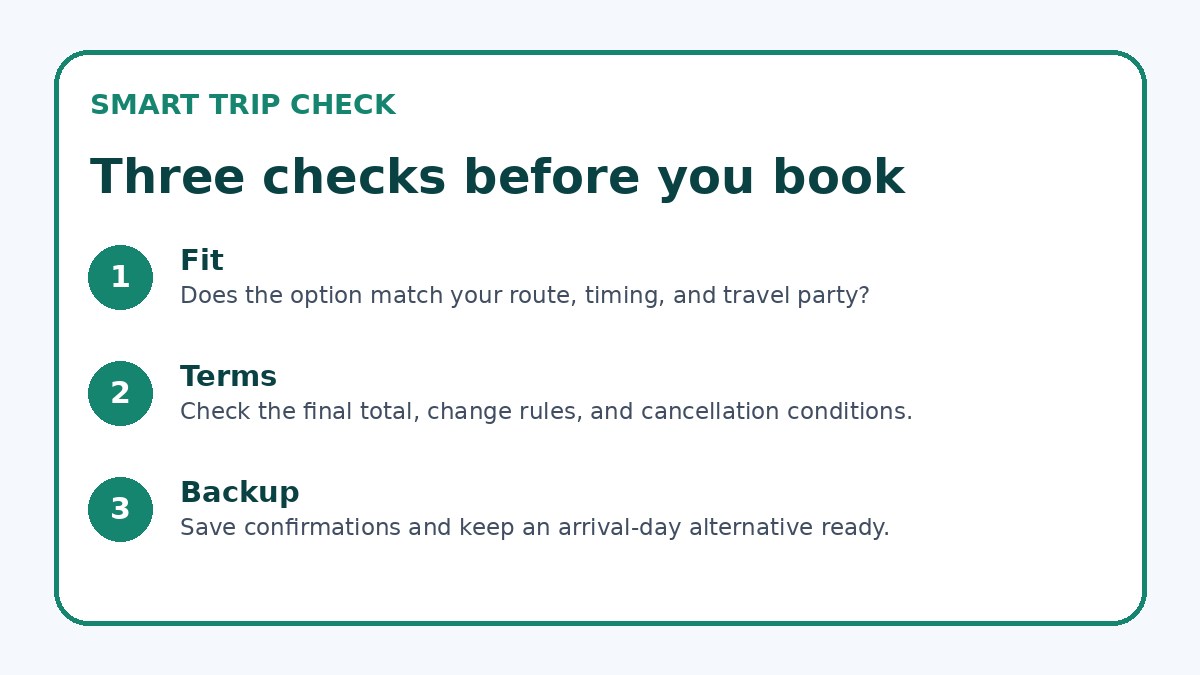
Before you book any service, verify three categories of facts on the provider’s official booking page: explicit baggage allowances and size/weight rules, where and how large items are loaded and collected, and any extra charges or booking add-ons for oversized pieces. Don’t rely on generic statements—look for a section about luggage policies or terms and conditions, and if something is unclear contact the provider’s customer service. Trip.com can be used to compare availability, but always verify baggage details on the operator’s final booking page before paying.
Also confirm station access and platform arrangements so you know how much carrying or stair-climbing to expect. Large railway stations often have elevators and luggage ramps but sometimes require long walks between concourses or to taxi ranks. For buses, check where the luggage compartment is opened and whether drivers help with loading. For private cars, confirm curbside pickup and whether the driver will meet you inside a station concourse or at an external pickup point.
| Approach | Best for | Tradeoff to check |
|---|---|---|
| Through train with checked space | Travelers who want minimal transfers and steady travel with several bags | Must confirm size/weight rules and may need to load yourself at busy platforms |
| Express bus with under-trunk storage | Those who prefer point-to-point road routes and central bus terminals | More stops and potential delays; trunk handling rules vary by operator |
| Private car transfer or rental | Groups, mobility-restricted travelers, or large awkward items | Higher cost and subject to road traffic and parking logistics |
| Luggage delivery/parcel meet-up | Sightseeing before check-in or travelers who want to avoid carrying bags | Requires precise pickup/delivery windows and trust in provider liability terms |
Ready to check the option that fits your plan?
Use your exact dates and traveler details so the provider page can show the current total and conditions.
Tradeoffs: speed, cost, and handling effort
Speed and simplicity often conflict with cost and control. A fast through-train or express bus with guaranteed onboard luggage is efficient and usually quicker than a multi-leg journey, but you may be constrained by published baggage rules. Private transfers offer the least handling and most convenience for bulky loads but can be pricier and subject to traffic delays. Luggage delivery removes lifting entirely but introduces lead time: parcels may be picked up earlier or delivered later than you want, so plan meeting windows carefully.
Consider risk tolerance too. Carrying your own bags keeps them with you but increases fatigue and raises the chance of missed connections if you’re slowed down. Handing bags to a delivery service shifts loss/damage risk to the provider—verify their liability terms and keep records of tracking numbers and receipts. Whatever option you pick, weigh the convenience of immediate access versus the reduced strain of being bag-free during transit.
Before you book
- Check the operator’s official baggage policy page for size, weight, and extra-fee details before booking.
- Measure and weigh each bag; note any item that might be classified as oversized or irregularly shaped.
- Reserve a direct service when possible or arrange a scheduled private pickup to avoid multiple transfers with heavy bags.
- Keep a compact carry-on with essentials and documents separated from larger checked items for quick access.
- Photograph bags and contents before handing them to a delivery service; keep tracking numbers and receipts easily accessible.
- Allow extra time at Seoul stations for elevators, ticket gates, and transfers—pad your schedule to avoid rushed lifts or missed connections.
Practical tips for packing and station movement
Distribute weight strategically: put fragile or vital items (documents, medication, electronics) in an easy-access carry-on you keep with you, and place bulky heavy items low in wheeled suitcases. Use straps or compression bags to keep loose items from shifting—this makes lifting and stacking much safer. If you must manage multiple bags, bring a lightweight rolling trolley or use suitcases with strong wheels and a firm handle, because dragging soft bags across station floors is more exhausting and risks wear.
At stations, give yourself extra time to move between platforms and to a taxi or pick-up point—large stations can require 10–30 minutes to navigate with luggage, depending on elevator availability and crowds. If you need assistance, ask station staff as soon as you arrive; many stations offer porter or luggage-storage options, but availability and terms change, so confirm and pay attention to pickup deadlines. Keep documentation handy: booking confirmations, sender/receiver numbers for any parcel service, and a local contact number for your accommodation.
Frequently asked questions
Can I bring oversized sports equipment or instruments from Seoul to Busan?
Most transport options permit large items but handle them differently. Trains may accept oversized pieces if stowed in designated areas or as checked luggage—confirm size and booking procedures on the carrier’s policy page. Buses often store large items in under-trunk compartments and drivers may assist loading, but trunk height and restrictions vary. Private cars are usually the easiest for bulky items but require measurement so the operator can assign the right vehicle. Luggage delivery services can transport irregular items but will list prohibited items and packing standards—always check liability limits and packing requirements on the service’s site.
Is it safer to send my bags ahead with a delivery service rather than carrying them on the train?
Safety comes down to tradeoffs. Sending bags ahead reduces the chance of dropping or losing items while you move between platforms and eliminates the physical strain of carrying them. However, it introduces dependence on a third party: verify tracking, pickup/delivery windows, and insurance or declared-value coverage before handing over possessions. If items are irreplaceable, keep them in a carry-on you control. For lower-risk, nonessential baggage, parcel services can be a convenient option—confirm the provider’s claims on their booking page and keep all receipts and tracking information.
How can I make station transfers easier with a lot of luggage?
Plan your route through the station in advance by checking maps and where platforms, elevators, and taxi ranks are located; many station websites publish layouts you can review. Book tickets for services that depart from main concourse platforms to minimize walking across multiple levels. Use wheeled suitcases and luggage trolleys designed for stair-to-elevator transitions; secure multiple bags together with straps to create one manageable unit. If mobility is an issue, ask station staff about porter services or priority boarding options and verify availability directly with the station office before travel.
Final planning note
Traveling from Seoul to Busan with extra luggage is a solvable logistics challenge once you know your priorities: minimize handling, guarantee timely delivery, or reduce cost. Choose trains or express buses for simple boarding with limited transfers; pick private car transfers when you need door-to-door service; use luggage delivery to be bag-free during sightseeing. Always verify baggage allowances, loading procedures, pickup/delivery windows, and liability terms on the provider’s official booking or station pages before finalizing. Prepare your bags and paperwork, allow extra station time, and keep a small carry-on with essentials so the journey stays as smooth as possible.
Continue planning
Check current options and final conditions
Use the provider page to confirm live availability, the final total, cancellation terms, and every condition that matters to your trip.
This evergreen planning guide was created with AI-assisted drafting and a structured quality review. It does not display live prices, schedules, availability, visa guidance, or provider rankings. Verify current details before booking. Some links are affiliate links; we may earn a commission at no additional cost to you.