For most families traveling from Seoul to Busan, the practical tradeoff to weigh is route convenience versus fare and connection risk. If you prioritize minimizing transit time in the city and a straightforward departure for domestic flights, the closer Seoul airport is usually the convenient choice; if you need an international connection, specific carrier schedules, or different baggage rules, the farther international airport can sometimes make sense despite the extra city transfer. The right pick depends on your party’s age range, stroller or car-seat needs, number of checked bags, and how tight your onward connections are. Start by confirming exact travel dates, the ages and mobility of all travelers, and whether you need to check bulky items. With those details in hand, you can compare fares, transfer options, and baggage allowances on airline pages or comparison tools like Trip.com before finalizing a booking.

See live routes for your exact travel day
Compare direct and connecting choices with the same baggage and traveler details.
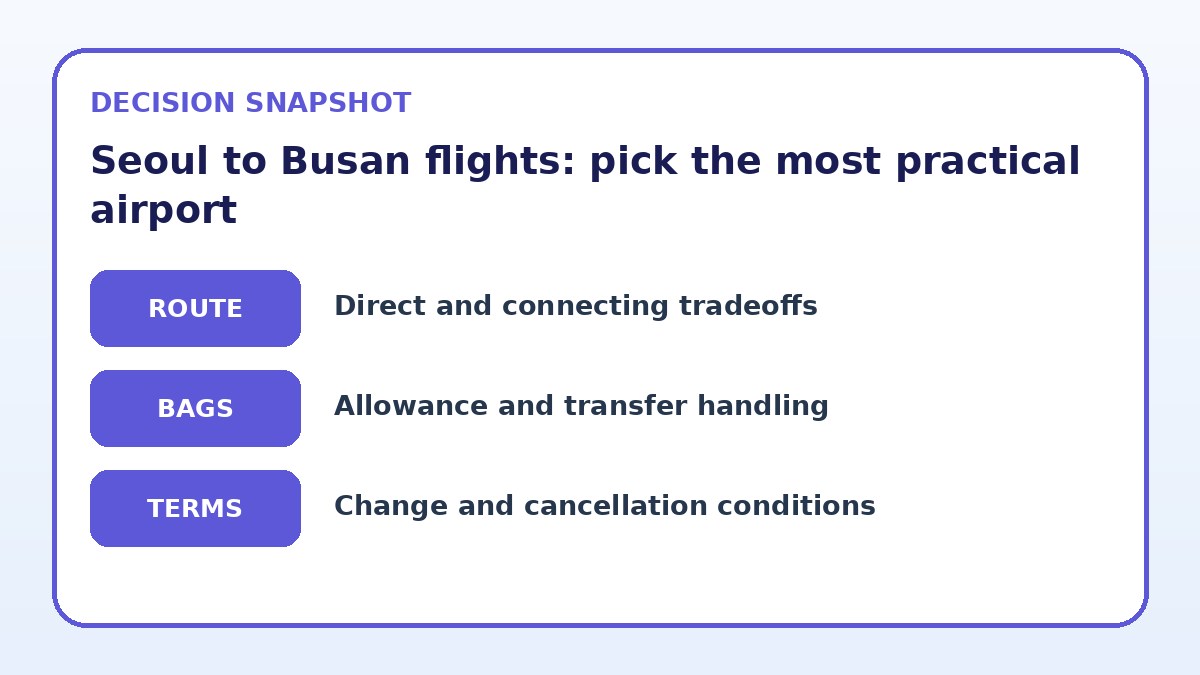
Routing: city transfer and door-to-gate time
Families should begin by mapping door-to-gate time from where they’re staying in Seoul. A shorter city transfer reduces stress: less time in traffic, fewer changed buses or trains, and an easier arrival window for children who need naps or predictable meals. Consider typical peak travel windows like morning commutes when deciding whether the slightly farther airport adds unpredictable delay. If you plan to travel with small children, strollers, or car seats, factor in the extra time needed to dismantle, check, and reassemble gear when calculating your effective travel time.
Also check how you’ll get to the airport with your luggage and kids — private transfer, taxi, airport bus, or metro — and whether those options allow you to board with small children comfortably. If the airport requires a longer transfer using public transport with stairs, multiple changes, or a crowded commute, that can negate a lower fare. When comparing routing options, list actual travel times and transfer modes for your exact departure address so you can compare total door-to-gate time rather than just scheduled flight time.
Baggage and connection risk for families
Families often travel with more bags and baby equipment than solo travelers; baggage rules and checked-item convenience matter. Verify the baggage allowance and fees for each fare class directly on the airline’s booking page before you commit. If you need to check a stroller or car seat, check whether the carrier treats those items as free checked items or needs a special label or protection. Also confirm how checked baggage is handled if you arrive internationally before an onward domestic leg — will you need to reclaim and re-check bags, or will the carrier transfer them?
Connection risk extends beyond flight-to-flight transfers. If your itinerary mixes international and domestic segments through different airports, account for immigration, customs, and re‑checking items, which can add significant time and stress when traveling with children. Ask the airline or check official airport guidance about recommended minimum connection times when children are traveling — and consider adding at least an extra 30–60 minutes cushion to whatever the airline states if you have young children, mobility needs, or lots of bags.
Compare flight-selection strategies
| Flight strategy | Best for | Risk to check |
|---|---|---|
| Choose the nearer domestic airport for departure | Families wanting shorter transfers and simpler check-in with children and bulky items | May have fewer or different fare classes and limited international connection options |
| Use the larger international airport | Families connecting from international flights or needing a specific carrier’s schedule | Longer city transfer and more variables like immigration and baggage reclaim to manage |
| Book based on the lowest fare regardless of airport | Budget-conscious families prepared to absorb extra transfer time and hassle | Potentially higher stress, more transfers, and added unseen costs for baggage or seats |
| Prioritize flexible fares and change policies | Families who value the ability to change plans without large penalties | Usually higher upfront cost but reduces risk of expensive last-minute adjustments |
Recheck the complete itinerary
Confirm airports, connection handling, baggage, and change conditions before deciding.
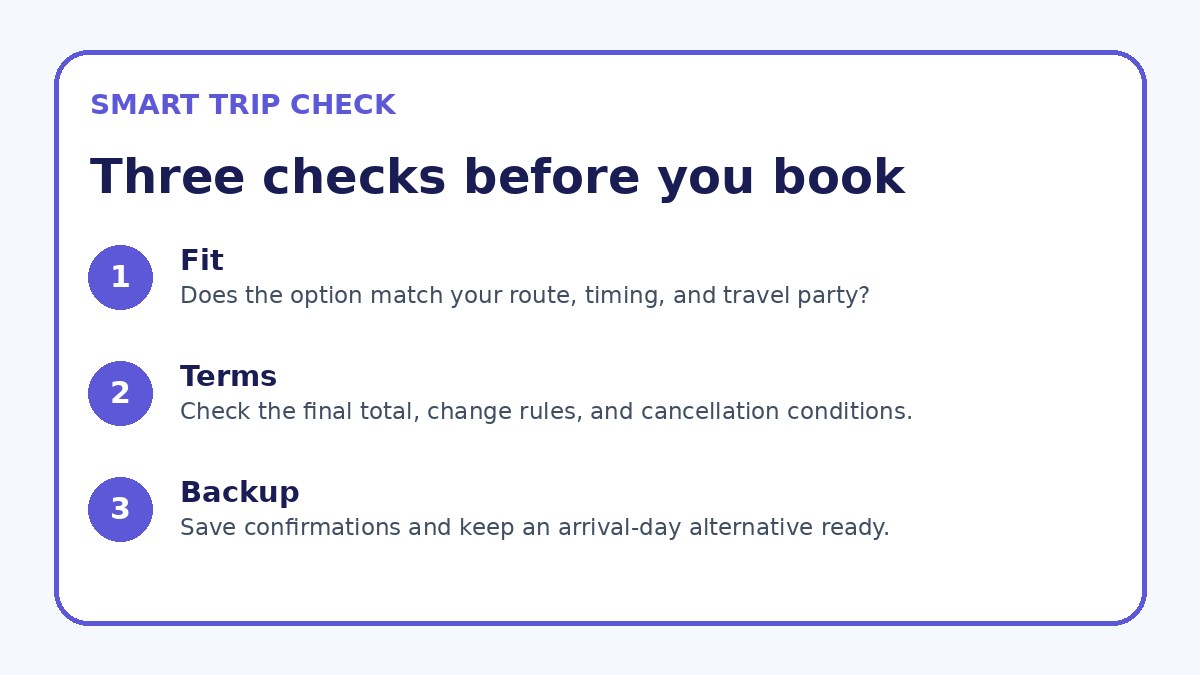
Schedule fit: departure times and family routines
Beyond raw duration, match flight times to your family’s routine. Early-morning flights might avoid traffic and crowds, but they require earlier wake-up and hotel departure; late-evening flights can mean a tired child and missed dinner routines. Look for departure times that align with natural nap windows or overnight sleep when possible, reducing the likelihood of meltdowns in transit. Also check the frequency of flights on your chosen route across a realistic window of dates — more frequent service means better backup options if one flight is delayed or if you need to rebook.
For families sensitive to timing, consider buffer nights in both origin and destination when schedules look tight around holidays or known busy travel periods. If you need a reliable, same-day city transfer after an international arrival, verify the earliest realistic arrival at your door given immigration and baggage reclaim. Remember to check airline cancellation and change policies before booking: flexible options can be worth a small fare premium when traveling with children who might fall ill or when schedules are uncertain.
Flight details to verify
- Confirm exact travel dates, passenger names, ages, and whether anyone requires a special assistance service before searching fares.
- List all carry-on and checked items including strollers and car seats, then verify each carrier’s baggage rules on its booking page.
- Map door-to-gate travel time for each Seoul airport from your accommodation for the planned departure time and transit mode.
- Check the airline’s published minimum connection time and add at least 30–60 minutes extra for families when connecting between airports.
- Compare seat selection fees, priority boarding, and family-lane availability on the airline’s final booking page before you purchase.
- If you need to compare live availability for multiple airports, use a comparison tool such as Trip.com then confirm all rules on the carrier’s website.
Fare conditions and what to verify before booking
Fare differences matter less for families when added costs and convenience are considered. A slightly higher fare from the nearer airport can save time and stress and may include more generous baggage or seat selection that you’d otherwise purchase separately. Before you pay, read the fare rules on the airline’s final booking page: confirm whether seats can be reserved in advance without a fee, what penalties apply for date changes, and whether taxes and airport charges are included. For connecting itineraries, check whether the fare covers through-checked baggage and missed-connection protection.
When comparing offers, prepare exact travel dates, passenger names, ages, and a list of any special equipment you need to transport. Use those specifics when searching so results reflect baggage fees, infant fares, or child discounts properly. If you’re comparing across different airports, verify the refund and rebooking terms for each option and any family-friendly add-ons such as priority boarding or family lanes. Finally, confirm baggage size and car-seat policy directly with the airline’s final booking details and, if using a comparison tool, click through to the carrier to verify live conditions — Trip.com can be used once to compare availability, but always confirm on the provider’s page.
Flight Guide questions travelers ask
Is one Seoul airport always better for families flying to Busan?
No single airport is always best. The closer domestic airport typically wins for families who want the fastest city transfer and simpler logistics with strollers and checked gear. However, if you’re arriving internationally into the larger airport, need a specific carrier, or the only acceptable flights depart from that airport, the longer transfer may be worthwhile. Compare total door-to-gate time, baggage handling, and fare conditions for your exact itinerary before deciding.
How should I handle strollers and car seats when flying with young children?
Treat strollers and car seats as part of your baggage plan. Before booking, verify whether the carrier allows them as free checked items, requires special packaging, or has dimensions and weight limits. If you have a connecting international-to-domestic itinerary, ask the airline if the items will be through-checked or must be reclaimed and re-checked. Always check the carrier’s final booking page for specific handling instructions and whether priority baggage pick-up is available for families.
What if I find a much cheaper flight from the farther airport — should I still take it?
Weigh the savings against added time, stress, and possible extra costs. A cheaper fare can be a good choice if your family tolerates longer transfers, you have lightweight luggage, and you’ve confirmed baggage fees and seat availability. But factor in taxi or transfer fees, potential overnight layovers, and how the travel time affects children’s routines. Calculate total travel time, out-of-pocket transfer costs, and the likelihood of delays before choosing the cheaper option.
Final decision note
For families traveling Seoul to Busan, practicality usually comes down to total door-to-gate time and the baggage and connection risks you’re willing to accept. The nearer domestic airport typically reduces city transfer time and simplifies family logistics, while the international airport makes sense when you need specific connections or carrier schedules. Before you book, gather exact travel dates, traveler ages, and a list of all baggage and equipment, then compare fares, baggage rules, and minimum connection guidance on the airline’s final booking page. Using those specifics will let you make a booking tradeoff that saves time, reduces stress, and suits your family’s routine.
Continue planning
Check current options and final conditions
Use the provider page to confirm live availability, the final total, cancellation terms, and every condition that matters to your trip.
This evergreen planning guide was created with AI-assisted drafting and a structured quality review. It does not display live prices, schedules, availability, visa guidance, or provider rankings. Verify current details before booking. Some links are affiliate links; we may earn a commission at no additional cost to you.