If your trip to Auckland is driven by meetings, conferences, or client dinners, decide first whether you need walkable proximity to the Central Business District (CBD) or an easier commute from a quieter neighborhood. For single-day, tightly scheduled trips the time saved by staying near the CBD often outweighs slightly smaller rooms and higher rates. For multi-day work that needs rest, long online calls, or colleagues joining, a larger room with a dedicated workspace and soundproofing becomes more valuable even if it adds 15–30 minutes of transit. This guide helps you choose an area, estimate daily-route friction, match room features to party needs, and identify the booking terms to confirm before you pay. Use the decision checklist to shortlist one or two neighborhoods so you can compare live inventory efficiently on your preferred booking site, including Trip.com if you want a quick cross-check.
Check live stays in the areas that fit
Use your dates and party size to compare current rooms after you narrow the neighborhood fit.
Neighborhood fit: match area to meeting locations
Start by mapping where your appointments, conference venues, and client offices are located. If most engagements cluster in the CBD, Viaduct Harbour or Britomart, staying within a 10–15 minute walk will cut the unpredictability of taxi waits and peak-hour traffic. Conversely, if your schedule includes suburban client sites in East Auckland, South Auckland, or the airport area, staying near a motorway corridor or major train station will reduce commute complexity. The goal is to trade hotel convenience against predictable travel time.
Think about evening plans and safety after dark. If dinners or client entertainment are likely, staying where restaurants and bars are dense makes logistics simpler and keeps last-mile travel short. For early-morning or late-night flights, hotels near the airport or on direct public-transport routes reduce stress. Choose an area that fits the timing of your typical day—tight daytime schedules favor centrality, while late work hours favor quieter, nearby neighborhoods.
Choose an area-selection strategy
| Area approach | Best for | Tradeoff to check |
|---|---|---|
| Stay in the CBD near major offices | Back-to-back meetings and minimal transit time | Smaller rooms, higher nightly rates, and busier streets in the evenings |
| Base near transport hubs (Britomart/Newmarket) | Access to multiple parts of the city with fewer transfers | May still require short public transport rides to some suburban offices |
| Choose quieter residential neighborhoods | Restful nights and larger rooms for working comfortably | Longer commutes to central meetings and less evening dining variety nearby |
| Airport-area hotels | Early flights and business that includes airport meetings | Far from city-center client meetings and limited city dining options |
Daily-route friction: time, transfer points, and reliability
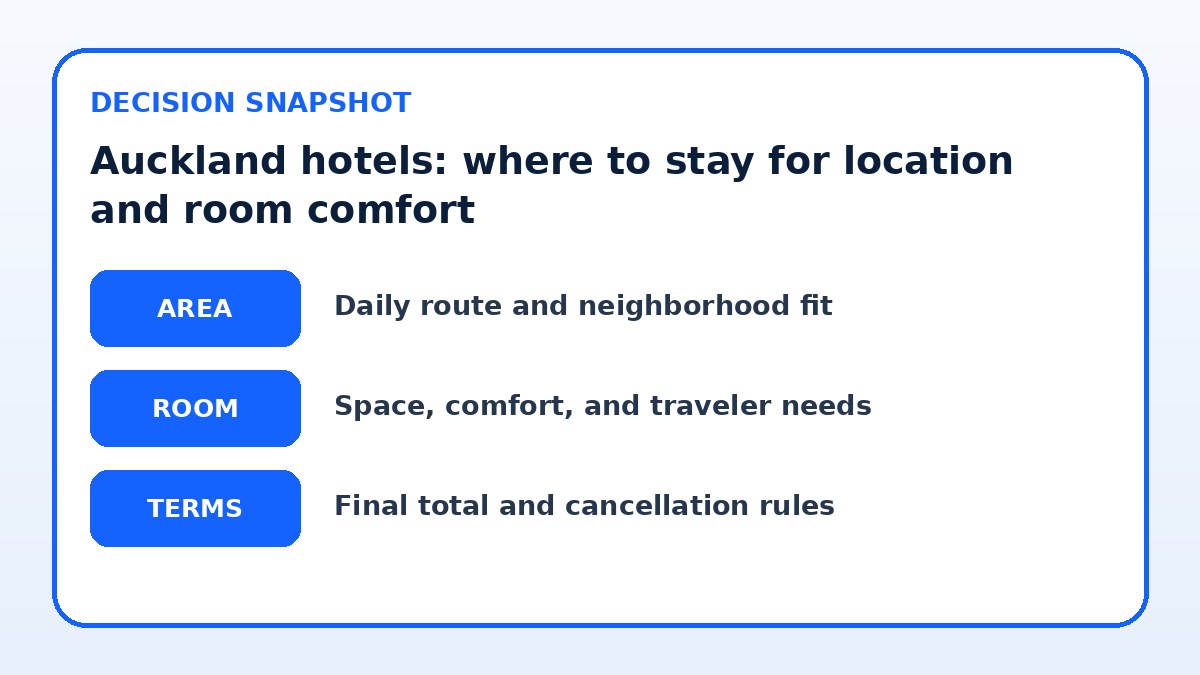
Estimate door-to-door travel time rather than point-to-point distance. Include walks to transit, waiting and transfer times, and buffer for Auckland rush-hour traffic. A hotel two kilometers from a meeting can be faster than one five kilometers away if the first has a direct bus or ferry link. Prioritize routes with fewer transfers and more frequent service, or hotels near reliable ride-hailing pickup spots to keep margins predictable when meetings overrun.
Also consider variability: ferries can be scenic and punctual but are subject to weather or scheduled windows; trains offer consistency on their lines but may not serve every suburb directly. If a large share of your time will be spent moving between disparate parts of the city, staying near a major interchange such as Britomart or Newmarket can save cumulative time. Confirm the current timetables and any planned engineering works on the provider’s page before you book.
Now compare like with like
Keep the same dates, guests, room needs, and cancellation preferences while you compare the final choices.
Room and party needs: what to prioritize inside the hotel
Decide whether you need a larger private room or a compact, well-located base. For solitary business trips with short stays, a small, well-managed room with strong Wi-Fi and a comfortable bed may be enough. But if you require all-day video calls, presentations, or have a colleague staying with you, prioritize rooms with a dedicated work area, soundproofing, blackout curtains, and flexible layout. Suites or executive rooms can be worth the extra for internal meetings and privacy.
Ask about in-room tech before booking: wired Ethernet, universal power outlets, and reliable mobile signal are often more important than floor area for productivity. Also consider hotel facilities that extend usable workspace—quiet lounges, business centers that allow private calls, and meeting rooms you can reserve for an hour. Verify these amenities on the hotel’s booking page and check cancellation and modification terms in case schedule changes force a date shuffle.

Hotel booking check before payment
- Map all meeting and event locations and mark a 15-minute walk radius around each to find hotels within easy reach.
- Confirm room features: dedicated desk, good lighting, available Ethernet port, and soundproofing on the hotel’s official page.
- Check public transport options and typical door-to-door travel times for your meeting hours using local transit sites.
- Review cancellation and modification terms to ensure flexibility if meeting dates or times change.
- Ask the hotel about business services (meeting rooms, printing, AV) and reserve them in writing if needed.
- Compare at least two neighborhoods and shortlist one backup hotel in case your first choice lacks the required room type.
Final booking terms: what to check before you confirm
Before clicking confirm, review cancellation policy, check-in/out times, and whether the hotel offers flexible rebooking. Business travel plans change; a room that permits free cancellation up to 24–48 hours before arrival reduces risk. Also confirm whether breakfast, parking, or airport shuttle services are included or extra, and make sure any promised business amenities (meeting rooms, printing, screen cables) are available and potentially bookable in advance.
When the hotel lists transport options, verify them on the provider’s live page and on local transit sites. If parking, early check-in, or late checkout matters, book these add-ons in writing. Finally, read recent guest comments for patterns—consistent praise or complaints about noise, Wi-Fi, or shuttle reliability are often more informative than single reviews. Trip.com can be used to compare current availability and booking conditions, but always confirm the final terms on the hotel’s own booking page.
Hotel Guide questions travelers ask
Should I prioritize a central Auckland location or a larger room when attending a short conference?
For short conferences with a dense schedule, prioritize a central location to reduce transit time and risk of late arrivals. Being within walking distance of the venue or close to direct transit removes uncertainty when sessions run over. If conference days are light and you plan long calls or private debriefs in the evening, consider upgrading to a larger room or booking a hotel with quiet business lounges. Always check the venue’s exact address and local transit options on current provider pages before finalizing.
How can I ensure good Wi-Fi and a reliable workspace in an Auckland hotel?
Look for explicit mentions of business-grade Wi-Fi, wired internet access, and private workspaces when checking hotel details. Contact the hotel directly to confirm bandwidth expectations for video calls and whether Ethernet is available in-room. If uninterrupted calls are critical, pick a room on higher floors away from busy streets and request a quiet location. Consider booking a room that allows access to a private business lounge or reservable meeting room as a backup for important calls.
Is staying near Auckland Airport a good option for business trips with city meetings?
Staying at the airport can be sensible if you have early flights or meetings at airport terminals, but it often increases commute time to CBD meetings. Factor in motorway congestion and the need for last-mile transit from an airport hotel to city offices. If you choose this option, confirm typical taxi or shuttle times during your meeting hours and whether the hotel offers direct airport transfers. For multiple central meetings, a city or transport-hub base usually saves time overall.
Final decision note
Balancing location and room comfort for business travel in Auckland comes down to mapping your schedule and choosing the most reliable daily route. If your day is packed with central meetings, prioritize proximity to cut transit risk. If rest, long calls, or hosting colleagues matter, prioritize room features and quieter neighborhoods even when commutes lengthen slightly. Use the checklist to shortlist a central and a backup neighborhood, verify transport links and room amenities on the hotel’s live booking page, and confirm cancellation flexibility. That approach leaves you able to compare live inventory quickly and pick the hotel that supports your most critical work priorities.
Continue planning
Check current options and final conditions
Use the provider page to confirm live availability, the final total, cancellation terms, and every condition that matters to your trip.
This evergreen planning guide was created with AI-assisted drafting and a structured quality review. It does not display live prices, schedules, availability, visa guidance, or provider rankings. Verify current details before booking. Some links are affiliate links; we may earn a commission at no additional cost to you.