
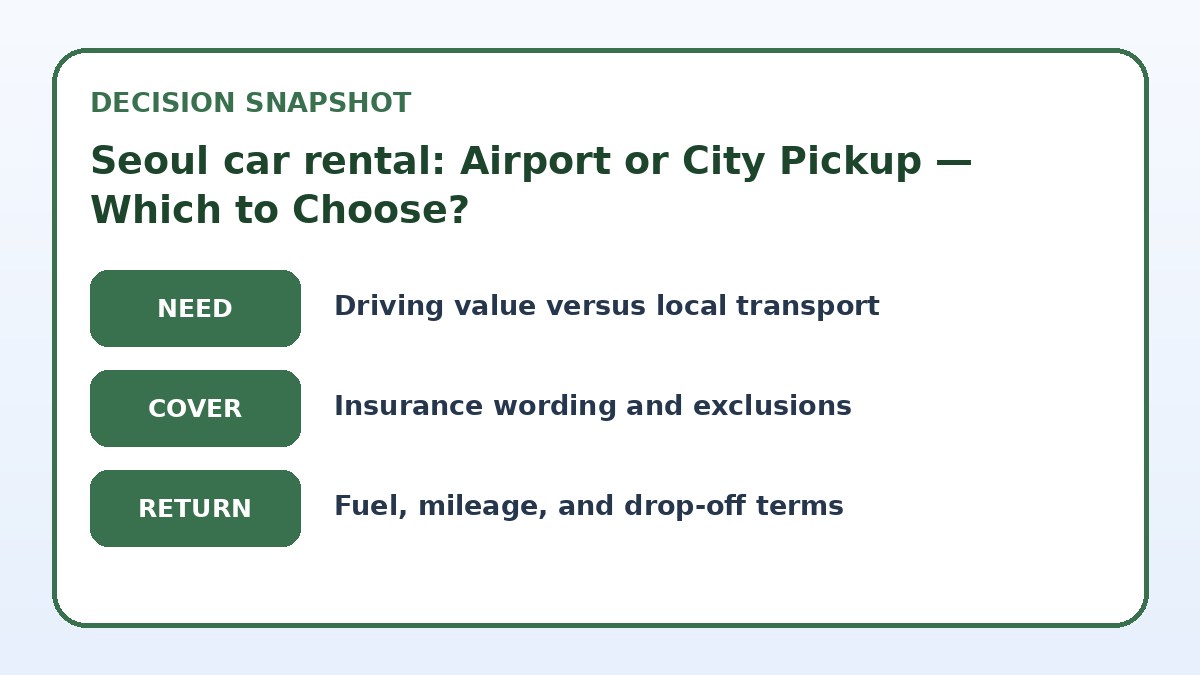
If you’re traveling to Seoul with extra luggage, the quickest practical answer is this: choose airport pickup when you want immediate access to a car and fewer transfers with heavy bags; choose city pickup when you prefer a wider vehicle selection or lower downtown parking and rental constraints. Both choices can suit travelers with bulky or multiple suitcases depending on your priorities: minimizing transfers, luggage handling, parking near your accommodation, or flexible drop-off points. This article walks through the tradeoffs you’ll face—time, physical effort, vehicle options, and local navigation—plus the specific booking checks to make before you commit. Read the decision checklist and comparison rows to match the option to your itinerary and mobility needs.
See current options before you compare the details
Availability and final conditions change. Open Trip.com now or keep reading for the practical comparison.
What ‘extra luggage’ means for your Seoul car rental decision
Extra luggage changes the usual calculus. Beyond simple trunk volume, consider the number of pieces, their shapes, and whether you have items that are heavy, fragile, or awkward to lift. If you have oversized sports gear, instruments, or several large suitcases, ask whether the rental’s stated car class fits those dimensions—images and model examples on the provider page are useful, but confirm at booking. Think about how many people will carry bags and the physical layout of arrival points: airport curbside, shuttle buses, or city walkways can affect how easily you move luggage from transport to car.
Also factor in connections: if you arrive to Seoul by multi-leg flights, have a long transfer, or bring checked items you’ll collect after immigration, airport pickup can save extra handling. Conversely, if you plan to drop bags at a central hotel before collecting a larger rental, city pickup can reduce the need to manoeuvre luggage through terminals. Consider how accessible your accommodation is for temporary luggage drop-offs and whether the local hotel will assist with transfers; verifying their policies ahead of time avoids surprise labor or time costs.
Practical pros and cons of Seoul airport pickup
Airport pickup’s clearest benefit is immediate mobility: you leave the terminal and drive straight to your next stop, keeping luggage handling contained to few moves. This is especially helpful if your arrival time is aligned with normal counter hours or if public transport options would require transferring heavy bags across stations. However, airports can be busy, with pickup zones, shuttle procedures, or remote lots that take time to navigate. Read the rental’s instructions for where exactly to meet the agent and whether there’s an on-site desk, off-airport shuttle, or third-party meet point.
Another consideration is vehicle availability and fleet distribution. Some companies stage their larger vehicles at airport locations for travelers who commonly need more cargo space, but that varies by provider and season. If you need a specific model, trim, or equipment like roof racks or child seats, check the booking page to confirm availability at the airport location rather than assuming all branches have identical inventory. Also verify return instructions and whether you must refill fuel or pay for refueling service at the airport.
| Approach | Best for | Tradeoff to check |
|---|---|---|
| Airport pickup | Travelers who want to leave the terminal with luggage and minimize transfers | May involve airport traffic and specific terminal meet-up procedures |
| City pickup | Those staying downtown who prefer more vehicle options and local parking alignment | Requires moving luggage to the branch and may need elevator or porter access |
| Hybrid approach (short-term storage + city pickup) | Travelers dropping luggage at a central hotel then getting a larger rental | Adds an extra stop and depends on hotel willingness to hold bags |
| Airport pickup with later city return | Itineraries that begin at the airport but end in the city for convenience | May incur one-way fees and requires confirming city drop-off availability |
Ready to check the option that fits your plan?
Use your exact dates and traveler details so the provider page can show the current total and conditions.
Practical pros and cons of Seoul city pickup
City pickup can be a good choice if you want to avoid airport congestion, prefer a broader selection of vehicles, or plan to base yourself in a central neighborhood before driving out. Downtown branches sometimes keep a wider mix of compact cars and specialty vehicles better suited to narrow streets or long-term city parking. If you’re staying in Seoul’s central districts, a city pickup can save on short-term airport parking and might align better with local parking permits and garage access—confirm whether the rental firm allows returns at a different city branch if you don’t plan a round trip.
Expect different logistics when collecting in town: you may need to carry luggage from your hotel, a subway station, or a drop-off point to the rental office. That matters if sidewalks are crowded, elevators are limited, or you have to transfer between buses and trains. Check the branch’s exact address, nearby public-transport stops, and whether the office provides luggage assistance, elevator access, or curbside loading. If you plan to pick up late at night, confirm the branch’s operating hours and any after-hours pickup procedures before you book.
Before you book
- Measure your bags and compare to the rental’s listed trunk capacity or request a specific vehicle example before booking.
- Confirm exact pickup point details (terminal number, counter name, shuttle process or meet point) on the provider’s final booking page.
- Verify branch hours and after-hours pickup or drop-off procedures if arriving late or leaving early.
- Ask whether the chosen location stocks the vehicle class and any special equipment (roof box, child seat) you require.
- Check the rental’s policy on tolls, refueling, insurance coverage, and one-way drop-off fees on the confirmation page.
- Plan your route from arrival spot to pickup office, accounting for elevators, stairs, and curb access for heavy luggage.
How to compare and what to verify before booking
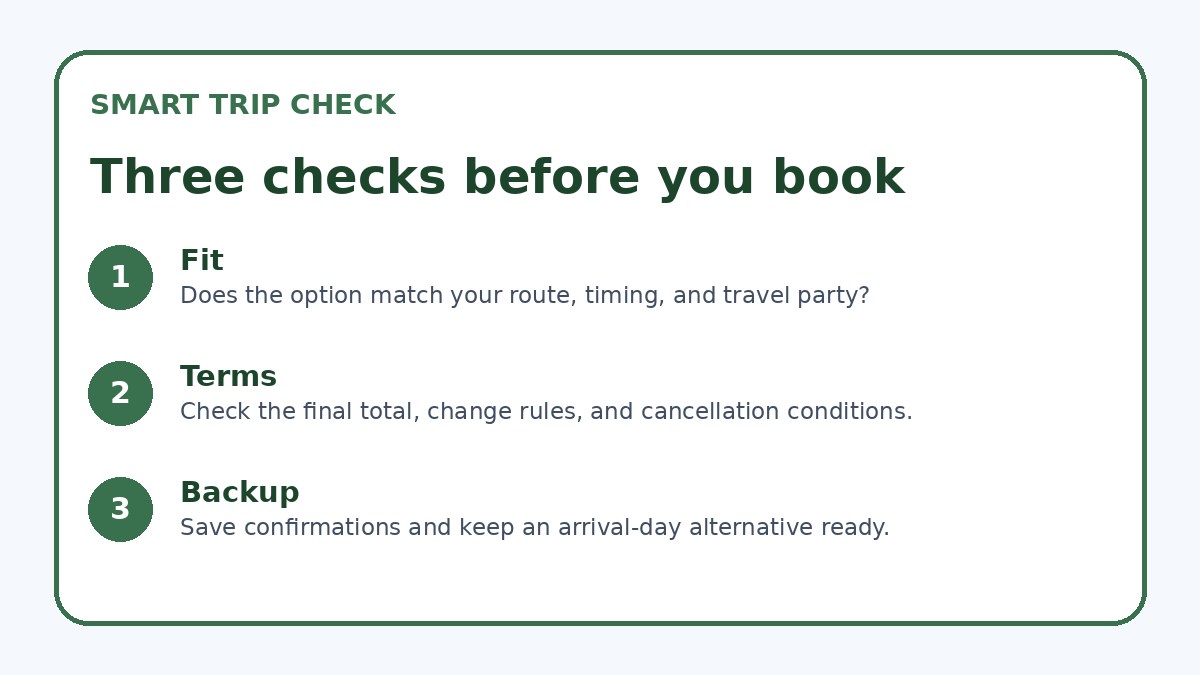
Start by listing your non-negotiables: required cargo volume, number of passengers, mobility constraints, and your arrival pattern. Use those to filter car classes; when a provider’s booking page lists trunk volume or seat layout, compare those specs to your luggage by measuring and estimating how the items will stack. Where provider-specific facts matter—like pickup desk location, shuttle times, required ID, payment policy, or fees—check the final booking confirmation or the rental company’s official terms. If you’re using a comparison site such as Trip.com to view availability, treat its listings as a snapshot and verify the supplier page for operational details and exact pickup instructions.
Also compare soft factors: convenience versus potential time loss. Airport pickup often wins on convenience for direct arrivals, while city pickup can win on vehicle choice and downtown parking alignment for stays confined to Seoul. Factor in traffic patterns for your arrival time—heavy rush-hour traffic can turn a short airport transfer into a long drive—so check local traffic guidance and transit alternatives. Finally, confirm fuel, insurance, and toll policies on the booking page, and decide in advance how you’ll handle tolls and navigation in Korea.
Frequently asked questions
If I arrive late at night in Seoul, should I book airport pickup or city pickup?
Late-night arrivals often make airport pickup more practical because it reduces the need to move heavy bags on public transport. Before booking, confirm the rental’s night-service policy, how to collect keys after hours, and whether an on-call desk handles arrivals. If the airport branch closes overnight, check the exact after-hours instructions on the supplier’s booking page and compare whether a nearby city branch has better late-night access. Planning ahead prevents long waits or unexpected transfers with heavy luggage.
How can I ensure my bulkier items actually fit in the car I reserve in Seoul?
Don’t rely solely on class names; request the specific vehicle model or trunk dimensions from the rental when possible. If the booking site shows vehicle photos or dimensional specs, compare those to your measured luggage. For very large items, ask if a larger vehicle is available at the selected pickup location and whether roof racks or a cargo box can be added. Always confirm these details on the booking confirmation page and ask the agent to inspect fit at pickup so you can exchange vehicles if necessary.
Will picking up in the city save money compared with airport pickup in Seoul?
City pickup can sometimes reduce airport-related surcharges or short-term parking fees, but cost differences vary by company, rental terms, and your itinerary. Don’t assume savings: one-way fees, insurance differences, or required add-ons can change the equation. Compare total rental charges for both pickup and return locations on the provider’s final booking page, and factor in incidental costs like taxis, luggage assistance, or extra time spent transporting bags to a city branch to determine the true cost.
Final planning note
Choosing airport or city pickup for a Seoul car rental with extra luggage comes down to a short list of priorities: how many times you’re willing to handle bags, whether immediate mobility from the terminal matters, and if downtown parking or vehicle selection is more important. Airport pickup minimizes transfers and is often the least physically demanding option on arrival, while city pickup can give you more tailored vehicle choices and parking alignment if you’ll spend time in Seoul’s central districts. Use the checklist above to verify pickup logistics, vehicle fit, branch hours, and fees on the supplier’s booking page before you finalize. If you compare options on an aggregator like Trip.com, always click through to the rental provider’s confirmation details to lock in the operational facts you need for a smooth start to your trip.
Continue planning
Check current options and final conditions
Use the provider page to confirm live availability, the final total, cancellation terms, and every condition that matters to your trip.
This evergreen planning guide was created with AI-assisted drafting and a structured quality review. It does not display live prices, schedules, availability, visa guidance, or provider rankings. Verify current details before booking. Some links are affiliate links; we may earn a commission at no additional cost to you.