If you're arriving in Seoul with children and more suitcases than usual, the fastest helpful step is to match your transfer choice to a single clear priority: reduce handoffs (less carrying) or reduce cost. For most families with excess luggage, a private or pre-booked door-to-door transfer or luggage-friendly shuttle that drops you at the hotel curb saves stress and time. But trains and airport buses can be cheaper and faster on predictable routes if you can manage strollers, heavy bags, and a child’s patience. Read on for tradeoffs, how to compare options, what to verify on booking pages, and a simple checklist so you don’t forget seats, car seats, or luggage limits.
See current options before you compare the details
Availability and final conditions change. Open Trip.com now or keep reading for the practical comparison.
Match the transfer type to your family’s pain points
Decide what causes the most stress for your group: carrying heavy bags across terminals, lifting a stroller up steps, or waiting with tired kids. A private car or family shuttle removes nearly all transitions: driver meets you at arrivals, helps load luggage, and drops you at the hotel entrance. That’s the simplest logistics choice when luggage is bulky, you have a baby or toddler, or you arrive late at night. The fewer handoffs and stairs, the less you’ll spend energy and time managing kids between modes of transport.
However, private transfers bring tradeoffs: you’ll pay more and may face vehicle-size limits for very large items like multiple checked bags and oversized gear. Shared shuttles can be price- and space-efficient but add stops and possible waits while other passengers board. Trains and airport buses can be a better fit when you’re staying near a direct line and can comfortably wheel or carry bags short distances. Consider how much you can realistically lift, how long children can wait, and whether you need a dedicated child seat.
Practical booking checks and what to confirm
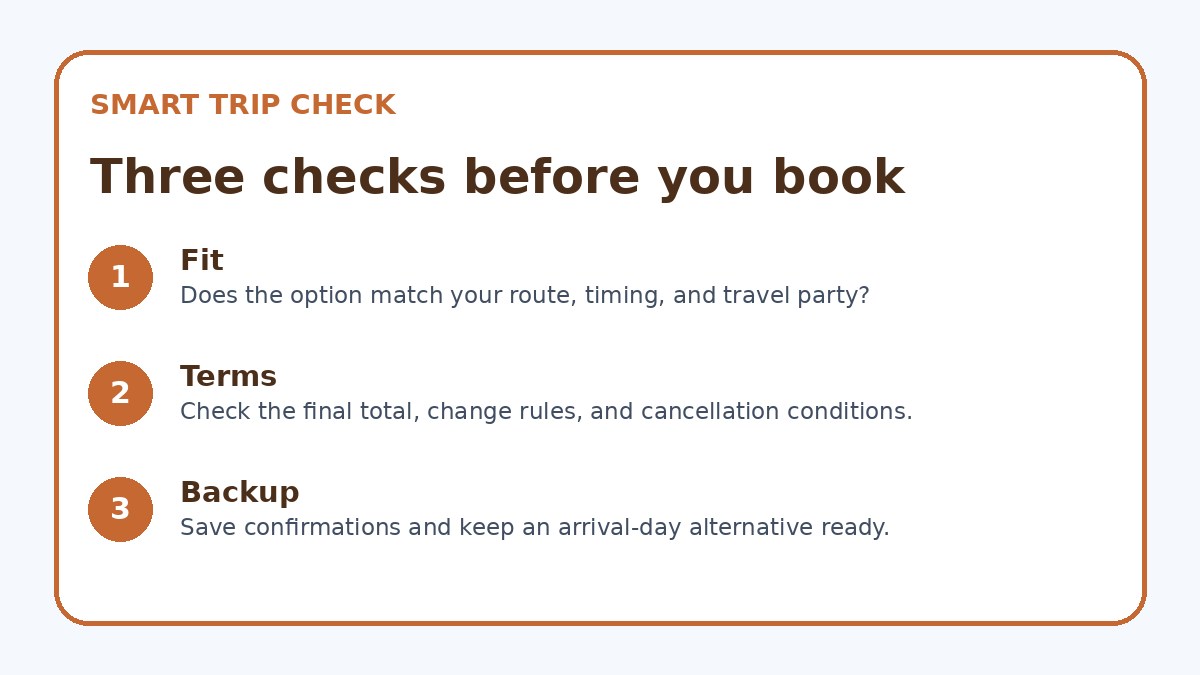
On any provider’s booking page verify three essentials: how many suitcases are included per vehicle, whether strollers count toward that limit, and whether a child or infant seat is available or you must bring one. Also check the stated pick-up point precisely — 'arrivals meet-and-greet' can mean different meeting locations at each terminal — and whether the driver will help with luggage. If information is ambiguous, use the provider’s direct contact or the booking confirmation message to confirm meet-up landmarks and how look for each other on arrival.
Don’t rely solely on general descriptions for timing and routing. If you choose a train or bus, check any required transfers or terminal walks and whether trains are accessible with a stroller or folding buggy. For taxis and private cars, confirm the vehicle type (sedan vs. minivan) if you have multiple bags. If you use an online marketplace, read the fine print about cancellation, wait time allowances, and surcharge rules. Trip.com can be a place to compare current availability, but always verify specifics on the operator’s final booking page before you finalize.
| Approach | Best for | Tradeoff to check |
|---|---|---|
| Private door-to-door transfer | Families prioritizing minimal handling and direct hotel drop-off. | Higher cost and you should confirm vehicle size for extra luggage and car seats. |
| Shared airport shuttle | Travelers wanting lower cost than private cars with some curbside convenience. | Possible multiple stops and longer total time; verify luggage limits and pick-up wait time. |
| Airport express train | Stays near major subway hubs where you can manage a short walk with luggage. | May require stairs or lifts and more personal handling; check stroller accessibility and platform routes. |
| Airport limousine or intercity bus | Straightforward routes to central districts with large luggage compartments. | Fixed routes may not stop at your hotel door; plan a short last-mile taxi if needed. |
Ready to check the option that fits your plan?
Use your exact dates and traveler details so the provider page can show the current total and conditions.
Luggage, strollers and car seats: solutions and workarounds
Think in terms of pieces and practical measures: large suitcases, carry-ons, one or two strollers, and any bulky child equipment. If you bring a non-folding stroller or a car seat, check whether it must be checked at the airline, fits through train gates, or can stay assembled on a vehicle rack. Many families find a compact, folding stroller that fits overhead or alongside luggage makes public transfer far simpler. If a car seat is essential, either bring an airline-approved travel seat you can use in hired cars or prebook a transfer listing child seats; always confirm the age/weight suitability.
When multiple large items exceed a standard sedan’s capacity, specify a minivan or family vehicle on the booking form. For trains, inspect station accessibility and platform-level gaps—some stations have elevators but others require escalators or steps. If your plan includes an overnight or late arrival, prioritize transfers that meet you at the terminal and load luggage directly into the vehicle so you avoid moving children and heavy bags across deserted stations or dimly lit streets.
Before you book
- Confirm the maximum number and size of suitcases allowed and whether strollers count toward that total.
- Reserve or request a child restraint and specify child age/weight on the booking confirmation page.
- Choose vehicle type (sedan, minivan, van) that fits all passengers, seats, and checked items; verify dimensions if unsure.
- Note the exact arrivals meeting point and driver identification method on the operator’s booking page.
- Pack a compact day bag with snacks, diapers, and a change of clothes to avoid opening hold luggage at the curb.
- Take photos of checked luggage and stroller/car seat before handing over to any driver or ground staff.
Timing, routes and hotel location considerations
Match your hotel’s location to the transfer type. If your accommodation is in central Seoul near a major subway line, express train or airport bus may drop you within an easy walk or short taxi from the door, saving money while keeping transfers straightforward. For hotels in neighborhoods with narrow streets or limited curb space, a private drop-off may be more convenient because drivers know the best place to stop and unload. Consider time of day—night arrivals often reduce public transport frequency, making door-to-door options more appealing for tired kids.
Always compare total travel time including luggage handling and waiting, not just in-vehicle duration. For example, a fast train might be quick on paper but requires navigating station entrances and elevators; a private shuttle will often add a few minutes on the road but much less carrying. When booking, check whether your chosen transfer can accommodate early or late flight times and confirm any wait-time windows included in the fare so you aren’t stranded or facing unexpected extra charges when your flight is delayed.
Frequently asked questions
Is it better to take the airport train with kids and lots of luggage?
The airport train can be a good choice if your hotel is close to a station on the line and you can manage short walks with bags. It avoids road traffic and is often predictable in journey time. But factor in station transfers, elevator availability, and whether your stroller folds easily; if you have bulky suitcases or very young children who need constant attention, the convenience of fewer transfers might outweigh the slight speed advantage of rail.
Do I need to prebook a taxi or private transfer for late-night arrivals with children?
Prebooking reduces uncertainty and ensures an appropriately sized vehicle with child seats if required. Nighttime public transport may be limited and local taxis can be slower to find when you’re tired and handling luggage. If you choose to book, verify the operator’s wait-time policy and pickup point. If you decide against prebooking, identify official taxi ranks inside the arrivals hall and prepare cash or a payment method accepted locally.
How many suitcases are reasonable to bring when traveling with kids to Seoul?
There’s no universal number—reasonable depends on your vehicle choice and willingness to handle luggage. For public transport, fewer and more compact pieces are easier: aim for one checked case per adult plus small carry-ons and a compact stroller. If you need multiple large items or bulky baby gear, plan a minivan or private transfer and confirm baggage capacity when booking. Always check the specific provider’s luggage rules rather than assuming standard limits.
Final planning note
Traveling to Seoul with children and extra luggage is manageable when you choose a transfer that reduces the most taxing part of the journey for your family. For minimal carrying and stress, a private or pre-arranged minivan that meets you at arrivals is the simplest operational choice; for cost-conscious families staying near major hubs, express trains or airport buses can work well if your luggage and stroller are compact. Before you book, confirm luggage allowances, car seat availability, meeting details, and vehicle size on the provider’s final booking page. With those checks done, you’ll spend less time juggling bags and more time enjoying Seoul.
Continue planning
Check current options and final conditions
Use the provider page to confirm live availability, the final total, cancellation terms, and every condition that matters to your trip.
This evergreen planning guide was created with AI-assisted drafting and a structured quality review. It does not display live prices, schedules, availability, visa guidance, or provider rankings. Verify current details before booking. Some links are affiliate links; we may earn a commission at no additional cost to you.