If you’re arriving in Sapporo for the first time, the most practical question is how to get from the airport into the city without wasting time or energy. The right choice depends on your arrival airport (New Chitose is the main international gateway), your luggage, group size, and whether you want convenience, cost savings, or door-to-door service. This guide gives the short answer up front — then lays out the tradeoffs and simple decision rules so you can compare options and verify details before booking. I’ll point out what to check on the provider’s booking page, what to expect at stations and terminals, and how to decide between direct and connecting routes when both are offered.
Quick practical choices and how to pick one
For most first-time visitors, comparing three criteria—time, cost, and convenience—quickly narrows the field. If you want the fastest consistent travel into the city center with no road-traffic variables, rail or dedicated airport rapid services are usually the best first check. If you have heavy or oversized luggage and prefer a single step from curb to hotel, an airport bus or taxi offers simpler handling. For travelers who immediately plan onward driving around Hokkaido, a rental car saves a transfer later but requires familiarity with parking and winter conditions if you’re visiting in colder months.
Before committing, run two checks: verify current schedules and seat availability on the operator’s booking page, and compare door-to-door logistics for your arrival time. Many services offer both direct and connecting routes; examine whether a connection adds wait time or requires changing platforms with luggage. If you have time-sensitive onward connections, prioritize options with published frequency and short transfer windows. Lastly, consider group size: a small group can split the cost of a taxi or rideshare, while solo travelers often find public options more economical and predictable.
Train and rail options: reliability and transfer considerations
Regional express and local trains from the main airport station into Sapporo typically provide a reliable, scheduled option with multiple daily departures. Trains are good when you prefer predictable timetables and want to avoid road congestion. That said, trains sometimes require a transfer at a central hub depending on your exact destination in the city. When trains offer both direct and connecting services to central Sapporo, compare total journey time including transfer wait and the effort required to move your luggage between platforms or across station concourses.
When looking at rail choices on the operator’s site, confirm platform access, the location of ticket offices, and whether reserved seating is an option for busy travel periods. Also verify walk distances between the train arrival point and any onward transit inside the city; some stations have long underground passages or shuttle connections. If you prefer minimal walking and no platform changes, choose a service advertised as a direct airport-to-city route and double-check final stop names against your hotel’s nearest station.
| Approach | Best for | Tradeoff to check |
|---|---|---|
| Regional train | Predictable timetable and avoiding road traffic | May require platform transfers and handling luggage on foot |
| Airport bus | Simple hotel-area drops and easier luggage handling | Subject to road congestion and fixed stop locations |
| Taxi or rideshare | Door-to-door convenience, late arrivals, small groups | Higher cost and variable travel time in traffic |
| Rental car | Flexible onward travel around Hokkaido | Parking in Sapporo and driving familiarity required |
Airport buses, taxis and door-to-door clarity
Airport buses and coach services often advertise stops at major hotels and transit hubs, which simplifies the final leg of your trip because you won’t need to transfer with heavy bags. A bus can be very convenient if it stops near your accommodation. But bus timetables and stop locations vary, and some services require reservations on busy days. Always check the operator’s boarding point at the airport and the exact hotel or landmark stops listed on their booking page so you know where to wait and where you’ll be dropped off in the city.
Taxis and rideshares give the clearest door-to-door option and remove any uncertainty about the final walk to your lodging, which is valuable late at night, after a long flight, or with a lot of luggage. Keep in mind that taxis are subject to road traffic and city pricing structures. When booking a private transfer or reserving a taxi, confirm where the driver will meet you at the terminal, whether they help with luggage, and any surcharge policies for late-night arrivals on the provider’s final booking page.
Before you book
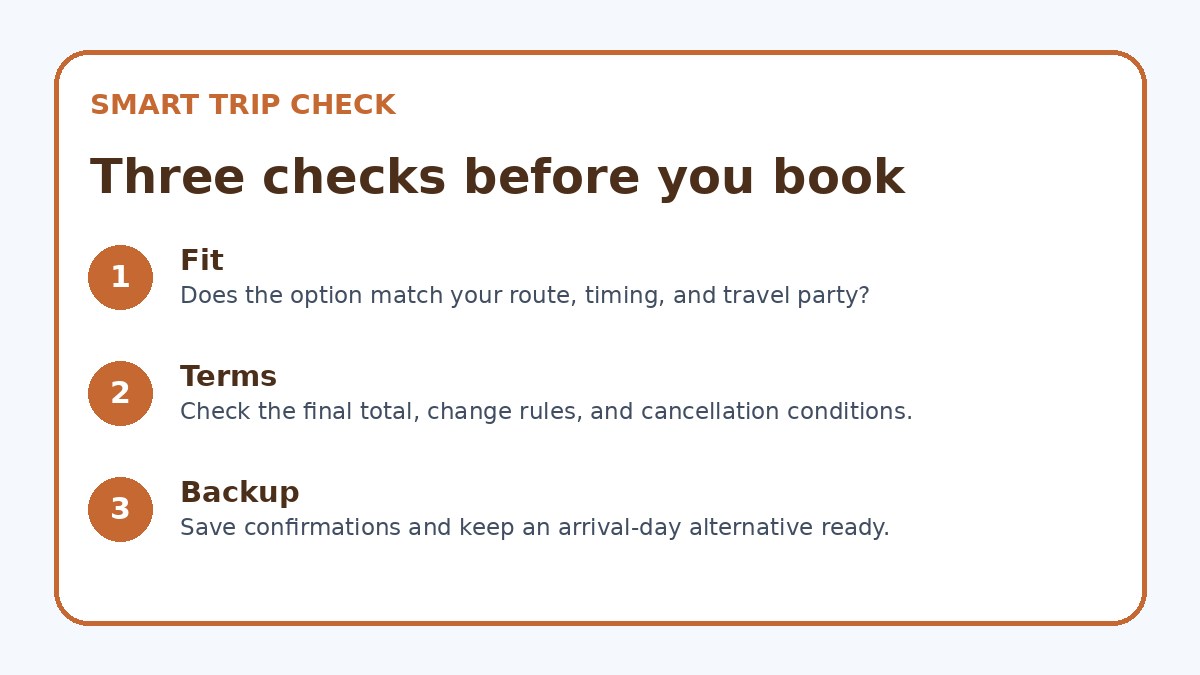
- Confirm which airport you arrive at (major international or a regional field) and locate that airport’s ground-transportation page.
- Check operator schedules, seat or vehicle availability, and pickup point details on the provider’s final booking page before you book.
- Decide whether you need reserved seating or a guaranteed vehicle with luggage capacity and make that selection when booking.
- Note the meeting point name or terminal door for your chosen service and allow extra time to walk between terminals if needed.
- If renting a car, verify insurance coverage, required documentation, and whether winter tires or navigation systems are included.
- Keep a local contact number, the provider’s booking reference, and a saved screenshot of your reservation to show staff at the airport.
Renting a car and when it makes sense
A rental car is ideal if you plan to explore outside the city immediately after arrival or if your itinerary includes national parks, coastal drives, or remote towns where public transport is infrequent. Renting at the airport is often the most convenient pickup point, but availability and vehicle type should be checked before you travel. Decide if you need winter tires or navigation aids, and confirm what documentation the rental company requires. Also ensure you understand fuel policies and any credit card holds used for security deposits.
Within Sapporo itself, parking availability can be limited and costly in busy neighborhoods, so factor that into your hotel choice. If you’re staying primarily in central Sapporo and will use public transit during your visit, consider returning the rental after a few days rather than keeping it docked in city parking. On the rental company’s booking pages verify pickup/drop-off locations, insurance coverage specifics, and whether roadside assistance and cross-border travel are permitted if you intend to continue beyond Hokkaido.
Frequently asked questions
Is it better to take the train or the bus from Sapporo airport?
The best choice depends on your priorities. Take the train if you value a consistent schedule and want to avoid road traffic; it’s often faster when services are direct. Choose the bus if you prefer fewer transfers and want a drop-off close to a specific hotel or district, which can be easier with large luggage. Before booking, compare total door-to-door time, how much walking is required, and whether the bus or train requires reservations—verify timing and stops on the operator’s official booking page.
Should I pre-book a taxi or just get one at the airport?
Pre-booking a taxi gives certainty about vehicle type and fixed meeting arrangements, useful for late-night arrivals or when you need extra luggage assistance. Getting a taxi at the airport is often straightforward but can involve a short queue at peak arrival times. If you rely on a pre-booked private transfer, confirm the exact terminal meeting point, cancellation policy, and where the driver will wait. Always check the provider’s final booking page for arrival instructions and any additional surcharge information.
Can I rent a car at the airport and drive into Sapporo immediately?
Yes, many travelers pick up rental cars at the airport and drive into Sapporo, which works well if you’re continuing to other parts of Hokkaido. Before you commit, confirm the rental company’s pickup location at the terminal, insurance options, and any requirements for winter equipment if you’re traveling in cold seasons. Remember to plan for parking in the city and to check whether your accommodation offers parking or has nearby public lots. Verify all rental terms and additional fees on the company’s booking page.
Final planning note
For first-time visitors to Sapporo, start by matching your priorities—time, cost, convenience—and choose the transfer mode that aligns with them. Trains are predictable and good for avoiding traffic; buses are handy for hotel-area drops and easier luggage handling; taxis give door-to-door ease; and rental cars are best if you’ll explore beyond the city. Before you finalize anything, verify schedules, pickup points, luggage policies, and meeting details on the provider’s official booking page. If you want a quick comparison of current availability, you can look at Trip.com as one place to compare options, but always use the operator’s site for final confirmation and any special terms.
Continue planning
Check current options and final conditions
Use the provider page to confirm live availability, the final total, cancellation terms, and every condition that matters to your trip.
This evergreen planning guide was created with AI-assisted drafting and a structured quality review. It does not display live prices, schedules, availability, visa guidance, or provider rankings. Verify current details before booking. Some links are affiliate links; we may earn a commission at no additional cost to you.