For families traveling between San Francisco and Vancouver, the practical question isn't only which carrier to pick but how to balance routing, baggage risk and schedule fit to keep the trip calm. Start by deciding whether you prefer a simpler itinerary with fewer connections or a lower fare that may require a longer layover or self-transfer. Focus on exact travel dates, the number and age of children, luggage needs, and how much buffer time you want for security, immigration, and restroom or snack breaks. With those details in hand, you can compare direct versus one-stop options, check baggage transfer policies, and read fare rules for changes and refunds. The guidance below gives a clear decision framework and an actionable checklist so you can set precise search filters, avoid common connection pitfalls, and book a family-friendly itinerary with confidence.

See live routes for your exact travel day
Compare direct and connecting choices with the same baggage and traveler details.
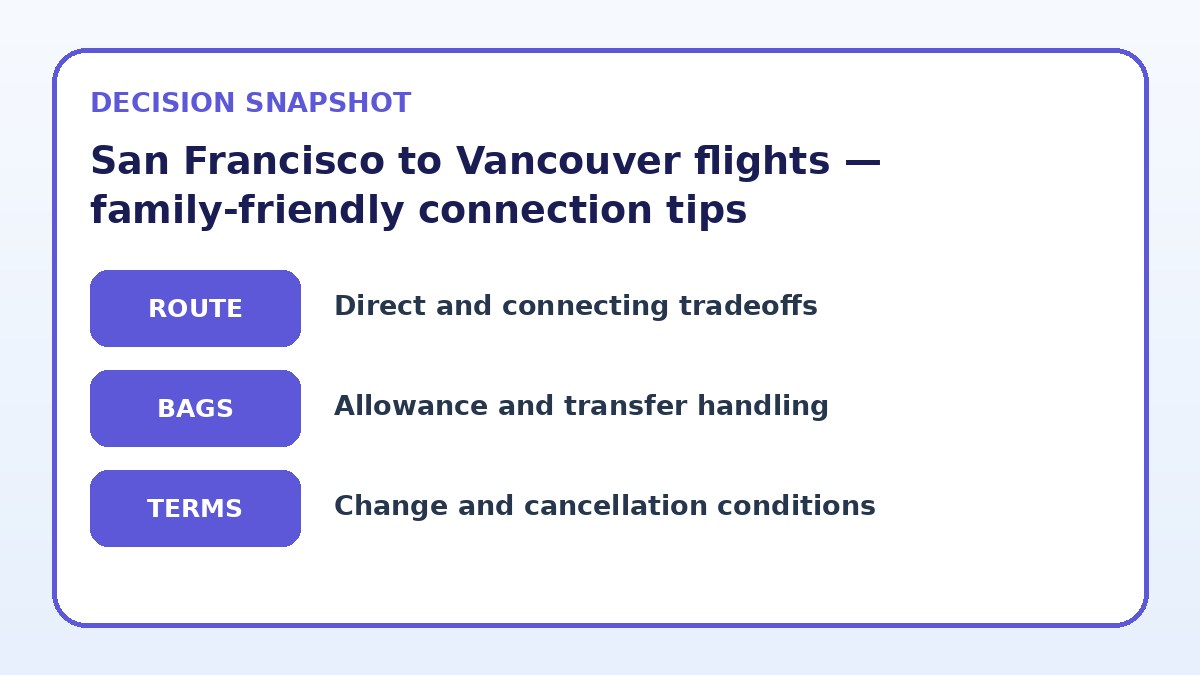
Routing: direct versus one-stop for family comfort
Families should weigh the simplicity of direct or single-connection itineraries against potential savings from more complex routings. A direct flight (if available) reduces time spent in airports, the need to manage carry-ons and children during transfers, and the chance of missing a connection. If a nonstop is not feasible, prioritize itineraries with a single connection that keeps both legs on the same ticket and in the same alliance or operating partnership to maximize baggage transfer and rebooking support.
When comparing one-stop itineraries, check the connection airport layout and typical minimum connection times—some airports require long walks or bus transfers between terminals, which is a real burden with strollers and young children. Also consider the time of day for the connection: an overnight stop or a red-eye followed by an early-morning connection may disrupt sleep schedules but can sometimes reduce airport crowdedness during transfers.
Baggage and connection risk: transfer policies to verify
Before booking, confirm on the carrier’s final booking page whether checked baggage is accepted through to Vancouver or must be collected and rechecked at intermediate stops. For international connections, some itineraries require passengers to clear customs and recheck bags at the first point of entry; families should plan extra time for this process and consider carrying essentials in an accessible carry-on for quick diaper changes, snacks and a change of clothes.
Also verify if strollers or car seats are included in the checked-baggage allowance or handled as gate-checked items; policies differ by airline and fare class. If a connection is on separate tickets, recognize the increased risk: a delayed inbound flight could leave you without automatic baggage transfer or protected rebooking, so allow long buffer times or consolidate travel on a single ticket when possible.
Compare flight-selection strategies
| Flight strategy | Best for | Risk to check |
|---|---|---|
| Nonstop or single-ticket direct connection | Families wanting the simplest airport experience with minimal transfers | Typically higher fares and fewer scheduling options compared with multi-stop routings |
| One-stop on a single ticket with same alliance | Families balancing cost savings with baggage transfer protection | Some connection airports are large or require long walks, which can be tiring with kids |
| Multi-leg itinerary on separate tickets to lower cost | Families willing to accept risk for significantly lower fares | No automatic baggage transfer or guaranteed rebooking; requires long buffers and contingency plans |
| Flexible/family-friendly fare with change privileges | Families prioritizing the ability to adapt travel plans without heavy penalties | Higher upfront cost but potential savings in time and stress if plans shift |
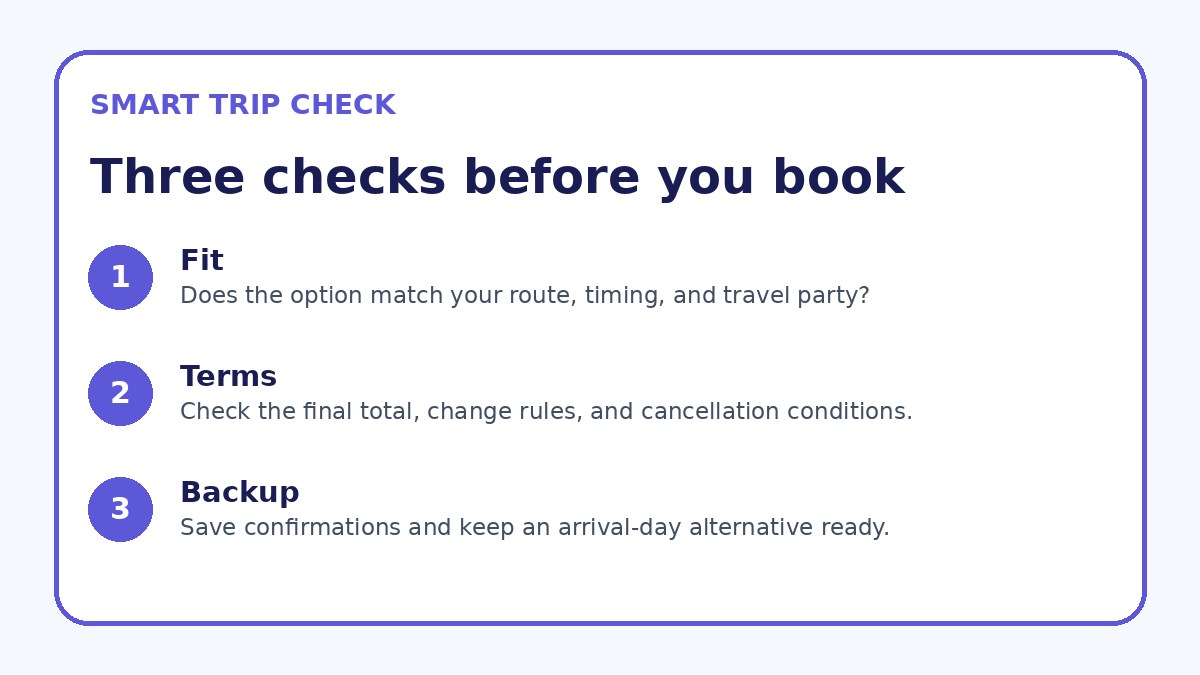
Recheck the complete itinerary
Confirm airports, connection handling, baggage, and change conditions before deciding.
Schedule fit: pick times that protect family routines
Work from your family’s usual rhythms when choosing flight times. Morning departures can be easier for families who wake early and want to arrive with part of the day left, while early-evening flights may align with children’s bedtime but can be harder if connections fall during night hours. Aim for connection windows that allow restroom breaks, security queues and a relaxed move between gates—families often need 60–120 minutes for domestic connections and more for international transfers.
When planning transborder travel, check for likely immigration lines and factor in additional time for passport control at the arrival airport. If you must travel during peak holiday periods, add extra buffer to your schedule for busier security and check-in counters. Finally, consider travel fatigue on the return: a midday flight home that avoids overnight waits can be kinder on young travelers and parents alike.
Flight details to verify
- Collect exact travel dates, full names as on passports, ages of each child, and any infant-seat or bassinet needs before searching fares.
- Filter search results to show single-ticket itineraries first; note whether baggage is through-checked to Vancouver on the airline’s booking page.
- Choose connection times with at least 60–90 minutes domestic or 90–150 minutes international buffer depending on whether customs or terminal transfers are required.
- Pack a carry-on with snacks, medication, a change of clothes, portable charger, and small comfort items for each child in clearly labeled compartments.
- Confirm seat assignments and request bulkhead or extra-legroom seats if available and suitable for child restraints on the airline’s site after booking.
- Save screenshots of your booking confirmation and the airline’s baggage/infant policies; store digital and paper copies of passports and proof of travel for all family members.
Fare conditions and booking details to confirm
Read the fare rules closely before you buy—pay attention to change fees, the ability to hold reservations, refund eligibility, and whether seat assignments are included. Some family-oriented fares include flexible change allowances or free seat selection for children; others are cheaper but more restrictive. If you plan to bring gear like car seats or boosters, confirm whether those items count against your checked-bag allowance or are allowed as additional items.
Also verify the carrier’s rebooking policy for missed connections caused by delays on the same ticket and any assistance offered for families. When using a third-party site to search options, click through to the airline’s official booking page to confirm final baggage rules, exact flight times, and cancellation policies before paying. Trip.com can be used to compare current availability, but always verify fare terms on the airline’s final checkout screen.
Flight Guide questions travelers ask
How much connection time should a family allow between San Francisco and Vancouver flights?
Connection time depends on whether you must clear customs or change terminals. For single-ticket connections within the U.S., families should aim for at least 60–90 minutes to allow time for deplaning, restroom breaks, and walking between gates. If your itinerary includes an international customs clearance or requires changing airports or terminals, build in 120–180 minutes or more. If you are booking separate tickets, add even more buffer. Always confirm typical connection times and recommended minimums on the operating airline’s website before booking.
Do checked bags usually transfer automatically on connecting itineraries to Vancouver?
Checked-baggage transfer depends on whether both legs are on the same ticket and the airlines’ interline agreements. When booking a single ticket operated by partner carriers, checked bags are often tagged through to the final destination—confirm on the carrier’s final checkout page. If you buy separate tickets, the airline that handles the first leg commonly will not transfer your bags, requiring you to collect and recheck them. For families, keeping essential items in carry-on luggage is wise in case bags are delayed or must be reclaimed during customs.
Which flight times are best for traveling with young children on this route?
The best flight time depends on your child’s routine: choose morning departures for families who travel well after breakfast and want daytime arrival, or early-evening flights if settling into a new time zone with a bedtime routine is important. Avoid schedules that force long waits at airports during naptime unless you’re prepared with a quiet rest plan. Also consider connection times—long daytime layovers can be tiring, while short but realistic buffers reduce overall travel time and the chance of missed connections.
Final decision note
Planning San Francisco to Vancouver flights for a family trip means prioritizing predictability: fewer transfers, confirmed baggage transfer on the same ticket, and connection windows that respect your family’s routines. Start by collecting exact traveler details and travel dates, then compare nonstop and one-stop itineraries with an eye on baggage rules and fare-change conditions. When flexibility matters, choose fares or add protections that reduce rebooking stress. Before you pay, confirm everything on the airline’s final booking page—especially baggage allowances, seat assignments, and change policies. With these checks and a straightforward contingency plan, your family can make the cross-border connection smoothly and comfortably.
Continue planning
Check current options and final conditions
Use the provider page to confirm live availability, the final total, cancellation terms, and every condition that matters to your trip.
This evergreen planning guide was created with AI-assisted drafting and a structured quality review. It does not display live prices, schedules, availability, visa guidance, or provider rankings. Verify current details before booking. Some links are affiliate links; we may earn a commission at no additional cost to you.