Short answer: renting a car in Busan can make a family-style road trip for a couple easier and more flexible, but it only pays off when your itinerary reaches beaches, temples, or scenic drives outside the city center. If your plans stick to central Haeundae, Seomyeon, and nearby attractions with easy public transport, driving may add cost and parking hassle. Start by mapping the specific day trips you want—coastal drives along Taejongdae, the port area, and nearby rural stretches are where a car creates real value. This guide helps couples weigh those tradeoffs, explains the insurance terms to check, surfaces pickup and return friction points, and offers a clear non-driving fallback you can use if renting doesn’t make sense.
Decide whether driving actually improves your couple’s family road trip
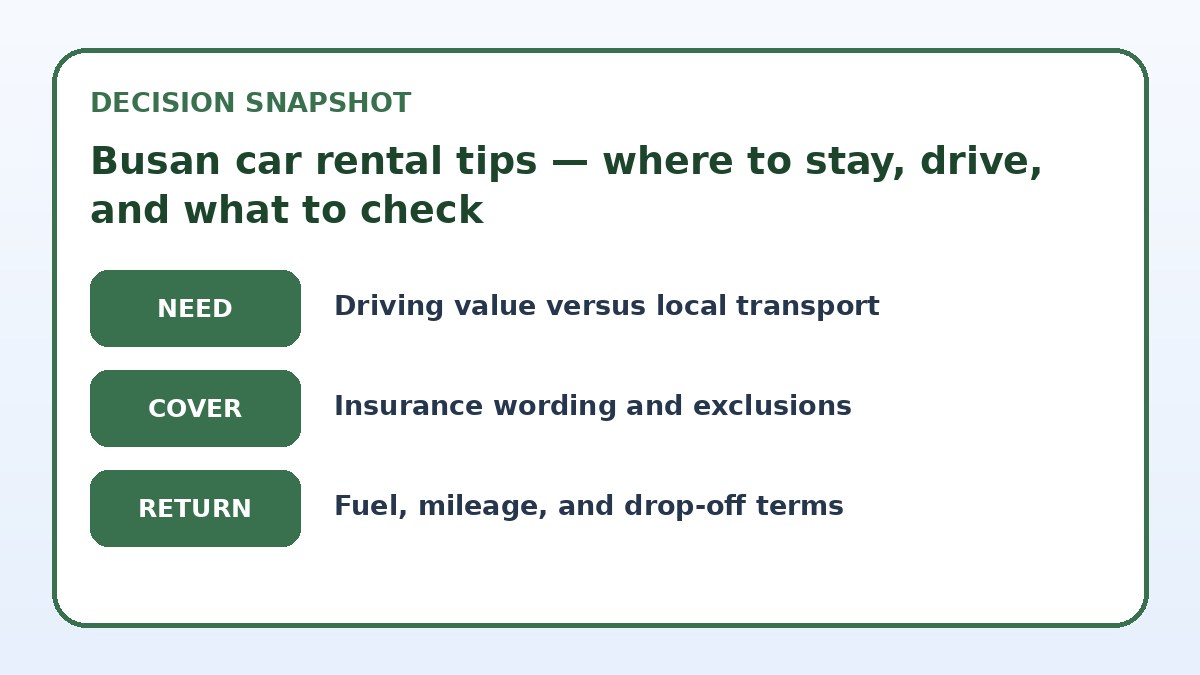
Begin with a simple map of the places you and your family will want to visit. Driving adds the most value when your days include multiple destinations that public transit reaches only slowly or with many transfers, when you carry bulky gear for kids, or when you seek early-morning or late-evening departures. If your schedule centers on dense neighborhoods, markets, museums and a short beach hop, public transport and walking can be faster, cheaper and far less stressful for a couple managing a child.
Think in time, not distance. A nearby seaside viewpoint that looks close on a map may require a long bus loop or two transfers; that’s a clear win for a rented car. Conversely, if parking is limited or costly where you plan to stay, or if your preferred hotels offer no easy parking, those factors reduce the advantage of driving. Use this section’s checklist to tally the number of out-of-center day trips and estimate whether driving would cut door-to-door time.
Decide whether driving earns its place
| Mobility strategy | Best for | Cost or friction to check |
|---|---|---|
| Rent a car full trip | Couples who plan multiple out-of-city day trips and need gear or flexible timing | Higher costs, parking hassle, and responsibility for insurance and inspection |
| Rent selectively (only some days) | Couples who want driving freedom for specific scenic days but city convenience otherwise | Requires careful planning of pickup/return windows and may limit spontaneous changes |
| Public transport plus taxis | Couples staying mainly in central Busan who prefer to avoid parking and driving stress | Less flexibility for remote day trips and potential discomfort when carrying bulky items |
| Guided day tours and transfers | Couples who prefer local knowledge and fixed itineraries without driving or navigation duties | Less privacy and schedule control; can be more costly per person for small groups |
Check live rental choices only after the route test
Use the exact driver, dates, pickup point, and return plan to compare current conditions.
Route value and sample drives couples should consider
Prioritize routes that repay the rental cost: coastal roads, short rural loops, and mountain overlooks near Busan are classic examples. Plan one or two longer day trips from your base—these are the trips that will justify handling child seats, packing snacks, and the extra freedom of a car. Build a realistic schedule: pair a longer drive day with a quieter day in the city to avoid burnout, and factor in parking searches and rest stops when estimating travel time.
When plotting routes, identify safe, child-friendly stops (parks, playgrounds, restrooms) and alternate pull-over points in case traffic or weather forces changes. If you expect to split driving between partners, plan clear handover points and check local driving conditions such as narrow seaside lanes or ferry access rules for vehicles. Write down each route’s key towns and public transport alternatives so you can switch strategies mid-trip if needed.
Compare the full rental conditions
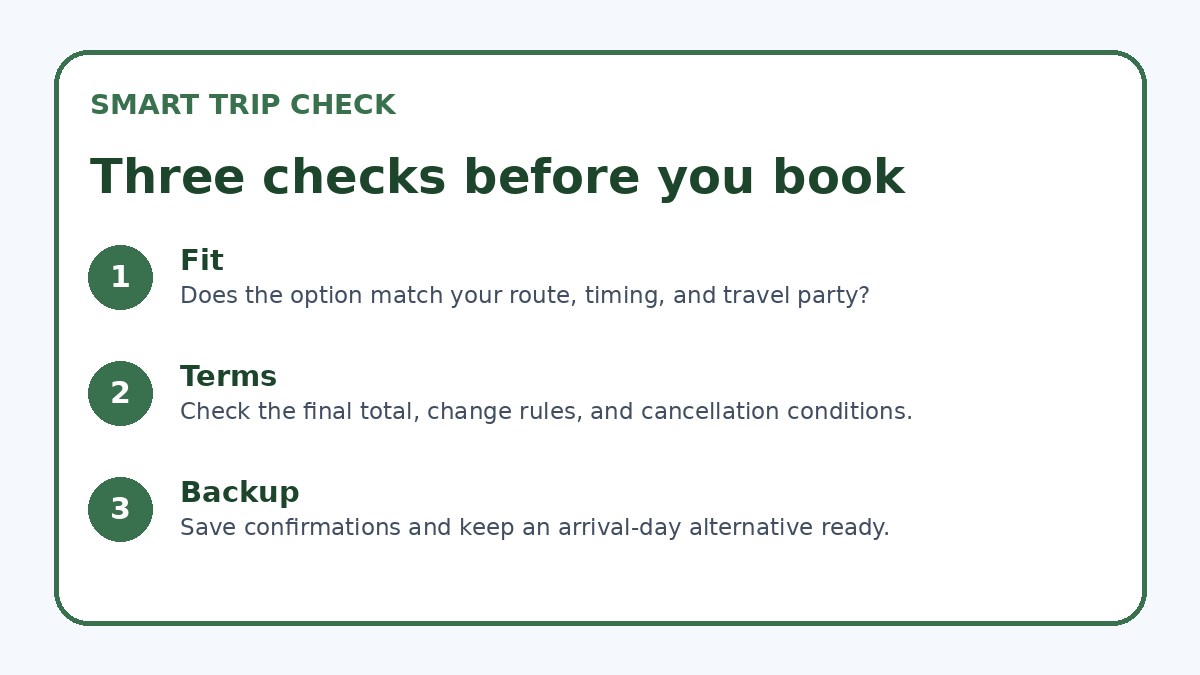
Confirm insurance wording, exclusions, deposit, fuel, mileage, and return terms on the final page.
Insurance wording, fees to verify, and pickup/return friction
Read every insurance clause on the final rental page before you book. Verify what counts as collision damage, whether glass and tire damage are included, and what the excess (deductible) is. Note whether additional drivers, young-driver fees, and child-seat charges apply, and confirm whether coverage is voided by off-road driving or driving in restricted areas. These provider specifics change often—always verify the final booking page for the exact liability limits, exclusions, and required documentation.
Pickup and return logistics matter as much as price. Check the rental counter location—airport desks are convenient but often busier; city locations may require a quick transfer. Confirm after-hours return procedures, fuel policy (full-to-full vs prepaid), and inspection process: ask whether you record existing damage with photos timestamped by the provider. Small friction points—late pickup queues, remote drop-off shuttles, or mandatory cleaning fees—can add hours or surprise costs to your trip.
Car rental terms to verify
- Map each planned day trip and mark whether public transit requires more than one transfer or a long wait—prioritize driving for those with poor connections.
- Open the rental provider’s final booking page and read the full insurance, excess, and excluded-damage wording before confirming.
- Confirm exact pickup and return addresses, after-hours policies, and whether a shuttle is needed to reach the rental desk.
- Verify child-seat options and fees; if you prefer to bring your own, check size compatibility and installation rules.
- Estimate parking availability and likely costs at each overnight stay and major stop, and add that to your daily budget.
- Note cancellation and modification terms so you can switch to the non-driving fallback without heavy penalties.
A clear non-driving fallback and how to mix modes
Even if you plan to rent, keep a non-driving fallback that’s ready to use: a mix of subway and regional trains for core city travel, intercity buses or local trains for longer legs, and point-to-point taxis where public transit is impractical. For couples traveling with a child, reserve or note a taxi app and local number you can use for short runs. Planning this fallback preserves flexibility: you can cancel or shorten the car rental with minimal disruption if weather, traffic, or parking proves onerous.
Also consider hybrid approaches: rent a car only for certain days and rely on public transport otherwise. This reduces rental days, lowers parking hassles in dense neighborhoods, and gives you driving freedom for the routes that need it. When comparing options on booking pages, look at cancellation rules and the ability to modify pickup dates; being able to adjust a reservation without heavy penalty makes a hybrid plan practical and stress-free. Trip.com can be a place to compare availability, but verify every policy on the provider’s booking page.
Car Rental & Road Trip questions travelers ask
Do couples with a single child really need to rent a car in Busan?
It depends on your itinerary. If most activities are in central Busan—beaches like Haeundae, markets, museums, and short tram or subway hops—public transport is efficient and family-friendly. You might avoid parking fees and the stress of city driving. However, if your plans include multiple out-of-city day trips, scenic coastal drives, or carrying bulky equipment for the child, a rental becomes attractive. Compare door-to-door times for each planned day; where public transit adds long transfers, a car often simplifies logistics.
What specific insurance terms should I check on the provider’s booking page?
Look for the policy on collision damage waiver (CDW), third-party liability limits, and whether glass, tires, and undercarriage damage are covered. Check the excess (deductible) amount and if there is an optional super-cover that reduces it. Verify whether additional drivers are included or charged, and read exclusions such as off-road driving or driving outside agreed regions. Finally, confirm required documentation—driver’s license format, IDP if needed, and payment card rules—directly on the provider’s final booking page.
How do I handle pickup and return to minimize friction during a short trip?
Choose a pickup location near your first-night accommodation to avoid long transfers, and book a pickup time outside expected peak queues if possible. Confirm whether after-hours returns are allowed and what the inspection process is—ask if you should take timestamped photos of the vehicle and note existing damage in writing. Fill the tank to the agreed level if the policy requires it, and allow extra time at return to clear paperwork. If any step seems unclear, request written confirmation on the booking page before departure.
Final decision note
For couples planning a family-style road trip in Busan, the right choice hinges on where you want to go and how much flexibility you need. Rent a car when several day trips lead beyond reliable, direct public transit—coastal drives and rural detours are typical scenarios where a car pays off. If most activities stay within the city, a non-driving plan combining subway, intercity trains and taxis will reduce hassles and hidden costs. Whatever you choose, read insurance and fee wording on the provider’s final booking page, confirm pickup/return procedures, and prepare a hybrid fallback so your trip stays adaptable and low-stress.
Continue planning
Check current options and final conditions
Use the provider page to confirm live availability, the final total, cancellation terms, and every condition that matters to your trip.
This evergreen planning guide was created with AI-assisted drafting and a structured quality review. It does not display live prices, schedules, availability, visa guidance, or provider rankings. Verify current details before booking. Some links are affiliate links; we may earn a commission at no additional cost to you.