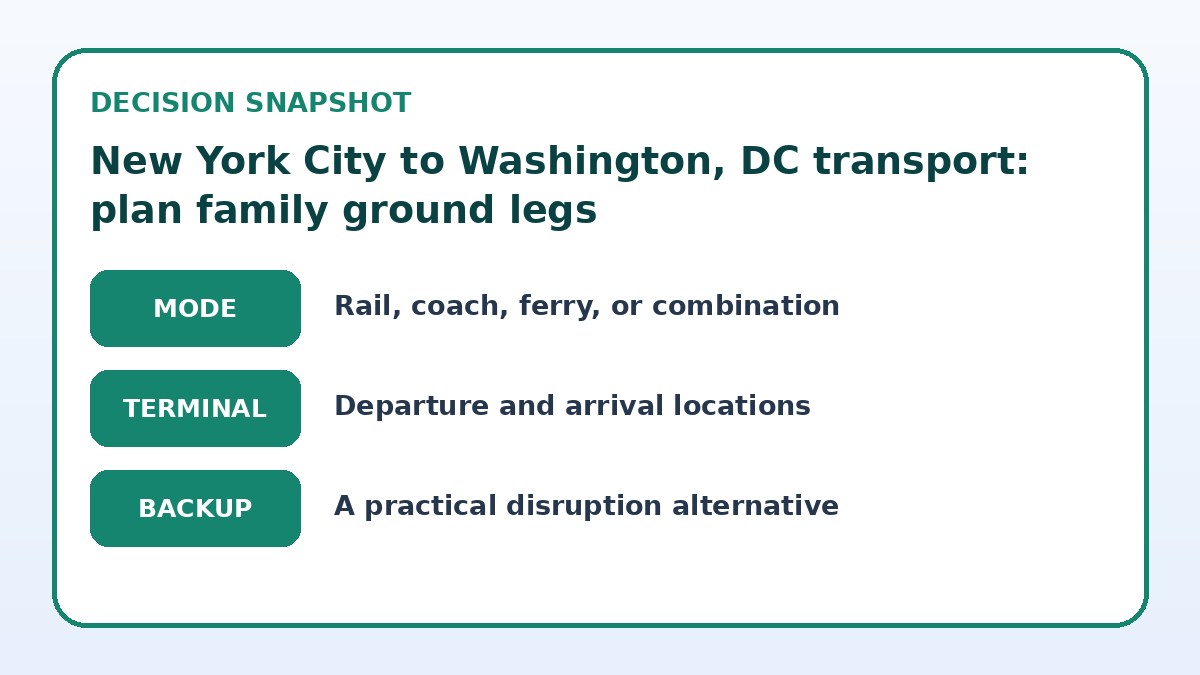
Choose the mode that minimizes transfers and luggage friction for your family, then layer in alternatives for flexibility. For most families traveling New York City to Washington, DC, the straightforward choices are rail for roomy seats and stations close to city centers, coach buses for lower-cost point-to-point options, driving for complete door-to-door control, and ferry+ground combinations if you want scenic legs near water. Start by mapping where you and your children will board and disembark in each city, how much luggage and child gear you’ll carry, and how many timed connections you can tolerate. Build a primary plan around the most practical single-mode solution, then pick one secondary path that avoids the same bottlenecks — different terminals, different roads, or a different departure time — so a single disruption doesn’t derail the whole trip.
How to choose between rail, coach, ferry, and driving
Start by asking four practical questions: where will you start and end each day; how much luggage, car seats, or strollers you’ll bring; what time windows are non-negotiable; and how many transfers your family can tolerate. Rail typically wins for families who value space, restrooms, and city-center terminals that reduce last-mile transfers. Coaches can be sensible for families on a tight budget or with simple carry-on needs, but check boarding access and luggage-handling policies first. Driving gives full control of schedule and door-to-door capability, which is especially helpful with small children or large gear, though it requires dealing with traffic and parking.
Consider combining modes for the best of each: a car to a nearby rail station, a scenic ferry ride for a short leg paired with rail, or a coach for the longest trunk segment and taxis for short urban hops. When comparing options, evaluate total door-to-door time and friction rather than on-the-road duration alone. That means adding the time and difficulty of getting to the terminal, loading and unloading, potential stroller fold times, and local connections. This approach keeps planning practical and focused on family comfort, not only on theoretical journey speed.
Choose the end-to-end journey plan
| Journey approach | Best for | Friction to check |
|---|---|---|
| Single-mode focus (rail-only or car-only) | Families who want simplicity and fewer transfers | Less redundancy if the chosen mode is disrupted; may miss cost or scenic benefits of multimodal routing |
| Multimodal plan (rail + coach or ferry + train) | Families seeking a balance of comfort, cost, and scenic variety | Requires coordinating transfers and more margin time between legs |
| Drive primary with public transit backups | Families needing door-to-door control and large-item transport | Exposes you to traffic and parking stress; backups may require early planning for parking logistics |
| Flexible bookings with staggered backups | Families prioritizing disruption resilience and schedule freedom | Often means higher booking complexity and possibly paying premiums for changeable fares |
Check live intercity options
Look beyond the ride itself and compare terminals, transfers, luggage, and arrival fit.
Terminal fit, luggage handling, and transfer friction
Terminal fit can make or break a family plan. A train station located near your hotel or rental lets you walk with a stroller or take a short taxi, whereas a bus terminal across town can add costly and stressful transfers. Investigate where each operator boards and where the city pickup/drop-off points are located. For rail, look for elevator access, wide platforms, and luggage racks or storage areas; for coach, confirm undercarriage baggage rules and whether you must meet a separate baggage handler. If you’re driving, research parking options near departure terminals and at your arrival neighborhood.
Luggage and transfer friction also include how you’ll manage car seats, double strollers, and overnight bags. Prioritize services with easy step-free boarding if mobility or toddler wrangling is an issue. If a leg requires switching modes—say, ferry to train—plan for extra time and a simple route between docks and stations. Make a short map showing each terminal, nearest taxi stands or rideshare meeting points, available luggage carts, and elevator locations so the day runs smoothly. Small preparation removes most of the stress families experience during transfers.
Timing flexibility and realistic scheduling for families
Families benefit from options with frequent departures or generous change policies. When a child refuses to nap or traffic delays your drive, having the flexibility to switch to a later train or coach keeps the trip salvageable. Look at service frequency across the day rather than the single fastest departure; services every hour or half-hour are more forgiving than a single morning-only train. Also, pick departure times aligned with your children’s routines—after breakfast for easier mornings, or near usual nap windows if you can bank travel time for sleep.
If you must book less-flexible legs, keep the rest of your itinerary adjustable: reserve accommodations with flexible check-in or plan an easy buffer day on arrival. For multi-city travel, staggered arrival windows and open-ended return legs reduce pressure. When comparing schedules, build an itinerary timeline that includes realistic door-to-door buffers for getting to terminals, bathroom stops, meal breaks, security lines, and potential delays. This prevents an optimistic plan from becoming a stressful day.
Compare the practical alternatives
Use the final page to confirm what is actually offered on your dates and save a workable fallback.
Intercity travel checklist
- Map exact pickup and drop-off points in both cities and note taxis, rideshare meeting spots, and elevator locations for stroller access.
- Measure or list all large items (car seats, strollers, suitcases) and confirm each operator’s baggage and boarding policies on their booking page.
- Build a door-to-door timeline adding 30–90 minutes of buffer per transfer and mark non-negotiable time windows for naps or events.
- Choose a secondary route that uses a different terminal or corridor than your primary plan and save its contact and booking details.
- Pack a compact family travel kit with snacks, wipes, a small blanket, chargers, spare clothes, and any medication clearly labeled.
- Before finalizing, verify change and cancellation terms on the provider’s official site (and optionally compare availability on Trip.com).
Disruption backups and practical alternatives
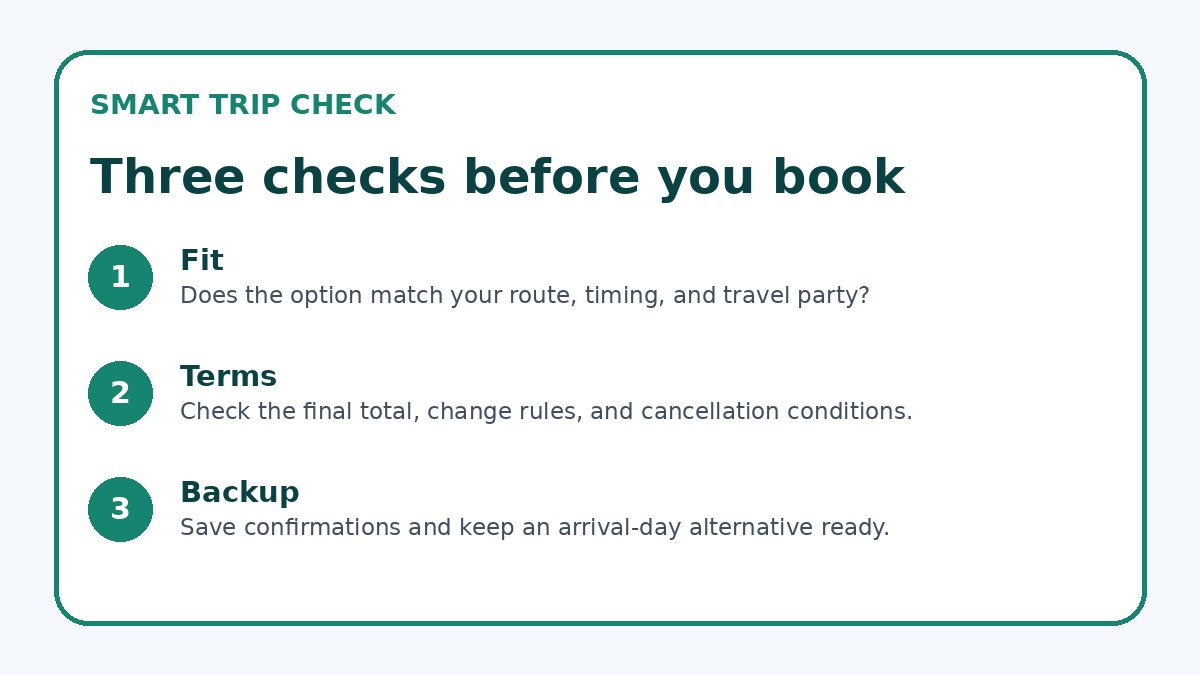
Design a backup that avoids the same chokepoint as your primary plan. If your main plan uses the same rail corridor and a single station, choose a coach or drive alternative that leaves from a different terminal or highway. If you rely on a late-afternoon departure, pick an earlier second-choice service in case of delays. Verify on providers’ booking pages what change or cancellation options exist and whether family accommodations like reserved seat groups or accessible boarding are handled differently for altered itineraries.
Also prepare small on-the-road contingencies: a compact kit with snacks, plastic bags, a lightweight blanket, a portable charger, and a basic first-aid pack keeps kids comfortable during unexpected waits. Identify local taxi and rideshare options around each terminal and note how long a typical taxi ride takes in non-rush hours so you can decide quickly whether to use one. Finally, keep printed or offline copies of reservations and contact options—online portals like Trip.com can help compare current availability, but always verify final terms on the provider’s official booking page before you commit.
Rail & Intercity Transport questions travelers ask
Is rail usually the easiest option for families between New York City and Washington, DC?
Rail often provides more space, onboard restrooms, and central stations that reduce last-mile transfers, which many families find easier. However, ease depends on your exact pickup and drop-off locations, the amount of gear you have, and mobility needs. Always check station access, elevator availability, and luggage rules before booking. If your accommodation is far from a main station, a coach or car that brings you closer to your door could be more practical despite the perceived advantages of trains.
How should families plan connections if they choose a multimodal route?
Plan multimodal connections by allowing generous time buffers for moving between terminals, factoring in stroller folding, restroom breaks, and traffic. Create a simple map showing the walking or taxi route between transfer points and the expected duration in off-peak conditions. Reserve seats or purchase tickets that permit reasonable changes when possible, and choose services with frequent departures so a missed connection can be recovered without an overnight disruption.
What’s the best way to handle car seats, strollers, and bulky gear on ground transport?
Decide whether you will bring or borrow equipment at your destination; bringing gear gives consistency but increases transfer friction. For public operators, confirm luggage allowances and how car seats or strollers are handled at boarding. If driving, use a vehicle large enough to carry car seats and luggage securely, and research parking near terminals in advance. Label all gear with contact information and consider compact, travel-friendly versions of strollers to ease transfers.
Final decision note
For families traveling between New York City and Washington, DC, the most practical plan balances terminal fit, luggage ease, timing flexibility, and a clear backup. Start by mapping doors to doors rather than focusing only on in-transit time: where you board and where you sleep matter most. Pick one primary mode that minimizes transfers for your family and one distinct backup that avoids the same chokepoints. Verify baggage and change policies on provider pages before booking, pack a compact family kit for disruptions, and leave extra time for transfers. With those steps, you’ll build a realistic, family-friendly multi-city ground-transport plan that handles the inevitable hiccups without turning travel into a scramble.
Continue planning
Check current options and final conditions
Use the provider page to confirm live availability, the final total, cancellation terms, and every condition that matters to your trip.
This evergreen planning guide was created with AI-assisted drafting and a structured quality review. It does not display live prices, schedules, availability, visa guidance, or provider rankings. Verify current details before booking. Some links are affiliate links; we may earn a commission at no additional cost to you.